Attentive readers will no doubt remember my post regarding the splendid and unjustly neglected volume "In a Tuscan Garden" by an anonymous author since identified as Mrs. Georgina Grahame, an aunt of Kenneth Grahame of "The Wind in the Willows" fame. I closed that post with the hope that I would be able to obtain a copy of the very scarce second volume of her memoirs, "Under Petraia", not a trace of which could be found in any of the big multidealer rare books websites. Well, less than a year later, my very good friend Paul Chipchase, scholar and gentleman, located a copy in Australia and nobly presented it to me.
This second volume was published in 1909, eight years before Mrs. Grahame's death in Florence in 1917 at the age of 79. It begins with a description of her successful efforts to find a new home when the lease on her house, Il Villino Landau, was terminated upon the death of the owner, Baron Landau, in 1903. The new house was located in an area to this day not especially popular with tourists, whether Italian or foreign, namely Castello, in the hills of Quarto, north west of Florence and on the boundary of Sesto Fiorentino (not surprisingly, since Quarto and Sesto refer to the 4th and 6th Roman milestones from Florence. Quinto lies between them and is home to Santo Croce a Quinto, the second most hideous church in Florence, the winner being Michelucci's brutalist Motorway Church). Quarto's main claim to fame is as the location of the Villa Medicea di Castello and, not far away, the Villa La Petraia, another Medicean villa and once the favorite residence of King Victor Emmanuel II.
 |
The giardino all'italiana of Villa di Castello, Florence |
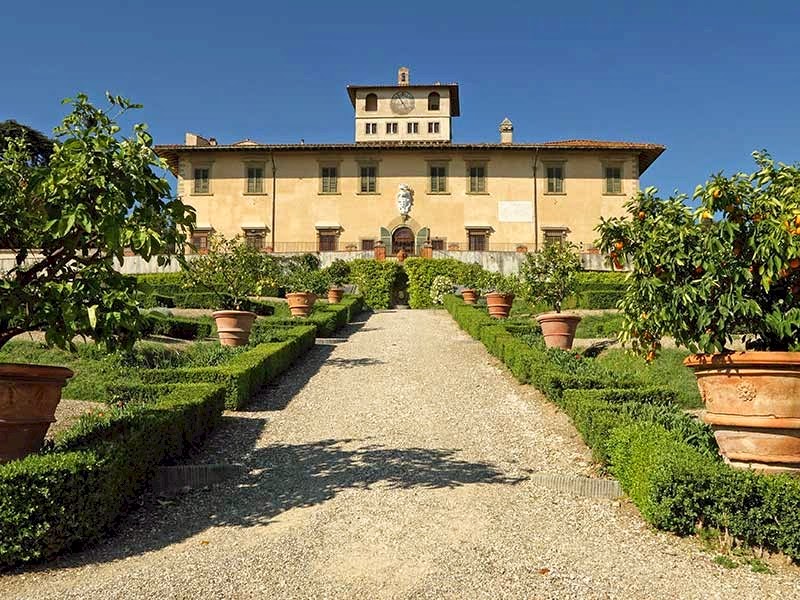 |
The Medicean Villa La Petraia near Florence |
Villa La Petraia is situated at the location of an old castle first documented in 1362 and which changed owners several times (Brunelleschi, Strozzi, Alessandra dei Bardi, Salutati). The castle was acquired by the Medici when they returned to Florence in 1530 and transferred from Cosimo I to his son, Cardinal Ferdinando in 1568. It was enlarged and transformed into a Villa on the initiative of the latter who became Grand Duke after the death of his brother, Francis I, in 1587. The basic layout of the gardens dates back to the late 16 C, with 18 C and 19 C additions such as the "Piano della figurina" decorated with the Fountain of Fiorenza and the English style park on the northern side, created according to the typically romantic taste that characterised the first half of the 19 C.
 |
The gardens of Villa La Quiete near Florence |
Another beautiful Medicean villa in the area, described in some detail by Mrs. Grahame, is the Villa La Quiete. known in the past as the Palagio di Quarto. It is recorded as being a possession of the Orlandini family when it was given to the condottiero Niccolò da Tolentino in 1438. The Medici bought it in 1453. For centuries a convent, then briefly in the 1990's a property of the University of Florence, La Quiete has belonged to the Region of Tuscany since 2008. Its fine italianate garden was created during the 18 C. The curator at that time was Sebastiano Rapi, head gardener at the Boboli Gardens in Florence.
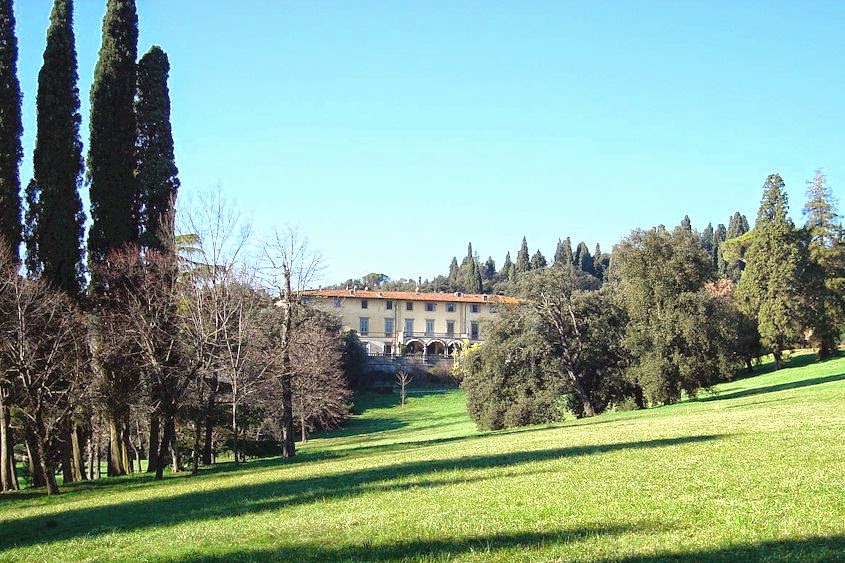 |
The parco all'inglese of Villa di Quarto |
Villa di Quarto, sometimes known as Villa di Castelquarto, Villa Paxton or Villa della Granduchessa, like some of the other villas in the area, possesses, in addition to its giardino all'italiana, a wonderful parco all'inglese. The property has a huge range of tree species and is a botanists' paradise. Villa di Quarto was rented for a time by Mark Twain and it was here that his wife passed away. At least one letter survives from Mark Twain to Mrs Graham (sic), dated 12 April, 1904 and appreciating her charming letter that added grace to the vivid, sunny morning in Florence, but adds, "Our house is a hospital, these 5 months, & the sunshine is all outside of it, there is none within." His stay there was not improved by the owner of the house, his compatriot Frances Paxton, Countess Massiglia, described by Mark Twain's secretary, who had known her previously in Philadelphia, in these words. "Count Massiglia is far away serving his country as Consul in Persia or Siam, and he is likely to stay there too; and it seems to me that for the sake of peace or freedom, he has left this Villa in the hands of the Countess … Here she remains, a menace to the peace of the Clemens household, with her painted hair, her great coarse voice, her slitlike vicious eyes, her dirty clothes, and her terrible manners." Twain himself described her as "excitable, malicious, malignant, vengeful, unforgiving, selfish, stingy, avaricious, coarse, vulgar, profane, obscene, a furious blusterer on the outside and at heart a coward." It must have been an interesting time at Villa di Quarto for all those not actually living there. Alas, we have no word on this topic from Mrs. Grahame.
Other villas in the area include Villa Corsini and Villa Medicea della Topaia. Topaia means "rats' nest" and hence "a dump" but the name of this villa, once a hunting lodge and definitely never a dump, has a much more appropriate origin, deriving from "opus topiarum", the art of topiary.
Mrs. Grahame's new address was given in her letters as "Bel Gioiello, Quarto, Castello, Florence", referring to a two storey farm house dating from well before 1481, belonging to the estate of Villa La Petraia, located on Via Pietro Dazzi (currently number 29) on the northern boundary of the estate of La Petraia - hence the name of her book, "Under Petraia". It is neighbour to another farmhouse at numbers 25-27, known as Villa del Gioiello. Mrs Grahame does not use the name Bel Gioiello in this book. I have been unable to obtain a picture of the house since it remains private property, but the layout of the grounds can be made out from the aerial photo below. The back of the contadino's house to the right forms one side of the quadrangle and the round well opposite seems to have been filled in since Mrs. Grahame's time.
 |
Aerial view of Bel Gioiello Castello Firenze |
Mrs. Grahame describes the creation of her new garden, slowed by the unfortunate employment of two crooked administrators in succession. The author's age and unavoidable absences prevented her from supervising the work as closely as she had done at Il Villino Landau but within a couple of years a jungle of weeds and areas as dry as "brick dust" had become a beautiful garden, many of the plants having been transferred from Il Villino.
 |
A photo of the pergola from the book. |
The later chapters of "Under Petraia" are devoted to the "wanderings" of the title and refer to the author's exploration of more northerly parts of Italy, with many lines devoted to her acute analysis of Italian government, character and customs. I was sad to reach the last page and bid farewell to Mrs. Grahame and her gardens.
More about the formal Tuscan gardens of the villas of Tuscany, Italy.
More about the villas of Tuscany .
|


Author: Anna Maria Baldini


