Tuesday, 8 November 2022

Roman bronze statues discovered at San Casciano dei Bagni in Tuscany

A few days ago in November 2022, a dramatic discovery was made at the excavations being undertaken at the Tuscan town of San Casciano dei Bagni in the province of Sienna. In fact, the largest deposit of bronze statues from the Etruscan and Roman ages ever discovered in Italy and one of the most significant in the whole of the Mediterranean has been found. At least 24 bronze statues, each roughly 1 m tall, in an excellent state of preservation and dating from the second century BC have been uncovered. The statues bear both etruscan and latin inscriptions suggesting that they were put in place over a considerable period.

Bronze statue of an archer found at San Casciano dei Bagni

 Bronze statue of an archer found at San Casciano dei Bagni

Some archaeologists are saying that the find compares in importance with the Greek bronzes found in the sea at Riace in Calabria fifty years ago. We'll have to wait for the San Casciano dei Bagni statues to be cleaned before we can know if they are comparable with the Riace warriors in artistic quality, but the statue of Hygieia, the goddess of health, with a snake coiled on her arm looks pretty good!

Bronze statue excavated at San Casciano dei Bagni

Bronze statue excavated at San Casciano dei Bagni

The statues were recovered from the mud accumulated in an area of thermal pools where they were deposited as votive offerings. The thermal baths where the statues were found operated from the third century BC until the fifth century AD, when public bathing was prohibited during Christian times. The sacred basin was deliberately hidden by being covered with large tiles and the columns of the sacred portico were lowered above it to seal the final closure of this place of pagan worship.

Bronze head from San Casciano dei Bagni

Bronze head from San Casciano dei Bagni

In addition to the statues, more than 6000 Etruscan and Roman coins have been recovered, offerings made up until the sanctuary was closed in the 5 C, along with innumerable inscriptions in both etruscan and latin.

The excavation site at San Casciano dei Bagni

The excavation site at San Casciano dei Bagni

More about San Casciano dei Bagni.

More about the Etruscans.


Tuscany Toscana
Don't forget to visit my Tuscany
Travel Guide!

Up-to-date news on what to see and where to stay in Chianti and all of Tuscany.

Tuscany Travel Guide

vacation accommodations in Tuscany


Author: Anna Maria Baldini

All content copyright © ammonet Italian Web Site Promotion 2022. All rights reserved.

Monday, 15 August 2022

Excellent 2022 Chianti wine vintage coming up


2022 Chianti wine vintage

Today we had another heavy rainfall here in Chianti, just 3-5 weeks before the Chianti vendemmia is due to begin, exactly when it was wished for. Already in June we knew that vines planted in Chianti indicated a bumper crop of grapes after five years of decline. Then the drought hit and growers became increasingly nervous. At first they hoped for a small but concentrated Chianti grape harvest, but as the drought continued it seemed there might be no harvest at all. Now, within a single week, we have had to massive downpours of rain which, combined with the extreme heat of the past couple of months, means grapes packed with concentrated flavour together with excellent juice volume.

The 2022 Chianti wine vintage will be phenomenal.
Get ready to stock your cellars early next year.

YOU READ IT HERE FIRST!


More about Tuscan wineries.

Pieve di San Cresci winery.


Tuscany Toscana
Don't forget to visit my Tuscany
Travel Guide!

Up-to-date news on what to see and where to stay in Chianti and all of Tuscany.

Tuscany Travel Guide

vacation accommodations in Tuscany


Author: Anna Maria Baldini

All content copyright © ammonet Italian Web Site Promotion 2022. All rights reserved.

Sunday, 10 July 2022

Things to see in Lucca

Last Saturday, when temperatures were down slightly, I paid a visit to Lucca, that lovely walled town in the west of Tuscany. I had forgotten just how pleasant Lucca is for a stroll - so compact, beautiful, full of things to see and virtually free of motorised vehicles within the walls.

Visit Lucca
 
Partial view of Lucca within the walls.

The main things to see in Lucca are described on the Lucca Tourist Information website. Here I want to describe some of the things that I personally enjoyed on this visit.

Map of Lucca

Map of Lucca

I arrived by train from Florence (1 hour 20 minutes) walked to the main entry portal of Lucca, Porta San Pietro, and followed my favorite route past Piazza Napoleone to Piazza San Michele to visit the church and admire there the very fine glazed, terracotta bas-relief by Luca della Robbia. 

The piazza was baking in the sun but luckily Lucca's streets are, for the most part, narrow and therefore shaded. Lucca is also noticeably well-endowed with excellent pasticcerie so that more than once I picked up a pastry to accompany very necessary cold drinks.

Pasticceria in Lucca

Pasticceria in Lucca

Lucca is also a remarkably good town for shopping, especially taking into account its small size. There are certain towns in Tuscany that attract wealthy visitors from nearby vacation areas and which therefore offer very high quality stock. Pietrasanta for example, attracts clientele from Forte dei Marmi and environs. Lucca is similar but, because of the large general tourist traffic, has in addition many moderately priced shops selling beautiful ladies' clothes, as well as a good number of leather goods and jewellery shops - the most famous of the latter is Gioielleria Carli, which has been owned by the same family since the 1600's. I found that Marchi, on via S. Lucia, had the best stock of "non-industrial" jewellery. Many of the others sell inexpensive "fashion jewellery". 

Gioielleria Carli
 
Gioielleria Carli, via S. Lucia, Lucca

In fact, the small size of Lucca, as for Pietrasanta, is a part of what makes the shopping good - there are a few streets packed with interesting stops all within an easy walk of one another. I leave aside the salumerie which, although attractive and full of good offerings, are not different from similar places scattered more diffusely in Florence and elsewhere. Via Fillungo is the main shopping street with many unique shops but also rather too many designer outlets selling the same old stuff. However, in the streets round about - via S. Lucia, for example - you will find many individually-owned clothes shops currently selling very nice linen outfits, among many other skirts, dresses and tops.

Next, time for lunch. Lucca is very well-provided with good quality restaurants. Prices are slightly higher than elsewhere in Tuscany but on the whole the quality of the dishes is very good. I went to my favorite - and the favorite of a great many others - Osteria Rosolo which is located in a small and quiet piazza, Corte Campana, off Via Pozzotorelli which exits the Piazza San Michele on its SW corner. As its name says, Osteria Rosolo is an osteria (a trattoria, a small eating house) and it offers more or less standard Tuscan fare (plus lamb chops). I come here for two reasons - the TASTE of the food is exceptional and the service is incredibly welcoming, informal and flexible. They have an indoor, air conditioned dining room but despite the general temperature, the tables outside were delightfully cool under the umbrellas. I was very hungry so I had linguine with vongole (both fresh and delicious) with a glass of local white wine. It was a trebbiano, a highly productive grape which usually yields a faîrly bland wine, but in this case it was excellent. Next, a fillet steak on toast with a sauce of mustard, cream and green pepper corns - fabulous, and cooked exactly to the degree I requested. With that I had a glass of cabernet sauvignon from Bolgheri - plus plenty of cold water. They willingly put my red wine in the fridge for a few minutes to cool it down a bit, an act of sacrilege forced upon me by the current heat wave.

Osteria Rosolo in Lucca

Fillet of beef at Osteria Rosolo in Lucca

For the afternoon, I picked two sights quite unique to Lucca, the Palazzo Pfanner and the Botanical Gardens.

Palazzo Pfanner (also known as Palazzo Controni) was constructed in 1660 and is now the home of the Pfanner family. Felix Pfanner (1818-1892), a brewer from Hörbranz on the shores of Lake Constance, came to Lucca and founded a famous brewery. He eventually bought the Palazzo from the Controni family. Pietro Pfanner (1864-1935) was a surgeon, philanthropist and Mayor of Lucca from 1920-1922.

Palazzo Pfanner in Lucca

Palazzo Pfanner in Lucca

As my intelligent and discerning readers will recall, I am a garden nut, and you can safely believe me when I say that the small garden of Palazzo Pfanner is delightful, especially on a hot day. There I relaxed in the shade. The garden is surrounded by high shrubs and bamboo so that only the fine campanile of the Basilica di San Frediano is visible. In summer the big terracotta pots holding the lemon trees are dotted around - these are housed in the limonaia during the winter months. A short walk bordered by larger than life marble statues leads to a small pond with a simple fountain in the middle of it. The best view of this walk is from the splendid loggia of the palazzo. The apartments of the palazzo that are open to the public are of moderately interesting, and among other things display some of the surgical equipment of Pietro Pfanner. The main reason for ascending the grand staircase is the view it affords out over the garden.

My next and last visit for the day was to the Botanical Gardens in the SE corner of Lucca. They can be reached from Palazzo Pfanner via the Piazza del Amfiteatro (well worth a brief visit - some of the stonework of the Roman amphitheatre can be seen in the walls of the apartment buildings now delineating the outline of the amphitheatre) and the Torre Guinigi, the famous tower with the trees growing on top of it, and then following the Via del Fosso and its fast flowing canal.

Botanical Gardens in Lucca

The Botanical Gardens in Lucca - Sequoia sempervirens

For such a small town, Lucca has an excellent Botanical Garden, with specimens ranging from a giant sequoia to a good collection of insectivorous plants. They have a huge ginkgo tree, surely one of the first specimens planted in Europe. Ginkgo leaves were known from fossils dating as far back as the Permian period. The last surviving genus is native to China and was first described by Engelbert Kaempfer in 1690 based on a tree he saw in Japan. Specimens soon found there way into botanical gardens throughout the Western world. Not only the plants are interesting. While I was at the gardens, a beautiful hoopoe was busily digging up worms just a few meters away from me. I could spend hours in these gardens and will surely return to them.

I suppose being sensitised by an afternoon of plants, I couldn't help but be fascinated by the miles and miles of tree and shrub nurseries in the Arno flood plain visible from the train back to Florence. It reminded me yet again how horticulture dominates the rural economy of Tuscany.

More about Lucca: https://www.lucca.info/

Lucca on Facebook:  https://www.facebook.com/lucca.tuscany.italy/


Tuscany Toscana
Don't forget to visit my Tuscany
Travel Guide!

Up-to-date news on what to see and where to stay in Chianti and all of Tuscany.

Tuscany Travel Guide

vacation accommodations in Tuscany


Author: Anna Maria Baldini

All content copyright © ammonet Italian Web Site Promotion 2022. All rights reserved.

Thursday, 9 June 2022

Calcio Storico Fiorentino 2022

The 2022 Calcio Storico Fiorentino, that brutal competition among four Florentine teams, begins tomorrow, Friday 10 June 2022, with the semifinals taking place on Friday 10 June and Saturday 11 June instead of on Saturday and Sunday because a national referendum takes place held on Sunday the 12 June. The final takes place as always on 24 June 2022.

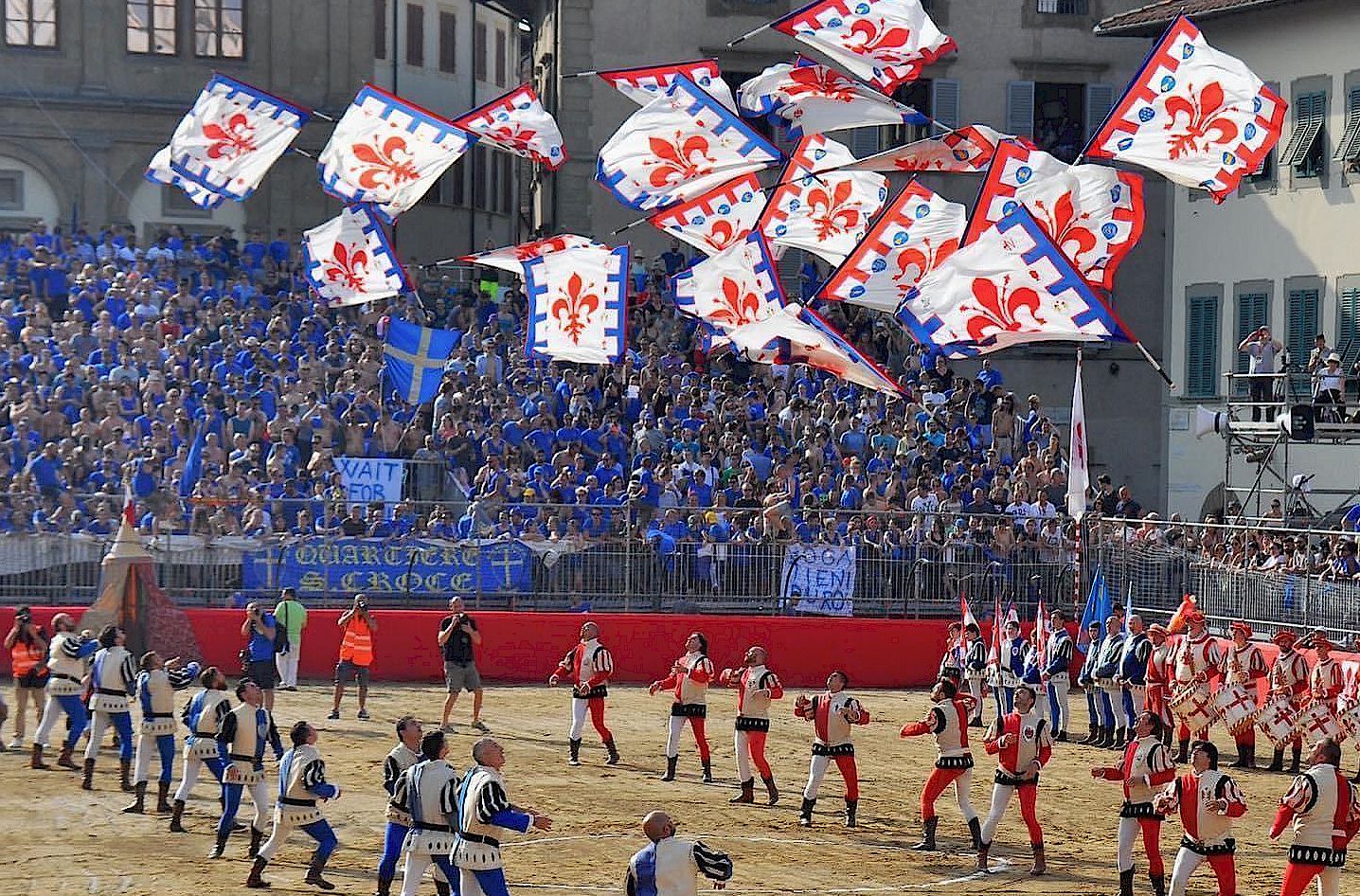
I guess almost every one has heard of the Calcio Storico Fiorentino, and in fact it's worth seeing this spectacle (once). Also don't forget that before the calcio itself there will be a splendid display of Tuscany flag throwing. Another Tuscan speciality that is well worth seeing, either on this occasion or another.

Flag throwers at the Calcio Storico Fiorentino in Florence

Flag throwers at the Calcio Storico Fiorentino in Florence

The Calcio Storico Fiorentino originated in the 16C in Florence and is played today in historical costume. The four teams are: Santa Croce (Azzurri, or Blues), Santo Spirito (Bianchi, or Whites), Santa Maria Novella (Rossi, or Reds), and San Giovanni (Verdi, or Greens). The game was invented by rich aristocreats and took place every night between Epiphany and Lent. The rules of the Calcio Storico were first published in 1580 by Giovanni de’ Bardi. These days it's a somewhat rougher event - actually, brutal is the appropriate expression and I sometimes wonder whether there are any "rules" at all. It's even rumoured that some players are released from jail for a day to participate - I don't think that's true.

On 24 June at 4 pm, the feast day of St. John the Baptist, the patron saint of Florence, a spectacular parade in historical costume starts in Piazza Santa Maria Novella and wends its way through the centre of Florence to Piazza Santa Croce. The four contrade of Florence are represented and you’ll see the players going by as they go to play the final, even those who won’t be playing the final. The parade starts roughly around 4pm since the final should start around 5 pm.

Calcio Storico Fiorentino 2022

To watch the match in Piazza Santa Croce, you need a ticket and they don't come cheap. Tickets cost 80 for Tribuna Onore Centrale, 60 for Tribuna Onore Laterale, 40 for Tribuna C and 29 Curve colori. These need to be bought in advance at the headquarters of BoxOffice Toscana on via delle Vecchie Carceri, 1, or at Teatro Verdi.

These are the hours:

  • Monday 6 June from 4 pm BoxOffice (at 9 am can pick up numbers for line) 
  • Tuesday, Wednesday and Thursday7, 8, 9 June 9 am - 4 pm BoxOffice
  • Friday, 10 June from 12 - 7 pm only at Teatro Verdi (Via Ghibellina 99)
  • Saturday 11 June at Teatro Verdi, from 12 - 6 pm.
You can also watch on Toscana TV, channel 18, and various streaming services.

Tuscany Toscana
Don't forget to visit my Tuscany
Travel Guide!

Up-to-date news on what to see and where to stay in Chianti and all of Tuscany.

Tuscany Travel Guide

vacation accommodations in Tuscany


Author: Anna Maria Baldini

All content copyright © ammonet Italian Web Site Promotion 2022. All rights reserved.

Wednesday, 18 May 2022

Open gardens day in Florence: Cortili e Giardini Aperti a Firenze

As my faithful readers will remember, I am an enthusiast for the formal gardens of Tuscany, especially those of the larger villas of Tuscany. I therefore always look forward to Open gardens day in Florence (Cortili e Giardini Aperti a Firenze) which in 2022, takes place on 22 May, when the private gardens of Florence are open to the public - see the list here. In 2018, I took the opportunity to visit some gardens in the Oltrarno which I either hadn't seen before at all or only a long time ago.

The one I want to describe in some detail is the Giardino San Francesco di Paola which extends upwards and away from the former home of Harry Brewster, "the last of the cosmopolites of Florence". Brewster, a descendent of William Brewster of the Mayflower, was also the grandson, on his mother's side, of the German sculptor Adolf von Hildebrandt, whose studio occupied part of the former Minimite convent of San Francesco di Paola. The convent is located at the foot of Bellosguardo, the beautiful hill that dominates the Oltrarno. It was an evocative experience for me to walk up Via Villani to the circular Piazza San Francesco di Paola. Although there are 19 C and modern buildings on two sides of the piazza, the old church and the wall and gate of the convent are still there, just as described by Brewster. The main structure was long ago divided up into apartments and, alas, the building is looking much the worse for wear. Indeed, so are some of the remaining Hildebrandt sculptures standing in the loggia at the back of the villa.

Villa of San Francesco di Paola
The loggia of the Villa of San Francesco di Paola - much in need of some restoration

However, the garden is beautifully kept up, as is the hay shed (fienile) which Brewster converted into a neat, strangely English-looking, cottage covered in roses and surrounded by a small lawn, where he himself lived in frugal simplicity writing his books. One continues up a series of irregular steps to Brewster's beloved belvedere from which there is a beautiful view of Florence, which because of its lower altitude, is almost more beautiful than the vista from the top of Bellosguardo.

Giardino San Francesco di Paola
View of Florence from the belvedere in the Giardino San Francesco di Paola

Next I walked to entrance of the Giardini Torrigiani not far from the Pitti palace. I have often passed the fine iron gates of these gardens - little did I know that there are 17 acres of gardens hidden behind the walls in the centre of the Oltrarno. In fact, the Torrigiani gardens are the largest private gardens within city limits in all Europe.

Torrigiani gardens in Florence, Italy
A view of a small part of the Torrigiani Gardens, In Florence

The Torrigiani gardens were originally planted by the founder of the Italian Botanical Society, the oldest such society, and the garden still has an uncommonly wide variety of trees, especially exotic species, in keeping with its 19 C “English Landscape” style. The gardens were designed at the height of the Romantic movement in the early 19 C, forming an idyllic oasis of green around the original 16 C villa. The garden hosts rare tree species, wide English-style lawns, herb and vegetables gardens, sculpted lions, a beautifully restored greenhouse and remains of the city walls built under Cosimo I in 1544. The layout of the garden is also profoundly symbolic and I strongly advise visiting it with a good Tuscan garden guide book in hand.

Giardino Torrigiani a Firenze
The astronomical tower in the Torrigiani gardens

Last but not least, I visited that exquisite jewel of a garden, the Giardino Corsi Annalena, nearby on via Romana. This garden is located on land formerly owned by the monastery of San Vincenzo which was founded in around 1441 by Countess Anna Elena (Annalena) Malatesta. During the long struggle for supremacy between Florence and Sienna, the area was dominated by the fortifications created by Cosimo I de’ Medici, including an underground passage that until this day connects the Boboli, Corsi and Torrigiani gardens. Following the destruction of the fortifications in 1571, the area was left abandoned for many years. In 1790, the Marquis Tommaso Corsi purchased the land, then known as the "Moors’ Garden", and the architect Giuseppe Manetti designed what can be considered the first English garden in Florence. It was completed during the years 1801 to 1810. If you have the chance to visit this beautiful garden, please don't miss it.

Giardino Corsi Annalena in Florence
The Giardino Corsi Annalena in Florence


Tuscany Toscana
Don't forget to visit my Tuscany
Travel Guide!

Up-to-date news on what to see and where to stay in Chianti and all of Tuscany.

Tuscany Travel Guide


vacation accommodations in Tuscany

Author: Anna Maria Baldini

All content copyright © ammonet Infotech website promotion 2015 - 2022. All rights reserved.

Tuesday, 17 May 2022

Donatello exhibition in Florence

This year's block-buster exhibition in Florence is dedicated to Donatello and goes under the not unjustifiably immodest name of "Donatello, the Renaissance." As for some of the previous exhibitions at the Palazzo Strozzi, the Donatello show is partially housed also at the Bargello (separate ticket required). Opening hours are 10 am to 8 pm every day except Thursday when the doors remain open until 11 pm. Donatello, the Renaissance stays in Florence until 31 July 2022, after which it will travel, with variations on the loans and probably the catalogue, to the Staatliche Museen in Berlin and the Victoria & Albert Museum in London. Tickets are linked to an entry time slot and can be booked on-line at https://palazzostrozzi.vivaticket.it/.

Donatello Exhibition in Florence 2022

Donatello Exhibition in Florence 2022

I strongly recommend this exhibition to any one interested in Renaissance art - indeed, to almost any art lover. The aim of the exhibition is to reconstruct the artistic development of Donatello throughout his long life (1386 to 1466) and to confirm him as one of the most important and influential masters of the Italian Renaissance by exhibiting his work next to workd by other Italian Renaissance masters such as Brunelleschi, Masaccio, Andrea Mantegna, Giovanni Bellini, Raphael and Michelangelo. A remarkable number of Donatello's works, normally never loaned, have made their way to the Palazzo Strozzi for this exhibition, making it far more ambitious than the two exhibitions organised in 1985 and 1986 commemorating the 600th anniversary of Donatello's birth. Not much is missing and two pieces that are mssing can be seen nearby - the Magdalene of the Duomo Museum and the Giuditta of the Palazzo Vecchio.

Donatello Exhibition at the Palazzo Strozzi in Florence

Donatello Exhibition in Florence 2022

It's a great exhibition - don't miss it if at all possible!


Tuscany Toscana
Don't forget to visit my Tuscany
Travel Guide!

Up-to-date news on what to see and where to stay in Chianti and all of Tuscany.

Tuscany Travel Guide

Author: Anna Maria Baldini

All content copyright © ammonet Italian Web Site Promotion 2022. All rights reserved.

Tuesday, 10 May 2022

When do the poppies appear in Tuscany?

Wild flowers in Tuscany.

This is the time of year when many readers ask me, "When do the poppies appear in Tuscany?" Of course, the exact time varies a bit from year to year, but right now, the end of April and beginning of May, is the time to see poppies and many, many other species of wild flowers in Tuscany. This is basically because April is one of the two rainy months in Tuscany (the other being October) and as long as the temperature and rainfall are more or less average, flowers will spring up everywhere - ploughed fields, olive groves, vineyards, roadside.

The picture below shows a bunch of wild flowers that I picked yesterday during the course of a 20 minute walk through my olive grove here in central Chianti. Those are just a few of the more spectacular blooms that had sprung up since the thunderstorm the day before, irises and poppies among them.

wild flowers of Tuscany

Tuscan wild flowers 


Poppies of the Val d'Orcia

When visitors to Tuscany ask about poppies in bloom, they're usually referring to the red poppies that blanket the Val d'Orcia at this time of year. This display is most spectacular on the ploughed hills of the heavily alkaline Crete Senesi in the Val d'Orcia before the crops are planted, and is the object of many a photographic excursion to that area of Tuscany during the last days or April and early May. Cultivation of agricultural land is often detrimental to wild plant species but not so the Tuscan poppy which, indeed, is also known as the "corn poppy" because it thrives on land subject to the annual rhythm of grain cultivation. This species is also famous under the name "Flanders poppy", the emblem of the fallen soldiers of World War I. Papaver rhoeas, the variety of papavero (poppy) that has become known as the Tuscan poppy, probably originated in Egypt, where the cyclic agricultural practices regulated by the annual flood of the Nile began favouring this spectacular plant. By growing on disturbed soil and seeding itself profusely during its growing season, the poppy has found a perfect harmony with the agricultural practices for the past 3,000 years or so and remains of poppies have been found in ancient Egyptian tombs.

Poppies in the Val d'Orcia of Tuscany
Poppies blooming in the Val d'Orcia of Tuscany

Orchids in Tuscany

Not everyone realises that there are more than 40 species of orchid native to Tuscany. Ophrys speculum is one of the most common and easiest to recognise of the Tuscan orchids, but the diligent flower enthusiast will soon discover several other common species that are currently in flower. Many of these are found in or near bogs high in the Apuan Alps, but others are common throughout Tuscany, especially in the hilly vineyards and fields of Chianti. The flowers of members of the genus Ophrys are famous for their resemblance to female insects, to the extent that male insects, bees in particular, attempt to copulate with them, hence pollinating the flowers. Although many authorities list between 50 and 150 species of Ophrys in Europe, molecular genetic analysis suggests that there might be as few as 10 species, with the other apparent species being variants arising from hybridisation. Nevertheless, whether they are different species or not, this genus alone provides a huge variety of floral pleasures for country walkers in Tuscany.

A Tuscan orchid, Ophrys speculum

More about the orchids of Tuscany.

Vacation accommodation in Tuscany
www.bella-toscana.com


All content copyright © ammonet Italian Web Site Promotion 2014 - 2026. All rights reserved.

Sunday, 8 May 2022

Anglo-American Florence since the mid 19th Century

Not everyone realises just how small Florence was in the mid-19th Century compared with today. The city walls were still intact. The latter weren't demolished until between 1865 and 1871 when Florence was provisional capital of Italy. I recently came across a provincial map dating from 1841. To the NE, Florence more or less ended just behind the railway station!

Florence in 1841
Florence in 1841

During the second half of the 19th century, a third of the population of Florence was made up of foreigners, the majority of them from England and America - the Anglo-American Florentines - along with numerous Germans, French and Russians. The English foreign colony between 1850 and 1930 included the poet Walter Savage Landor, Robert and Elizabeth Browning with their literary salon in Casa Guidi on Via Maggio, George Nassau, the third Earl Cowper, the countess of Orford, Lady Sybil Cutting (the mother of Iris Origo) at Villa Medici, Longworth Powers, Janet Ross, Norman Douglas, Vernon Lee, Bernard Berenson at Villa I Tatti and many, many others. The last direct connections to the last of the Anglo-American Florentines was probably Sir Harold Acton (1904 - 1994) whose father moved into Villa La Pietra in 1903, or perhaps Harry Brewster who passed away in 1999.

Aside from those who made Florence their home, there was a constant stream of illustrious visitors who came to stay for months at a time. In 1869, Henry James made his first visit to the city that became one of his favorites and one of the settings for his wonderful novel, The Portrait of a Lady.

Since that time, the city has spread out across the flood plain of the Arno, virtually swallowing up Prato and, no doubt soon, Pistoia to the NE, and with hardly a patch of green separating its outskirts from Signa and Lastra d Signa.

Florence in 2022
Florence in 2022

Tuscany Toscana
Don't forget to visit my Tuscany
Travel Guide!

Up-to-date news on what to see and where to stay in Chianti and all of Tuscany.

Tuscany Travel Guide

vacation accommodations in Tuscany

Author: Anna Maria Baldini

All content copyright © ammonet Italian Web Site Promotion 2022. All rights reserved.

Saturday, 7 May 2022

Palazzo Chigi Zondadari in Sienna opens to the public

Everyone visiting the main piazza of Sienna, especially during the Palio, will have seen, although perhaps not particularly noticed, the Palazzo Chigi Zondadari which is located on the higher side of the Piazza del Campo and provides the perfect view of the Palio. However, very few know that the interior of this palazzo is spectacularly decorated and furnished.

From 8 May 2022, the Palazzo Chigi Zondadari in Sienna opens to the public on a permanent basis.

Palazzo Chigi Zondadari in Siena

Palazzo Chigi Zondadari

The Palazzo was built for Cardinal Antonfelice Zondadari (1655 - 1737) and his brother Bonaventura (1652 - 1719), first Marquis Chigi Zondadari and founder of this aristocratic dynasty. The palazzo has been the Siennese residence of the family since 1724 and was the last palazzo to be constructed in the Piazza del Campo.

The Palazzo Chigi Zondadari is a typical baroque-neoclassical structure designed by Antonio Valeri (1648 - 1736), the last pupil of Gian Lorenzo Bernini, who was brought in from Rome to modernise and expand the pre-existing mediaeval buildings that were were purchased by the Chigi at end of the 17 C.

Bust of Pope Alexander VII by Bernini
$
Bust of Pope Alexander VII by Bernini

The palazzo is a linear structure, with five rows of windows, an internal courtyard and a splendid main staircase. The main floor is the most interesting. The halls and galleries have frescoed ceilings, house a collection works of art, archaeological finds, paintings and sculptures, among them a fine bust of Pope Alexander VII by Gian Lorenzo Bernini, and three rooms have their walls decorated in spectacular Venetian "corami" from the 1780s.

Salotto Rosso of the Palazzo Chigi Zondadari

Salotto Rosso of the Palazzo Chigi Zondadari

Among the renowned artists who worked on the palace were Placido Costanzi, a pupil of Francesco Trevisani, one of the most important artists who was a followers of Carlo Maratta and of Benedetto Luti. Cardinal Antonfelice Zondadari entrusted the execution of some frescoes depecting episodes from the life of Pope Alexander VII and Cardinal Zondadari to Placido Costanzi. Another painter who worked on the noble floor was Marco Benefial, a pupil of the Carraccesco Bonaventura Lamberti. Francesco Nenci who completed the decoration of the rooms during the 19 C.

Tuscany Toscana
Don't forget to visit my Tuscany
Travel Guide!

Up-to-date news on what to see and where to stay in Chianti and all of Tuscany.

Tuscany Travel Guide

Author: Anna Maria Baldini

All content copyright © ammonet Italian Web Site Promotion 2022. All rights reserved.

Wednesday, 27 April 2022

Who was Mona Lisa?

 Who was Mona Lisa?

"Mona Lisa" by Leonardo da Vinci

The question of who was Mona Lisa has occupied scholars for at least 150 years, more or less since Leonardo da Vinci's painting, known in English as "Mona Lisa", became the most famous painting on the planet - before that time it was well-known but not as highly esteemed as it became. The subject of the painting is widely believed to be Lisa del Giocondo who was a member of the Gherardini family of Florence and Tuscany, and the wife of the wealthy Florentine silk merchant, Francesco del Giocondo. This was Vasari's belief and there is no doubt that Leonardo worked on a portrait of Lisa del Giocondo. This was confirmed in 2005, when a scholar at Heidelberg University discovered a marginal note in a 1477 edition of a work by Cicero. The note was written by Leonardo's contemporary Agostino Vespucci, is dated October 1503 and states that Leonardo was at that time working on a painting of Lisa del Giocondo. There have even been claims that the portrait was painted at Villa Vignamaggio near Greve in Chianti, and that some of the geological formations in the background are the famous Tuscan balze, a type of eroded badlands formation.

However, was that painting the one we know today as "Mona Lisa"? According to Martin Kemp, one of the foremost Leonardo scholars, there is not the slightest scrap of evidence that it was. In his still valuable 1981 study, "Leonardo da Vinci. The marvellous works of Nature and Man", Kemp punctiliously refers to the Louvre painting as "Portrait of a Lady on a Balcony" and is convinced that it was started shortly before 1506 during Leonardo's Florentine period. Based on the 1517 report of his meeting with Leonardo by Antonio de' Beatis, Kemp also rules out the possibility of identifying her as one of the great ladies of the Renaissance. de' Beatis stated that it was a "portrait of a certain Florentine lady, made from nature at the instigation of the late Magnificent Giuliano de' Medici". However, Kemp thinks that the portrait was worked on from time to time later, especially the elaboration of the background.

Needless to say, several other names have been proposed for the subject this portrait, including Isabella d'Este, Isabella of Aragon, Cecilia Gallerani, Costanza d'Avalos, Duchess of Francavilla, Pacifica Brandano or Brandino, Isabela Gualanda, Caterina Sforza and, most recently, Bianca Giovanna Sforza. 

Carla Gori has proposed that the Mona Lisa is in fact a portrait of Bianca Giovanna Sforza, wife of the jouster Galeazzo Sanseverino, daughter of Ludovico il Moro, Duke of Milan and Lord of Bobbio near Piacenza. The basis of her hypothesis is as follows. She considers that the mural drawings of the Malaspina dal Verme castle dedicated to Sanseverino, patron and friend of Leonardo, were, at the very least, supervised on site by Leonardo. 

Bridge in the background of Mona Lisa
The bridge in the background of the Mona Lisa

Ponte Gobbo di Bobbio

In the background of the Mona Lisa, a bridge is depicted which she identified, in 2010, as the Ponte Gobbo di Bobbio, specifically as viewed from Malaspina dal Verme castle. In addition to the Ponte Gobbo, the Trebbia river and its large bend coincide with the stream depicted to the right of the Mona Lisa. The same goes for the mountains in the background, similar to the topography of the Val Tidone, the Pietra Parcellara and the badlands area. Most recently, circumstantial evidence suggests that Leonardo did indeed spend time at Pierfrancesco di Gropparello, near Bobbio. A group of geologists published a description of ichnofossils quite specific to that zone which seem to be the same as those illustrated by Leonardo in the Codex Leicester.

It's unlikely that Bianca Giovanna Sforza will displace Lisa del Giocondo as "Mona Lisa" anytime soon, but as research continues, who can tell?


Tuscany Toscana
Don't forget to visit Elena Spolaor's
Travel Guide!

Up-to-date news on what to see and where to stay in Chianti and all of Tuscany & Umbria.

Chianti Travel Guide

Author: Anna Maria Baldini

All content copyright © ammonet Web Site Promotion 2015 - 2022. All rights reserved.

Saturday, 2 April 2022

Free entry to state museums in Florence on the first Sunday of each month

Starting on the 3rd of April, 2022, there will be free access for all visitors to state museums, archaeological parks and cultural sites in Florence and elsewhere in Tuscany on the first Sunday of the every month. This might not apply to municipal museums and other sights that belong to the city of Florence.

Free entry into Florence museums

 Florence is one of several cities in Italy that have had, for several years, a  day of the month when entry to many museums is free for residents. In Florence the programme is known as Domenica Metropolitana. All of this was disrupted by the COVID-19 pandemic. However, as the severity of the pandemic declines and the rules are slowly relaxed, state-owned sights are being added to the municipal ones that are included in the Domenica Metropolitana programme. In Florence, this allows residents of the metropolitan city of Florence to visit city museums for free on first Sunday of every month, and all visitors to enter state-owned sights free.

Although it has been reported that from the 1st of April 2022, access to historical sights, museums, galleries and gardens no longer requires the covid vacination Green Pass (or equivalent document providing evidence that you have been vaccinated and have received a booster shot within the past 6 months), it is unclear whether this applies everywhere. It therefore remains advisable for you to have your Green Pass with you. The requirement to wear a face mask remains in place in all instances.

Tuscan sights open to all for free on the first Sunday of every month include: 

Antiquarium nazionale di Sestino
Via Marche - 52038 Sestino (AR)

Area archeologica di Vetulonia
vie Case di Siena, s.n.c. - 58043 Castiglione della Pescaia (GR)

Basilica di San Francesco
piazza San Francesco, 1 - 52100 Arezzo (AR)
    
Cenacolo di Andrea del Sarto a San Salvi
via di San Salvi, 16 - 50135 Firenze (FI)

Eremo di San Leonardo al Lago
strada dell'Osteriaccia, 4 - 53035 Monteriggioni (SI)

Galleria dell'Accademia di Firenze
via Ricasoli - 50122 Firenze (FI)

Gallerie degli Uffizi – Gli Uffizi
piazzale degli Uffizi - 50122 Firenze (FI)

Gallerie degli Uffizi - Tesoro dei Granduchi (Palazzo Pitti)
piazza Pitti - 50125 Firenze (FI)
    
Gallerie degli Uffizi - Museo della Moda e del Costume (Palazzo Pitti)
piazza Pitti - 50125 Firenze (FI)
    
Gallerie degli Uffizi - Galleria Palatina e Appartamenti Reali e Imperiali (Palazzo Pitti)
piazza Pitti - 50125 Firenze (FI)
    
Gallerie degli Uffizi - Giardino di Boboli
piazza Pitti - 50125 Firenze (FI)
    
Gallerie degli Uffizi - Museo delle porcellane
piazza Pitti - 50125 Firenze (FI)

Gallerie degli Uffizi – Galleria d’Arte Moderna (Palazzo Pitti)
piazza Pitti - 50125 Firenze (FI)

Museo archeologico nazionale ed Area archeologica di Cosa
via delle Ginestre, s.n.c. - 58015 Orbetello (GR)

Museo archeologico nazionale di Firenze
piazza S.S. Annunziata, 9b - 50122 Firenze (FI)

Museo archeologico nazionale “Gaio Cilnio Mecenate” e Anfiteatro romano
via Margaritone, 10 - 52100 Arezzo (AR)

Museo delle arti e tradizioni popolari dell’Alta Valle del Tevere - Palazzo Taglieschi
piazza Mameli, s.n.c. - 52031 Anghiari (AR)
    
Museo di Casa Vasari
via XX settembre, 55 - 52100 Arezzo (AR)

Museo nazionale della Certosa monumentale di Calci
via Roma, 79 - 56011 Calci (PI)
    
Museo nazionale delle residenze Napoleoniche Palazzina dei Mulini
piazzale Napoleone, 1-3 - 57037 Portoferraio (LI)

Museo nazionale delle residenze Napoleoniche Villa S. Martino
via di San Martino - 57037 Portoferraio (LI)
    
Museo nazionale di Casa Giusti
viale Vincenzo Martini, 18 - 51015 Monsummano Terme (PT)
    
Museo nazionale di Palazzo Mansi
via Galli Tassi, 43 - 55100 Lucca (LU)
    
Museo nazionale di San Matteo
piazza S. Matteo In Soarta - 56126 Pisa (PI)

Museo nazionale di Villa Guinigi
via della Quarquonia s.n.c. - 55100 Lucca (LU)

Museo nazionale etrusco e necropoli di Chiusi
via Porsenna, 93 - 53043 Chiusi (SI)
    
Museo nazionale etrusco, Necropoli di Poggio Renzo e Tomba del Colle
via della Pellegrina - 53043 Chiusi (SI)
    
Musei del Bargello - Museo nazionale del Bargello
via del Proconsolo, 4 - 50122 Firenze (FI)
    
Parco di Villa Il Ventaglio
via Giovanni Aldini, 10/12 - 50131 Firenze (FI)
    
Pinacoteca nazionale di Siena
via San Pietro, 29 - 53100 Siena (SI)
    
Villa medicea della Petraia
via della Petraia, 40 - 50141 Firenze (FI)
    
Villa medicea di Cerreto Guidi e Museo storico della Caccia e del Territorio
via Ponti Medicei, 7 - 50050 Cerreto Guidi (FI)

Free entry on the first Sunday of every month in Florence
 

Tuscany Toscana
Don't forget to visit Elena Spolaor's
Travel Guide!

Up-to-date news on what to see and where to stay in Chianti and all of Tuscany & Umbria.

Chianti Travel Guide

Author: Anna Maria Baldini
All content copyright © ammonet Web Site Promotion 2015 - 2022. All rights reserved.