Showing posts with label Events. Show all posts

Saturday, 13 June 2026

Mercantia at Certaldo, Tuscany, one of the best street theatre festivals in Europe

Mercantia, one of the best street theatre festivals in Europe, takes place this year, 2026, from 15 to 19 July in the attractive mediaeval walled town of Certaldo, Tuscany. Certaldo consists of the ancient Certalo Alto, on its hilltop, and Certaldo Basso, the modern part of the town in the valley below. Certaldo is very likely the place where Boccaccio was born and he certainly lived there towards the end of his life and regarded it as his hometown. It's therefore appropriate that Certaldo should provide popular entertainment today in the form of Mercantia, its famous street theatre festival.

Mercantia Certaldo 2026

Mercantia Certaldo
2026

Mercantia 2022 Certaldo

Mercantia Certaldo
2022


Mercatia Certaldo 2019

Mercatia Certaldo 2019


Mercantia at Certaldo 2016

Mercantia at Certaldo 2016

The festival takes place in Certaldo Alto, the ancient upper town which can be accessed easily by funicular or on foot. Within the walls, there will be dozens of performers along the few streets of the town and also inside the courtyards, where stages are set up to host clowns and comedians, contortionists and acrobats, puppeteers and ventriloquists, magicians and illusionists, fire-eaters and dancers, actors and street musicians.

Mercantia street theatre festival at Certaldo, Tuscany

Mercantia street theatre festival at Certaldo, Tuscany

Tickets cost roughly €13.00 on Wednesday, Thursday, Friday and Sunday, and €12.00 on Saturday, €15.00 on Saturday. If you are planning to visit Mercantia more than once, you can buy the 5-day pass for about €52.00.

Certaldo street theatre festival

Certaldo street theatre festival
 
In addition to the street theatrical performances in Certaldo Alto, Certaldo Basso is packed for the duration of the festival with street stalls selling hand-made jewellery, clothing, masks, various kinds of art, herbal remedies and beauty products, hand-crafted leatherware and shoes, and a wide range of other arts and crafts, all of varying quality and price. No ticket is required for Certaldo Basso. There are also some stalls in Certaldo Alto.

www.chianti.info

More about Certaldo.

Map of the main sights of Chianti. 

Festivals of Tuscany.


Author: Anna Maria Baldini

All content copyright © ammonet Web Site Promotion 2012 - 2026. All rights reserved.

Wednesday, 1 April 2026

Upcoming Chianti wine festivals

The Chianti Classico wine zone of Tuscany is the home to several really good wine festivals where you can taste a wide range of Chianti Classico wines and talk directly to the producers. On 23 and 24 May 2026, in the attractive village of Radda in Chianti there is a wine tasting event, Radda nel Bichiere, taking place that is well worth a visit if you are in the area. A bit later in the year, on the first weekend of June (6th and 7th) 2026, there is another wine festival taking place in Lamole in Chianti, I Profumi di Lamole. And the Chianti wine festival takes place in Montespertoli from 30 May to 7 June 2026. To take in some or all of these wine tasting occasions, you could find a place to stay on the Panzano in Chianti website.and for the Montespertoli Chianti wine festival on the Montespertoli website.

Radda nel Bichiere

At Radda nel Bichiere

For September 2026, there are two upcoming Chianti wine festivals to note in your agenda.

Chronologically, the first is the Chianti Classico wine fair taking place in Greve in Chianti, 45-60 minutes south of Florence and reachable by bus from Florence. The official name is the Il Rassegna del Chianti Classico (54th Expo of Chianti Classico wines). In 2026, this wine festival takes place from the 10th to the 13th September 2026 in Piazza Matteotti, the main piazza of Greve in Chianti. Note that you might have to park some distance from the venue due to heavy traffic - this fair is very popular. If you also plan to drink some wine, that's just one more reason to take the bus.

Rassegna del Chianti Classico

The Terre di Melazzano booth at the Rassegna del Chianti Classico
 
The way it works is that you buy a wine glass from the Cassa and Informazioni booth and this allows you to try a certain number of the wines displayed. You can both buy and order wine and olive oil at the booths. In addition to the wine tasting, a variety of events is offered during the four days, but I wouldn't over-estimate their intrinsic interest. Click here for the 2026 programme. The Greve Chianti wine fair has a good number of Tuscan wineries represented, each offering all of the wines that they produce - mainly Chianti Classico, of course. My only objection to this fair is that when the weather is hot, few of the exhibitors take any steps to keep their wines cool. Some of them are left in direct sunlight and are distinctly warm when you taste them.

The second wine tasting event is Vino al Vino, taking place one week later in Panzano in Chianti, 10 minutes drive in the direction of Sienna from Greve and also accessible by bus from Florence. Vino al Vino takes place from 17 to the 20 of September 2026. To some extent, I prefer Vino al Vino over the Chianti Classico Expo if only because it is smaller, with about 21 wineries presenting their wines and olive oil, and has a more intimate atmosphere. I also find the food on sale better than in Greve. There's live Jazz on Saturday & Sunday from 6 until 8 pm.

Vino al Vino Panzano Chianti wine festival

Vino al Vino Panzano Chianti wine festival

For accommodation nearby the venues:

Greve in Chianti accommodation.

Panzano in Chianti accommodation.

Villa hotels.

Chianti wine festivals on Facebook.

Tuscany Toscana
Don't forget to visit my Tuscany
Travel Guide!

Up-to-date news on what to see and where to stay in Chianti and all of Tuscany.

Tuscany Travel Guide

Author: Anna Maria Baldini

All content copyright © ammonet Italian Web Site Promotion 2013 - 2026. All rights reserved.

Tuesday, 17 March 2026

Chianti wine festival at Montespertoli 2026


The Chianti wine festival at Montespertoli is coming up (30 May - 7 June 2026) and as usual it will be an entertaining occasion with a procession of locals dressed up in 19th century costumes and, of course, lots of wine to taste. This wine festival is unusual in the number of street musicians and costumed bands who, along with Tuscan flag throwers and street actors, turn out to provide entertainment. In this respect the Montespertoli Chianti wine festival is superior to the Rassegna del Chianti Classico wine festival held later in the year in Greve in Chianti. The Greve festival has plenty of excellent wine available to try and buy but the entertainment is quite feeble in comparison with that of the Montespertoli event, especially in the evenings.

Chianti wine festival at Montespertoli
Chianti wines ready for tasting at Montespertoli

The important difference between the Greve and Montespertoli Chianti wine festivals is that they present wines from different wine zones of the Chianti appellation. The Montespertoli festival covers Chianti, Chianti Montespertoli and Chianti Colli Fiorentini while the Greve festival is devoted to Chianti Classico.

Montespertoli Chianti wine festival
Wagon loaded with Chianti fiasci pulled by Chianina oxen at the Montespertoli Chianti wine festival

Montespertoli is within easy reach of Florence by public transport and there are some excellent agriturismi vacation accommodations in the area

More about Montespertoli.

More about the Greve in Chianti wine festival.

Calendar of events in Tuscany.

Important festivals of Tuscany.

Tuscany Toscana
Don't forget to visit my Tuscany
Travel Guide!

Up-to-date news on what to see and where to stay in Chianti and all of Tuscany.

Tuscany Travel Guide


vacation accommodations in Tuscany
Author: Anna Maria Baldini

All content copyright © ammonet Infotech website promotion 2015 - 2022. All rights reserved.

Friday, 13 February 2026

"Il Magnifico 1492" - a fabulous exhibition promised for Autumn 2026 at the Uffizi Galleries in Florence

Start planning now! The Uffizi have announced that they are putting together an exhibition for Autumn 2026 that will reconstruct part of the unequalled art collection assembled by Lorenzo di Piero de’ Medici (1449-1492), "il Magnifico", as it was in the year of his death in 1492.

"Il Magnifico, 1492"

Portrait of Lorenzo il Magnifico by Vasari

More than a hundred works borrowed from around the world will form a reconstruction of some of Lorenzo's collection - the collection that helped earn him the description "Il Magnifico" - once housed in the Medici family palazzo in Via Larga, Florence - now the Palazzo Medici-Riccardi. The exhibition is based on the description and inventory prepared in 1492, shortly after Lorenzo's death. The Uffizi promises us a selection of paintings and sculptures, including several famous masterpieces, as well as vases, gems, cameos, coins, codices, and maps, reflecting the interests and curiosity that were among the characteristic traits of the Medici family that ruled Florence and Tuscany between the 15 C and the 17 C.

Bronze medal of depicting Lorenzo il Magnifico

Bronze medal of depicting Lorenzo il Magnifico

Lorenzo was a shrewd and capable politician and diplomat, and a fervent promoter of the arts, literature and philosophy, himself a poet and prolific letter writer, defining the very concept of patronage. He surrounded himself with some of the most brilliant intellectuals of his time, including Angelo Poliziano, Marsilio Ficino and Giovanni Pico della Mirandola, as well as supporting artists such as Botticelli, Leonardo da Vinci, Verrocchio and Michelangelo, transforming Florence into the undisputed capital of the Renaissance.

Don't miss this exhibition if you will be anywhere near Florence during Autumn 2026!

More about the Medici family.


Tuscany Toscana
Don't forget to visit my Tuscany
Travel Guide!

Up-to-date news on what to see and where to stay in Chianti and all of Tuscany.

Tuscany Travel Guide

vacation accommodations in Tuscany


Author: Anna Maria Baldini

All content copyright © ammonet Italian Web Site Promotion 2026. All rights reserved.

Monday, 5 January 2026

Events and festivals in Tuscany during 2026

The new year has begun and now is the moment to think about events and festivals in Tuscany during 2026. If you're planning a trip to Tuscany, do look at our lists of folkloric festivals, jousts, archery and crossbow contests and numerous other events that take place in Tuscany during the course of the year. These range from the massive float parades of the Carnevale in Viareggio through the great mediaeval costume festivals to simple village food feste.

Events and festivals in Tuscany
Huge processional float at Viareggio Carnevale

The festivals of Tuscany have become more and more polished and exciting in their presentation and yet remain genuine folk festivals dependent entirely on the enthusiasm of the local organisers, in many cases these being competing local contrade, rioni etc. These latter are clubs and societies based on the various residential quarters of villages, towns and cities, the most famous being the contrade of Sienna which enter their horses (and riders) in the famous Siena palio twice every year.

Siena palio
 The Palio in Sienna, Tuscany

In addition to annual or twice yearly events, there are always "unscheduled" occasions to see and even participate in Tuscan folkoric activities. Keep your eyes open for posters advertising upcoming local events in the town you are visiting or where you are staying. They are very often extremely worthwhile attending. One of the most popular of these activities in Tuscany, especially in Florence, are flag tossing groups - bandierai or sbandieratori - who train to become expert in synchronised flag throwing.

Bandierai degli Uffizi di Firenze performing in Piazza Santa Maria Nuova, Florence 
 Bandierai degli Uffizi di Firenze performing in Piazza Santa Maria Novella, Florence 

The competitions are almost always costume events with processions, and very often dinners and food stands play an important role. Look through our lists for local events taking place near where you will be staying, and in addition try to attend at least one major event during your stay.

The main Tuscan festivals.

A comprehensive list of local events and festivals in Tuscany.


Tuscany Toscana
Don't forget to visit Elena Spolaor's
Travel Guide!

Up-to-date news on what to see and where to stay in Chianti and all of Tuscany & Umbria.

Chianti Travel Guide


vacation accommodations in Tuscany

Tuscany tourist information - tourist information

Author: Anna Maria Baldini

All content copyright © ammonet Infotech website promotion 2026. All rights reserved.

Saturday, 3 January 2026

The Fra Angelico exhibition in Florence - last days

It's only a couple of days ago that I was able to visit the marvellous Fra Angelico exhibition currently on show at the San Marco Museum and the Strozzi Palace in Florence. The exhibition is in its final days and will end on 25 January 2026, so if you are in Florence now or have the possibility to be here before then, don't hesitate - this is an amazing display of the works of Fra Angelico of Fiesole (ca. 1395 - 1455) and other artists associated with him and his times. Fra Angelico was born around 1395, named Guido di Pietro, in the Tuscan area of Mugello near Fiesole, not far from Florence. He was one of the greatest painters of the late Gothic and early Renaissance during the 15C, his only competitor, and perhaps superior, in painting during the first part of his life being Masaccio who died at age 26, and Fra Filippo Lippi later. For this exhibition the organisers have gathered over 140 works from Florence and around the world. The exhibition catalogue follows the layout of the exhibition closely and contains illustrations of many of the works on display. Despite its expense (€80), the catalogue is indispensable. (I suspect it will show up on Amazon at a substantial discount after the exhibition closes.) I recommend that you book a time slot first for San Marco since the museum is open only in the morning, and then go on to Palazzo Strozzi after lunch, if you plan to see the entire exhibition in one day.

Fra Angelico exhibition catalogue 
 
In this review, I'll emphasize some aspects of Fra Angelico's artistic output and other items on display that especially interested me and which might be less familiar to my faithful readers.


San Marco Museum


All of Fra Angelico's admirers as well as huge numbers of other art enthusiasts will already be familiar with the frescoes he painted in the monks' cells in the Monastery of San Marco by commission of his first and greatest patron, Cosimo de Medici, the Elder. These frescoes form the major part of the exhibition at San Marco. 
 
Fra Angelico: fresco in cell 7, The Mocking of Christ
 
In addition, there is a small but absorbing exhibition of items associated with the fanatical monk, Savonarola (1452 - 1498) who occupied Fra Angelico's former cell some thirty years after Fra Angelico had left the monastery. The famous portrait of Savonarola by Fra Bartolomeo can be viewed close up alongside an extremely expressive terracotta bust of Savonarola attributed to Marco della Robbia, later Fra Mattia (1468-1534). The display also includes a manuscript written by Savonarola in exquisite and minute script - BE SURE TO BRING A LARGE MAGNIFYING GLASS WITH YOU (see the next paragraph).

Bust of Savonarol by Marco della Robbia
Terracotta bust of Savonarola attributed to Marco della Robbia 


The San Marco Monastery Library


The libary of the Monastery of San Marco in Florence
The San Marco Library during the Fra Angelico Exhibition.
 
Not everyone realises that Fra Angelico was a skilled miniaturist and illustrator of illuminated manuscripts and this aspect of his artistic output should definitely not be thought of as being somehow a secondary activity, as indeed the exquisite examples of his illuminations on display in the library of San Marco Monastery demonstrate. Looking into the library from the main door, on the left are manuscripts and other sheets containing work by Fra Angelico while on the right are manuscripts that originally belonged to the library but which have been dispersed around the world following the depredations of Napoleon. Many of the manuscripts are humanistic works, some of them collected by the Medici family and donated to the library. The miniatures deserve to be examined under a magnifying glass in many cases. One example, which I can't find in the exhibition catalogue, is the only significant surviving page, the frontispiece, from Silius Italicus: De bello punico, 1450, a manuscript poem in the Biblioteca Nazionale Marciana, illuminated by most likely by Zanobi Strozzi, who was strongly influenced by Fra Angelico. (Click the image to study the details, especially the birds.)
 
Silius Italicus: De bello punico. 1450 Manuscript Biblioteca Nazionale Marciana, Venice

Another example, Saint Thomas Aquinas lecturing, from an Antiphonary for the Proper of Time, by Fra Angelico and collaborators, dating from about 1440-42.


The Strozzi Palace

The major part of the exhibition is located at the Palazzo Strozzi where almost all of the surviving major works by Fra Angelico are displayed. This part of the exhibition provides excellent insight into Fra Angelico’s artistic development and influence, and his relationship to painters such as Lorenzo Monaco, Masaccio, and Filippo Lippi, as well as sculptors like Lorenzo Ghiberti, Michelozzo, and Luca della Robbia.

Coronation of the Virgin painted for the Santa Maria Novella in Florence
Fra Angelico: the Coronation of the Virgin painted for the Church of Santa Maria Novella
 
When we first see the Coronation of the Virgin painted for the Church of Santa Maria Novella in Florence and the other works displayed around it, all the elements that a very expensive altarpiece of the 14 C was expected to provide leap out - a precisely tooled gold background, much azure, and much vermilion, the gilded haloes and gold-edged robes. What we are seeing at first seems all very Gothic but what makes this a Renaissance painting is the three dimensional depth and naturalism of the figures and the realism of their garments. The exhibition allows the viewer to follow Fra Angelico from Late Gothic to Early Renaissance - compare the images directly above and directly below.
 
Fra Angelico: Naming of St John the Baptist
 
I want to mention three other works from the period of Fra Angelico displayed here. The first is one of Luca della Robbia's masterpieces, the Virgin of the Apple ca. 1440-1445. Aside from the great beauty of this piece, where the only colour used is for the eyes of the Madonna and of the Child, a curiosity of the work is that the terracotta figures are placed against an apparently brocade design but which in fact includes two hidden paintings of the Madonna and Child, one painted overlaying the other. The more recent and visible painting is by Michele di Ridolfo del Ghirlandaio or his workshop, while the underlying work, viewed using infrared reflectography, is attributed to Domenico di Michelino (1417-1491).
 
Luca della Robbia the Virgin of the Apple

My faithful and intelligent readers will undoubtedly recall my obsession with the Medici family. I was delighted to be able to view up close an extremely evocative marble relief (but look at it from the left side - it's almost a sculpture in the round) of Cosimo de' Medici, the elder, by Antonio Rossellino  dating from ca. 1460-64. Cosimo was the first patron of Fra Angelico.
 
Cosimo de' Medici
Antonio Rossellino: Cosimo de' Medici
 
Cosimo's son and the father of Lorenzo il Magnifico, was Piero (1416-1469), known as "the gouty" due to his sufferings from this disorder later in his short life. Not only is the bust of Piero on display a fine sculpture, it is one of the first objects of this kind where the provenance is clear. The various inscriptions under its base identify the artist as Mino da Fiesole, state that the subject is Piero de' Medici and that Piero was 37 years old at the time (1453-54).
 
Piero de' Medici
 Mino da Fiesole: Piero di Cosimo de' Medici
 
As I staggered through this splendid exhibition (believe me, after three hours the legs grow weary), I was reminded again and again how Fra Angelico's originality, based on the foundations laid almost a century previously by Cimabue and then his pupil Giotto, finds expression in Fra Angelico's pupil Benozzo Gozzoli's portraiture and technical expertise in the art of fresco. Gozzoli links to Domenico Ghirlandaio and so to the latter's pupil Michelangelo and hence to the High Renaissance.


Tuscany Toscana
Don't forget to visit my Tuscany
Travel Guide!

Up-to-date news on what to see and where to stay in Chianti and all of Tuscany.

Tuscany Travel Guide

vacation accommodations in Tuscany


Author: Anna Maria Baldini

All content copyright © ammonet Italian Web Site Promotion 2026. All rights reserved.

Saturday, 25 March 2023

The traditional start of the new year in Florence - 25 March.

The 25th of March is the ancient Florentine New Year's Day and, in fact, it marked the beginning of the new year in Florence until as recently as 1750. The Grand Duke Francis III of Lorraine changed the date of the New Year into conformity with the Gregorian calendar, which had already been in force in the rest of Italy since 1582. The 25th of March is the day on which the Church commemorates the announcement of the incarnation by the angel Gabriel to the Virgin Mary and was taken as the beginning of the civil calendar in Florence. The feast of the Annunciation is usually held on 25 March but is moved in the Catholic, Anglican and Lutheran liturgical calendars when that date falls during Holy Week or Easter Week or on a Sunday.

25 th March in Florence

Throughout 25 March, you can visit the Brindellone, the famous cart of the Scoppio del Carro (explosion of the cart) event which is held every year on Easter morning. The cart, which is almost 12 m high and 3.5 m wide, can be visited in via del Prato 48, between 10 am and 6 pm. Guides are available who will describe the features of the carriage itself and the events involving it and the historical figures in the procession that takes place on Easter morning.

Florence Scoppio del Carro

More about the Scoppio del Carro. 

Since 2020, 25 March in Florence has also been designated Dantedì, to celebrate the beginning of Dante's journey into the Inferno, so famously described in his epic poem, the Divine Comedy.

Multiple fairs, museum opening and other festivities take place on 25 March and the days leading up to and following it in Florence.

More about festivals and events in Tuscany

.
Tuscany Toscana
Don't forget to visit my Tuscany
Travel Guide!

Up-to-date news on what to see and where to stay in Chianti and all of Tuscany.

Tuscany Travel Guide

vacation accommodations in Tuscany

Author: Anna Maria Baldini

All content copyright © ammonet Italian Web Site Promotion 2023. All rights reserved.

Thursday, 9 June 2022

Calcio Storico Fiorentino 2022

The 2022 Calcio Storico Fiorentino, that brutal competition among four Florentine teams, begins tomorrow, Friday 10 June 2022, with the semifinals taking place on Friday 10 June and Saturday 11 June instead of on Saturday and Sunday because a national referendum takes place held on Sunday the 12 June. The final takes place as always on 24 June 2022.

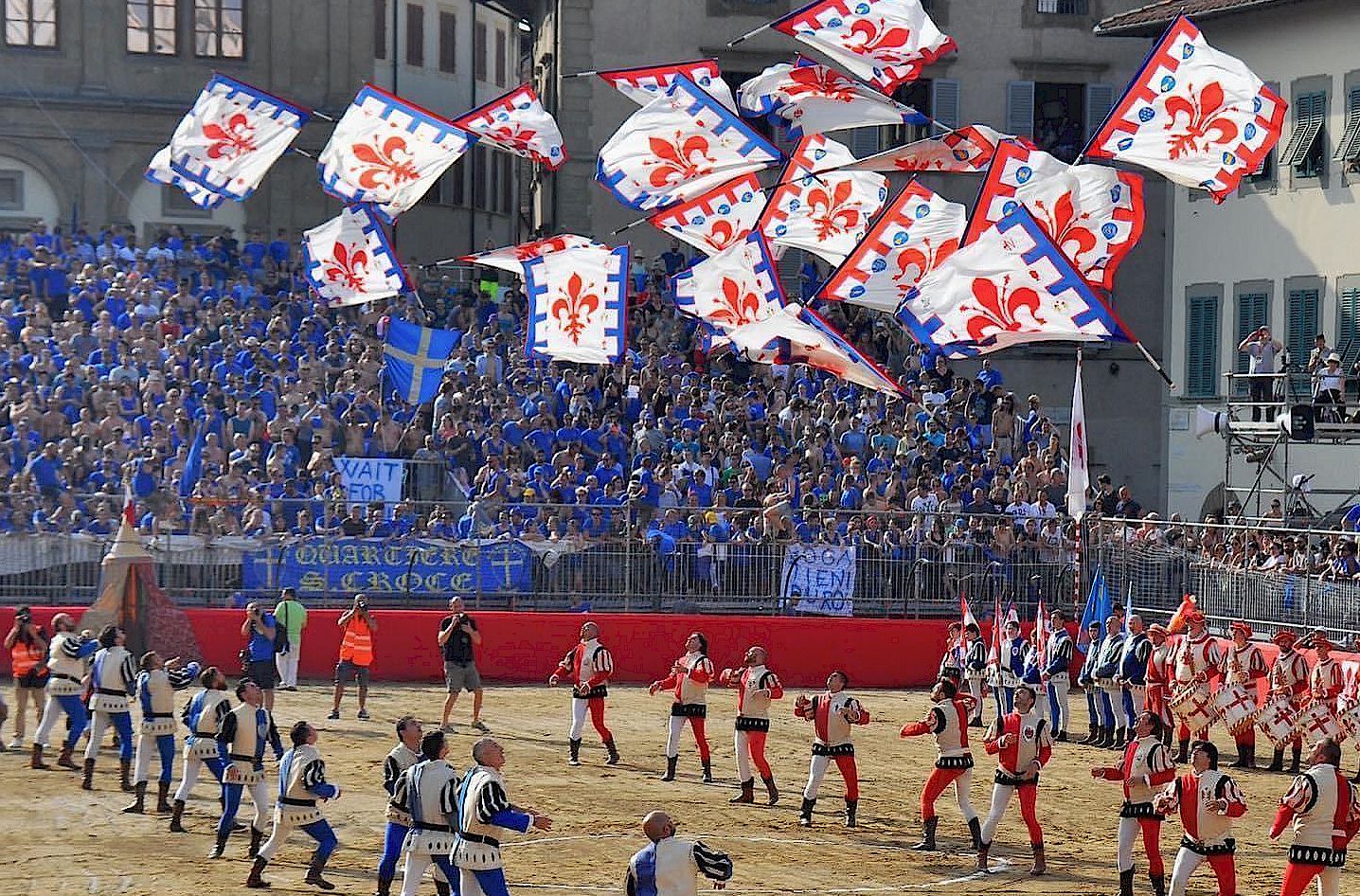
I guess almost every one has heard of the Calcio Storico Fiorentino, and in fact it's worth seeing this spectacle (once). Also don't forget that before the calcio itself there will be a splendid display of Tuscany flag throwing. Another Tuscan speciality that is well worth seeing, either on this occasion or another.

Flag throwers at the Calcio Storico Fiorentino in Florence

Flag throwers at the Calcio Storico Fiorentino in Florence

The Calcio Storico Fiorentino originated in the 16C in Florence and is played today in historical costume. The four teams are: Santa Croce (Azzurri, or Blues), Santo Spirito (Bianchi, or Whites), Santa Maria Novella (Rossi, or Reds), and San Giovanni (Verdi, or Greens). The game was invented by rich aristocreats and took place every night between Epiphany and Lent. The rules of the Calcio Storico were first published in 1580 by Giovanni de’ Bardi. These days it's a somewhat rougher event - actually, brutal is the appropriate expression and I sometimes wonder whether there are any "rules" at all. It's even rumoured that some players are released from jail for a day to participate - I don't think that's true.

On 24 June at 4 pm, the feast day of St. John the Baptist, the patron saint of Florence, a spectacular parade in historical costume starts in Piazza Santa Maria Novella and wends its way through the centre of Florence to Piazza Santa Croce. The four contrade of Florence are represented and you’ll see the players going by as they go to play the final, even those who won’t be playing the final. The parade starts roughly around 4pm since the final should start around 5 pm.

Calcio Storico Fiorentino 2022

To watch the match in Piazza Santa Croce, you need a ticket and they don't come cheap. Tickets cost €80 for Tribuna Onore Centrale, €60 for Tribuna Onore Laterale, €40 for Tribuna C and €29 Curve colori. These need to be bought in advance at the headquarters of BoxOffice Toscana on via delle Vecchie Carceri, 1, or at Teatro Verdi.

These are the hours:

  • Monday 6 June from 4 pm BoxOffice (at 9 am can pick up numbers for line) 
  • Tuesday, Wednesday and Thursday7, 8, 9 June 9 am - 4 pm BoxOffice
  • Friday, 10 June from 12 - 7 pm only at Teatro Verdi (Via Ghibellina 99)
  • Saturday 11 June at Teatro Verdi, from 12 - 6 pm.
You can also watch on Toscana TV, channel 18, and various streaming services.

Tuscany Toscana
Don't forget to visit my Tuscany
Travel Guide!

Up-to-date news on what to see and where to stay in Chianti and all of Tuscany.

Tuscany Travel Guide

vacation accommodations in Tuscany


Author: Anna Maria Baldini

All content copyright © ammonet Italian Web Site Promotion 2022. All rights reserved.

Wednesday, 18 May 2022

Open gardens day in Florence: Cortili e Giardini Aperti a Firenze

As my faithful readers will remember, I am an enthusiast for the formal gardens of Tuscany, especially those of the larger villas of Tuscany. I therefore always look forward to Open gardens day in Florence (Cortili e Giardini Aperti a Firenze) which in 2022, takes place on 22 May, when the private gardens of Florence are open to the public - see the list here. In 2018, I took the opportunity to visit some gardens in the Oltrarno which I either hadn't seen before at all or only a long time ago.

The one I want to describe in some detail is the Giardino San Francesco di Paola which extends upwards and away from the former home of Harry Brewster, "the last of the cosmopolites of Florence". Brewster, a descendent of William Brewster of the Mayflower, was also the grandson, on his mother's side, of the German sculptor Adolf von Hildebrandt, whose studio occupied part of the former Minimite convent of San Francesco di Paola. The convent is located at the foot of Bellosguardo, the beautiful hill that dominates the Oltrarno. It was an evocative experience for me to walk up Via Villani to the circular Piazza San Francesco di Paola. Although there are 19 C and modern buildings on two sides of the piazza, the old church and the wall and gate of the convent are still there, just as described by Brewster. The main structure was long ago divided up into apartments and, alas, the building is looking much the worse for wear. Indeed, so are some of the remaining Hildebrandt sculptures standing in the loggia at the back of the villa.

Villa of San Francesco di Paola
The loggia of the Villa of San Francesco di Paola - much in need of some restoration

However, the garden is beautifully kept up, as is the hay shed (fienile) which Brewster converted into a neat, strangely English-looking, cottage covered in roses and surrounded by a small lawn, where he himself lived in frugal simplicity writing his books. One continues up a series of irregular steps to Brewster's beloved belvedere from which there is a beautiful view of Florence, which because of its lower altitude, is almost more beautiful than the vista from the top of Bellosguardo.

Giardino San Francesco di Paola
View of Florence from the belvedere in the Giardino San Francesco di Paola

Next I walked to entrance of the Giardini Torrigiani not far from the Pitti palace. I have often passed the fine iron gates of these gardens - little did I know that there are 17 acres of gardens hidden behind the walls in the centre of the Oltrarno. In fact, the Torrigiani gardens are the largest private gardens within city limits in all Europe.

Torrigiani gardens in Florence, Italy
A view of a small part of the Torrigiani Gardens, In Florence

The Torrigiani gardens were originally planted by the founder of the Italian Botanical Society, the oldest such society, and the garden still has an uncommonly wide variety of trees, especially exotic species, in keeping with its 19 C “English Landscape” style. The gardens were designed at the height of the Romantic movement in the early 19 C, forming an idyllic oasis of green around the original 16 C villa. The garden hosts rare tree species, wide English-style lawns, herb and vegetables gardens, sculpted lions, a beautifully restored greenhouse and remains of the city walls built under Cosimo I in 1544. The layout of the garden is also profoundly symbolic and I strongly advise visiting it with a good Tuscan garden guide book in hand.

Giardino Torrigiani a Firenze
The astronomical tower in the Torrigiani gardens

Last but not least, I visited that exquisite jewel of a garden, the Giardino Corsi Annalena, nearby on via Romana. This garden is located on land formerly owned by the monastery of San Vincenzo which was founded in around 1441 by Countess Anna Elena (Annalena) Malatesta. During the long struggle for supremacy between Florence and Sienna, the area was dominated by the fortifications created by Cosimo I de’ Medici, including an underground passage that until this day connects the Boboli, Corsi and Torrigiani gardens. Following the destruction of the fortifications in 1571, the area was left abandoned for many years. In 1790, the Marquis Tommaso Corsi purchased the land, then known as the "Moors’ Garden", and the architect Giuseppe Manetti designed what can be considered the first English garden in Florence. It was completed during the years 1801 to 1810. If you have the chance to visit this beautiful garden, please don't miss it.

Giardino Corsi Annalena in Florence
The Giardino Corsi Annalena in Florence


Tuscany Toscana
Don't forget to visit my Tuscany
Travel Guide!

Up-to-date news on what to see and where to stay in Chianti and all of Tuscany.

Tuscany Travel Guide


vacation accommodations in Tuscany

Author: Anna Maria Baldini

All content copyright © ammonet Infotech website promotion 2015 - 2022. All rights reserved.