Showing posts with label Cortona. Show all posts

Friday, 19 February 2016

A fascinating Etruscan exhibition in Cortona focussed on the interpretation of Etruscan script

From 19 March 2016 until 31 July 2016, a fascinating Etruscan exhibition focussed on the script used in Etruscan writing is taking place at the Museo dell'Accademia Etrusca e della Città di Cortona, in Cortona - itself an Etruscan foundation, site of several Etruscan tombs and a member of the Etruscan dodecapoli. I strongly recommend this exhibition to anyone with an interest in this fascinating people.

Etruscan tessera d'ospitalità
The aspect of the Etruscan language that most immediately springs to mind is that even now, despite intensive study, it is still not well understood, even though it can be read fairly easily when written down, as it usually is, in a variant of the Greek alphabet. This is especially the case with regard to the specific meanings of individual words, which are unrelated to the vocabulary of the Indo-European languages such as the Greek and Latin. This reduced level of comprehension of the Etruscan language is the result of the paucity of extant long texts - the entire Etruscan literary corpus has been lost - and of the brevity and repetitiveness of Etruscan funerary, legal and commercial texts.This has helped to create an aura of mystery around the Etruscan language and the Etruscan people. The mystery of the origin of the Etruscans draws nourishment from a language that seemed incomprehensible and archaic, even to contemporary ears. In addition, this air of mystery was exacerbated by 19th century archaeological excavations that were mainly investigations of graves and everything that goes with them, including the meticulous Etruscan funerary rituals in preparation for the afterlife. Lists of Etruscan gods and goddesses are well-established, but little else.

Etruscan perfume jar
The spread of Etruscan language and its script is an unusual topic since we (or, anyway, I) generally think of the Etruscans as a static people whiling away their time quaffing wine and playing double pipes in the Tuscan sunshine. However, it seems there was probably a degree of diffusion of the Etruscan language through conquests, trade contacts and, especially, the spread of Etruscan religion around the Mediterranean basin between the 7th century and the 1st century BC. Recent discoveries of Etruscan inscriptions at a site near Lattes, in the south of the prefecture of Montpellier, suggest the presence of Etruscan merchants in France, possibly for an extended period. It is even possible that Germanic runes (Futharc) are derived from the Etruscan alphabet.

Etruscan Tabula cortonensis
This exhibition and its catalogue beautifully illustrate the latest research in the field of of Etruscan syntax, grammar and vocabulary, based on numerous inscriptions, some of them completely new. Some major examples of Etruscan epigraphy are displayed together for the first time. Progress in the comprehension of the Etruscan language was assisted by the discovery in Cortona a few years ago of the Tabula cortonensis, the third longest Etruscan text so far known (after the Liber lintaeus of Zagreb and the Capua Tablet). The Tabula cortonensis is a land transfer agreement, some 40 lines long.  Of the longer inscriptions, the most important is the Zagreb mummy wrapping or Liber Lintaeus found in Egypt in the 19th century and carried back to Yugoslavia by a traveler. It had originally been a book made of linen, which was cut up into strips to be wrapped around a mummy. With about 1,300 words, written in black ink on the linen, it is the longest existing Etruscan text. It contains a calendar and instructions for sacrifice, which are sufficient to convey some idea of Etruscan religious literature.

Etruscan liber lintaeus
Of course, bilingual texts are the key to interpretation of an unknown language, and for Etruscan there is a single important example, namely the Pyrgi Lamellae, two inscribed gold plaques found at the site of the ancient sanctuary of Pyrgi, the port city of Caere, modern Cerveteri, 50-60 km NNW of Rome. These plates provide two texts of significant length (about 40 words) and of similar content, one in Etruscan and the other in Phoenician. They offer substantial data for the elucidation of Etruscan by way of Phoenician, a known language. The find is also an important historical document that records the dedication to the Phoenician goddess Astarte of a "sacred place" in the Etruscan sanctuary of Pyrgi by Thefarie Velianas, king of Caere, early in the 5th century BC.

The Etruscan Pyrgi Lamellae


My review of the Etruscan exhibition in Cortona, March through July 2014.


Tuscany Toscana
Don't forget to visit my Tuscany
Travel Guide!

Up-to-date news on what to see and where to stay in Chianti and all of Tuscany.

Tuscany Travel Guide


vacation accommodations in Tuscany

Author: Anna Maria Baldini

All content copyright © ammonet Infotech website promotion 2016. All rights reserved.

Saturday, 22 March 2014

Etruscan exhibition in Cortona, March through July 2014

A not to be missed Etruscan exhibition in Cortona has just opened!

Etruscan Enchantment. From the secrets of Holkham Hall to the wonders of the British Museum.

Palazzo Casali, Cortona. 22 March through 31 July 2014.
 
Etruscan exhibition in Cortona, March through July 2014
Etruscan terracotta head from the Etruscan exhibition in Cortona, March through July 2014
Cortona was one of the cities making up the Etruscan Dodecapoli league and parts of the Etruscan walls and gateways, as well as several Etruscan tombs are still to be seen there. In 1727, inspired by the publication of Dempster's De Etruria Regali, the Etruscan Academy was founded in Cortona by three brothers, Marcello, Filippo and Ridolfino Venuti. With the foundation of a museum that houses splendid Etruscan artifacts, the Etruscan Academy of Cortona became the first institution in Europe that specialised in the rediscovery and study of the Etruscans. In 2005, the museum was doubled in size to become the Museum of the Etruscan Academy and of the City of Cortona (MAEC).

During the second quarter of 2014, there is an excellent exhibition devoted to the Etruscans taking place at MAEC in Cortona. This exhibition, Etruscan Enchantment. From the secrets of Holkham Hall to the wonders of the British Museum, was inspired by recent archival finds related to the Grand Tour of Thomas William Coke, 1st Earl of Leicester (1754 – 1842). During the first years of the 18 C., Coke, known as Coke of Norfolk or Coke of Holkham and who later became an immensely popular MP and an agricultural reformer, was sent on the Grand Tour by his father and his great-aunt. The latter offered him £500 to not go to university, which she regarded as a den of vice, and he used the money to finance his tour.

Bronze masterpiece of Etruscan art at the Cortona Etruscan exhibition
Bronze masterpiece of Etruscan art at the Cortona exhibition

Coke was entranced by the Etruscan artifacts that he saw in Italy, both in public displays and private collections. Upon his return to England, he organised and paid for the publication, in 1726, of the manuscript De Etruria Regali by Thomas Dempster (1579 – 1625). A century earlier, Dempster had been the first to assemble a history of the Etruscan people, creating the first “handbook of Etruscology” and summarising everything that was known about Etruscan civilisation up to that time. Dempster was a Cambridge-educated and very quarrelsome Scotch aristocrat. Recommended by Pope Paul V, who had previously incarcerated him as a spy (which he probably was), Dempster eventually found refuge and patronage under Grand Duke Cosimo II. The latter made him a professor in Pisa and commissioned his work on the Etruscans. After three years of intense research, Dempster presented Cosimo with his magnum opus, the manuscript of De Etruria Regali Libri Septem, "Seven Books about Royal Etruria", written in Latin. It was considered a brilliant work by all who saw it.
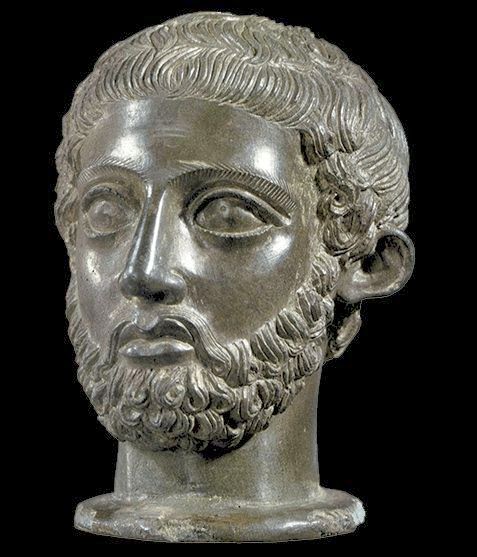
Etruscan bronze portrait bust at the Cortona exhibition
Etruscan bronze portrait bust
After publication, the manuscript remained at Coke's Holkham Hall and recently the preparatory drawings and copper plates used for the printing of the De Etruria were found in the archives there. These illustrations formed the inspiration for the present exhibition which shows many of the drawings and paintings from Holkham Hall plus over fifty works from the British Museum, never lent before, and many more from Etruscan museum galleries all around Italy.

Etruscan ceramic from the Cortona exhibition

The exhibition recreates the atmosphere of excitement that followed the publication of De Etruria, and documents the role of the Grand Tour to Italy in the 18 C and 19 C, and the fascination with the Etruscans and the Etruscan style in Britain during that period. It presents to the public for the first time ever some iconic masterpieces of that ancient people - such as the Aule Metele and the Graziani Putto - alongside the original drawings for De Etruria as well as the Etruscan masterpieces gathered together by the British Museum during the course of three centuries. Many of these Etruscan artifacts are wonderful works of art in their own right, and displayed together form a show that should not be missed.

Exhibition website.

The Etruscans – who were they and where did they come from?

Vacation accommodation in Tuscany
www.bella-toscana.com


All content copyright © ammonet Italian Web Site Promotion 2014. All rights reserved.