Showing posts with label Etruscans. Show all posts

Monday, 20 April 2026

Stay in Fiesole when you visit Florence

The most popular months to visit Florence are also tend to be hot and unfortunately visitors experience that heat not just while staggering around the sights of Florence, but also when they're trying to sleep. There is a solution. Find your vacation accommodations in Fiesole!

View of Fiesole above Florence

View of Fiesole above Florence

A bit of history. The Etruscans lived where Fiesole is now - they called it Vipsul - in large part because they were hedonists who enjoyed the good life, especially cool breezes during mid-summer. The Romans were made of sterner stuff. They built their colony down below in the stifling Arno valley where they could tax north-south traffic that crossed the river over the bridge they built there. This was Florentia, founded around 59 BC, most likely under Julius Caesar, to settle veterans in the Arno valley. Needless to say, the better classes of Roman society migrated to their country houses up in Fiesole during summer. They even built themselves a nice theatre up there.

Roman theatre in Fiesole

Roman theatre in Fiesole.

You should consider a stay in Fiesole when you visit Florence. Forget the humid heat at midnight, forget the tour group on the doorstep at 7am, forget the queue at your favorite restaurant, forget a street full of drunk twenty-year-olds below the window until 2am. Instead, after a cool, quiet night of sleep, you walk out of your hotel or B&B and onto a quiet piazza where old men are playing cards outside the bar.  A three-star hotel in Fiesole with a view over Florence costs what a two-star in the centro storico of Florence costs without the view. An agriturismo on the slopes between Fiesole and the city often costs less than a standard hotel room in the historic centre of Florence. From the terrace behind the Fiesole cathedral, Florence unfolds below - the Duomo, the Campanile, the Arno, the hills on the far side.

View of Florence from Fiesole

 View of Florence from Fiesole

What about getting from Fiesole to Florence and back? 

Don't take your car, if you have one. You don't need to grapple with traffic, one way streets and ZTLs. Take the line 7 bus from Piazza Mino in Fiesole to Ponte Rosso and then take the T2 tram to Piazza San Marco in central Florence. Buy a single ATAF ticket from the ticket-dispensing machine (cash or touch your credit card to the machine) or from any tabaccheria before you board, or a day pass if you plan to come and go twice. Don't forget to validate your ticket as you enter the bus. Sit on the left side going down for the view. You can even walk down, starting on Via Vecchia Fiesolana, all the way to Florence in about 90 minutes. The fastest way to get from Fiesole to Florence is to taxi which takes 13 min and costs €12 - €15.

Note that I don't recommend that you try to return to Fiesole on foot! The line 7 bus from Ponte Rosso to Fiesole Piazza Mino takes 18 min and departs every 20 minutes.

Tuscany Quintessence eBike tour of Fiesole from Florence

 Tuscany Quintessence eBike tour of Fiesole from Florence

HOWEVER I can and do highly recommend the Tuscany Quintessence eBike guided tour from Florence to Fiesole and back.

More about the Tuscany Quintessence eBike tour of Fiesole from Florence.

What to see and do in Fiesole.

Tuscany Toscana
Don't forget to visit my Tuscany
Travel Guide!

Up-to-date news on what to see and where to stay in Chianti and all of Tuscany.

Tuscany Travel Guide

vacation accommodations in Tuscany


Author: Anna Maria Baldini

All content copyright © ammonet Italian Web Site Promotion 2013 - 2026. All rights reserved.

Sunday, 20 February 2022

The Roman origin of the street plan of central Florence

I think everyone knows that Florence was founded by the Romans - and not by the Etruscans, who established themselves in the cooler heights at Fiesole. Perhaps not everyone is aware of the Roman origin of the street plan of central Florence.

Florence was founded by the veterans of Julius Caesar's legions, to whom, in 46 BC, under the Lex Julia Agraria, cultivatable land was assigned as part of their severance pay. As with a great many newly created Roman towns, Florentia was laid out by the ex-legionaries with the same ground plan as a military castrum (camp), meaning a rectangle crossed by two main roads: the cardo, from north to south and the decumano from east to west. New Roman towns followed this format wherever the terrain allowed it, and excellent examples are scattered all over the flat coastal regions of North Africa, for example, and, closer to home, the Roman city of Casulae in Umbria. As with many other Roman towns, the location was very probably determined by the option to build a bridge, in this case across the Arno, very near where the Ponte Vecchio is today, with the aim of both protecting and taxing a popular river crossing on the via Cassia trade route.

Today, in the centre of Florence, visitors can easily detect evidence of the ancient settlement. Florentia was originally a rectangular area of about 450 m by 550 m, in which all the roads still meet at right angles and are divided by via Roma-via Calimala (from north to south) and via Strozzi-via degli Speziale-via del Corso (from east to west) that meet in the centre, where the forum was located and where today we find the Piazza della Repubblica. The urban perimeter stretched from via Tornabuoni to via Proconsolo (west to east), and from Via Cerretani - piazza del Duomo to piazza della Signoria (north to south). The main buildings of the city were the temples dedicated to Jupiter, Juno, and Minerva, the forum, the amphitheatre, the theatre, the public baths, the temple of Isis and the temple consecrated to Mars.

Location in modern Florence of the Roman town of Florentia.

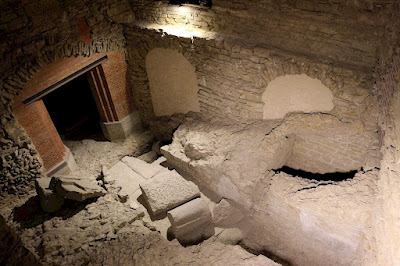
The Roman theatre of Florentia was located more or less where the Palazzo Vecchio stands today, some 4 m above the level of the Roman town. There are remains of the public baths are under Torre della Pagliazza, and other remnants have been excavated under the Duomo and under the Baptistery.

Remains of the Roman theatre under the Palazzo Vecchio in Florence.

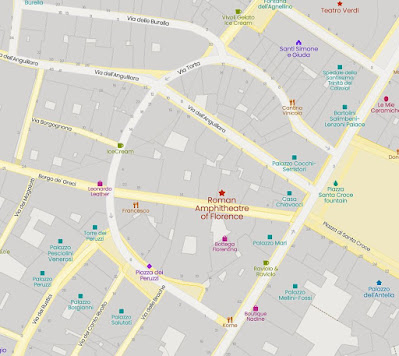
Between Piazza della Signoria and Piazza Santa Croce there is a curiously curved street, via Torta, which originated as part of the perimeter of the Roman amphitheatre. The latter had a diameter of 125 m, with a capacity of 20,000 seats. It was built in the 130 AD outside the walls and marked the point of maximum expansion of the town to the east. More of the outline of the amphitheatre is preserved in the curved Piazza dei Peruzzi.

Location of the Roman amphitheatre in Florence.

 
Roman streets in Florence
 

During the rule of the Emperor Hadrian, Florentia was enlarged, and by the 3 C it was a successful commercial centre. In 287, it became the capital of the region Tuscia et Umbria, and in 405 it was able to withstand the sieges of the Ostrogoths.

More complete Roman (and Etruscan) ruins can be visited in Fiesole where there were Roman baths and a Roman theatre.


Tuscany Toscana
Don't forget to visit my Tuscany
Travel Guide!

Up-to-date news on what to see and where to stay in Chianti and all of Tuscany.

Tuscany Travel Guide

vacation accommodations in Tuscany


Author: Anna Maria Baldini

All content copyright © ammonet Italian Web Site Promotion 2022. All rights reserved.

Friday, 20 December 2019

Roselle and Grosseto in the Tuscan Maremma: an ancient Etruscan town and a modern cathedral city in Tuscany

Roselle is a picturesque, Etrusco-Roman ruin located on the boundary between the valley of Ombrone and the Maremma, on the shore of the ancient lake Prile (Lacus Prelius). The ruins are about 15 km SE of Vetulonia, another Etruscan site, and 8 km NE of Grosseto, the largest town in this part of Tuscany.

Remains of the Roman amphitheatre at Roselle in the Tuscan Maremma

The relationship between Roselle and Grosseto is quite interesting - to a large extent, Roselle is the ancestor of Grosseto.

Roselle (Rusellae) stood and, as a ruin, still stands on two hills separated by a valley that formed its political, economic and religious nucleus. The area has been frequented humans since prehistoric times, but Roselle became a real city when it was settled by the Etruscans, in the 7 C BC. Roselle was among the Etruscan cities that were not members of the Etruscan Dodecapoli.

In 294 BC, Roselle was conquered by the Romans, led by the consul Lucio Postumio Megelio. Its flowering began in the first century AD. Thanks to the imperial favour and the work of some munificent families of local patrons, there was intense building activity at this time, that extended throughout the county.

From the late imperial age, Roselle was affected by the same decadence that struck numerous Roman cities. Archaeologists have been able to identify signs of this recession in the contraction of the urban area and in the numerous cases of re-use and abandonment of the oldest structures. Roselle was unable to recover its modest but not unimportant status in Tuscany, despite its role as a bishopric.

In fact, it was at Roselle that the first cathedral of this bishopric stood, at least from the 5 C AD, when Bishop Vitaliano participated in the Roman Synod of 499. The first building was built on the remains of a thermal baths complex dating from between the 1st and 2nd centuries AD, on the slopes of the northern part of the city and was subjected to various reconstructions, such as the imposing Romanesque phase, characterised by the bell tower of which the foundations may still be seen.

The Duomo of Grosseto

The spiritual and administrative center of the diocese was, however, transferred in 1138 to nearby Grosseto, by a bull issued by Pope Innocent II. Thus, from the 12 C the city of Roselle was gradually abandoned and its remains reused as building or decorative materials elsewhere. Some of them were used to embellish the new Duomo and others were generally transported to Grosseto. Some architectural remains have been recovered and displayed in the Museum and in the Archaeological Garden or form part of the Grosseto street decorations, to illustrate the close link with ancient Roselle.

decorated stone element from Roselle
Decorated stone element from Roselle

More about the Maremma.

More about Grosseto

Tuscany Toscana
Don't forget to visit Elena Spolaor's
Travel Guide!

Up-to-date news on what to see and where to stay in Chianti and all of Tuscany & Umbria.

Chianti Travel Guide

Author: Anna Maria Baldini

All content copyright © ammonet Web Site Promotion 2019 - 2020. All rights reserved.

Friday, 19 February 2016

A fascinating Etruscan exhibition in Cortona focussed on the interpretation of Etruscan script

From 19 March 2016 until 31 July 2016, a fascinating Etruscan exhibition focussed on the script used in Etruscan writing is taking place at the Museo dell'Accademia Etrusca e della Città di Cortona, in Cortona - itself an Etruscan foundation, site of several Etruscan tombs and a member of the Etruscan dodecapoli. I strongly recommend this exhibition to anyone with an interest in this fascinating people.

Etruscan tessera d'ospitalità
The aspect of the Etruscan language that most immediately springs to mind is that even now, despite intensive study, it is still not well understood, even though it can be read fairly easily when written down, as it usually is, in a variant of the Greek alphabet. This is especially the case with regard to the specific meanings of individual words, which are unrelated to the vocabulary of the Indo-European languages such as the Greek and Latin. This reduced level of comprehension of the Etruscan language is the result of the paucity of extant long texts - the entire Etruscan literary corpus has been lost - and of the brevity and repetitiveness of Etruscan funerary, legal and commercial texts.This has helped to create an aura of mystery around the Etruscan language and the Etruscan people. The mystery of the origin of the Etruscans draws nourishment from a language that seemed incomprehensible and archaic, even to contemporary ears. In addition, this air of mystery was exacerbated by 19th century archaeological excavations that were mainly investigations of graves and everything that goes with them, including the meticulous Etruscan funerary rituals in preparation for the afterlife. Lists of Etruscan gods and goddesses are well-established, but little else.

Etruscan perfume jar
The spread of Etruscan language and its script is an unusual topic since we (or, anyway, I) generally think of the Etruscans as a static people whiling away their time quaffing wine and playing double pipes in the Tuscan sunshine. However, it seems there was probably a degree of diffusion of the Etruscan language through conquests, trade contacts and, especially, the spread of Etruscan religion around the Mediterranean basin between the 7th century and the 1st century BC. Recent discoveries of Etruscan inscriptions at a site near Lattes, in the south of the prefecture of Montpellier, suggest the presence of Etruscan merchants in France, possibly for an extended period. It is even possible that Germanic runes (Futharc) are derived from the Etruscan alphabet.

Etruscan Tabula cortonensis
This exhibition and its catalogue beautifully illustrate the latest research in the field of of Etruscan syntax, grammar and vocabulary, based on numerous inscriptions, some of them completely new. Some major examples of Etruscan epigraphy are displayed together for the first time. Progress in the comprehension of the Etruscan language was assisted by the discovery in Cortona a few years ago of the Tabula cortonensis, the third longest Etruscan text so far known (after the Liber lintaeus of Zagreb and the Capua Tablet). The Tabula cortonensis is a land transfer agreement, some 40 lines long.  Of the longer inscriptions, the most important is the Zagreb mummy wrapping or Liber Lintaeus found in Egypt in the 19th century and carried back to Yugoslavia by a traveler. It had originally been a book made of linen, which was cut up into strips to be wrapped around a mummy. With about 1,300 words, written in black ink on the linen, it is the longest existing Etruscan text. It contains a calendar and instructions for sacrifice, which are sufficient to convey some idea of Etruscan religious literature.

Etruscan liber lintaeus
Of course, bilingual texts are the key to interpretation of an unknown language, and for Etruscan there is a single important example, namely the Pyrgi Lamellae, two inscribed gold plaques found at the site of the ancient sanctuary of Pyrgi, the port city of Caere, modern Cerveteri, 50-60 km NNW of Rome. These plates provide two texts of significant length (about 40 words) and of similar content, one in Etruscan and the other in Phoenician. They offer substantial data for the elucidation of Etruscan by way of Phoenician, a known language. The find is also an important historical document that records the dedication to the Phoenician goddess Astarte of a "sacred place" in the Etruscan sanctuary of Pyrgi by Thefarie Velianas, king of Caere, early in the 5th century BC.

The Etruscan Pyrgi Lamellae


My review of the Etruscan exhibition in Cortona, March through July 2014.


Tuscany Toscana
Don't forget to visit my Tuscany
Travel Guide!

Up-to-date news on what to see and where to stay in Chianti and all of Tuscany.

Tuscany Travel Guide


vacation accommodations in Tuscany

Author: Anna Maria Baldini

All content copyright © ammonet Infotech website promotion 2016. All rights reserved.

Saturday, 22 March 2014

Etruscan exhibition in Cortona, March through July 2014

A not to be missed Etruscan exhibition in Cortona has just opened!

Etruscan Enchantment. From the secrets of Holkham Hall to the wonders of the British Museum.

Palazzo Casali, Cortona. 22 March through 31 July 2014.
 
Etruscan exhibition in Cortona, March through July 2014
Etruscan terracotta head from the Etruscan exhibition in Cortona, March through July 2014
Cortona was one of the cities making up the Etruscan Dodecapoli league and parts of the Etruscan walls and gateways, as well as several Etruscan tombs are still to be seen there. In 1727, inspired by the publication of Dempster's De Etruria Regali, the Etruscan Academy was founded in Cortona by three brothers, Marcello, Filippo and Ridolfino Venuti. With the foundation of a museum that houses splendid Etruscan artifacts, the Etruscan Academy of Cortona became the first institution in Europe that specialised in the rediscovery and study of the Etruscans. In 2005, the museum was doubled in size to become the Museum of the Etruscan Academy and of the City of Cortona (MAEC).

During the second quarter of 2014, there is an excellent exhibition devoted to the Etruscans taking place at MAEC in Cortona. This exhibition, Etruscan Enchantment. From the secrets of Holkham Hall to the wonders of the British Museum, was inspired by recent archival finds related to the Grand Tour of Thomas William Coke, 1st Earl of Leicester (1754 – 1842). During the first years of the 18 C., Coke, known as Coke of Norfolk or Coke of Holkham and who later became an immensely popular MP and an agricultural reformer, was sent on the Grand Tour by his father and his great-aunt. The latter offered him £500 to not go to university, which she regarded as a den of vice, and he used the money to finance his tour.

Bronze masterpiece of Etruscan art at the Cortona Etruscan exhibition
Bronze masterpiece of Etruscan art at the Cortona exhibition

Coke was entranced by the Etruscan artifacts that he saw in Italy, both in public displays and private collections. Upon his return to England, he organised and paid for the publication, in 1726, of the manuscript De Etruria Regali by Thomas Dempster (1579 – 1625). A century earlier, Dempster had been the first to assemble a history of the Etruscan people, creating the first “handbook of Etruscology” and summarising everything that was known about Etruscan civilisation up to that time. Dempster was a Cambridge-educated and very quarrelsome Scotch aristocrat. Recommended by Pope Paul V, who had previously incarcerated him as a spy (which he probably was), Dempster eventually found refuge and patronage under Grand Duke Cosimo II. The latter made him a professor in Pisa and commissioned his work on the Etruscans. After three years of intense research, Dempster presented Cosimo with his magnum opus, the manuscript of De Etruria Regali Libri Septem, "Seven Books about Royal Etruria", written in Latin. It was considered a brilliant work by all who saw it.

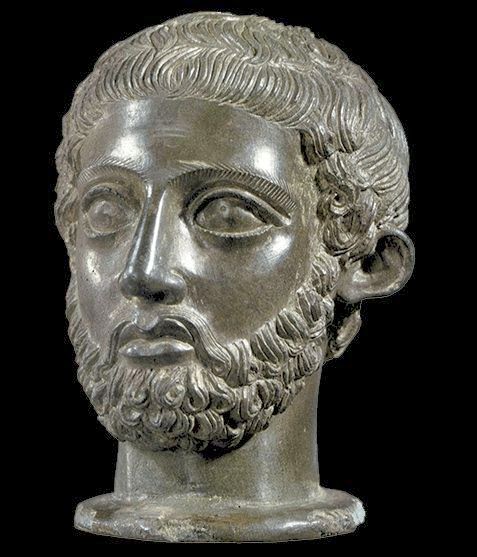
Etruscan bronze portrait bust at the Cortona exhibition
Etruscan bronze portrait bust
After publication, the manuscript remained at Coke's Holkham Hall and recently the preparatory drawings and copper plates used for the printing of the De Etruria were found in the archives there. These illustrations formed the inspiration for the present exhibition which shows many of the drawings and paintings from Holkham Hall plus over fifty works from the British Museum, never lent before, and many more from Etruscan museum galleries all around Italy.

Etruscan ceramic from the Cortona exhibition

The exhibition recreates the atmosphere of excitement that followed the publication of De Etruria, and documents the role of the Grand Tour to Italy in the 18 C and 19 C, and the fascination with the Etruscans and the Etruscan style in Britain during that period. It presents to the public for the first time ever some iconic masterpieces of that ancient people - such as the Aule Metele and the Graziani Putto - alongside the original drawings for De Etruria as well as the Etruscan masterpieces gathered together by the British Museum during the course of three centuries. Many of these Etruscan artifacts are wonderful works of art in their own right, and displayed together form a show that should not be missed.

Exhibition website.

The Etruscans – who were they and where did they come from?

Vacation accommodation in Tuscany
www.bella-toscana.com


All content copyright © ammonet Italian Web Site Promotion 2014. All rights reserved.