Showing posts with label Firenze. Show all posts

Saturday, 3 January 2026

The Fra Angelico exhibition in Florence - last days

It's only a couple of days ago that I was able to visit the marvellous Fra Angelico exhibition currently on show at the San Marco Museum and the Strozzi Palace in Florence. The exhibition is in its final days and will end on 25 January 2026, so if you are in Florence now or have the possibility to be here before then, don't hesitate - this is an amazing display of the works of Fra Angelico of Fiesole (ca. 1395 - 1455) and other artists associated with him and his times. Fra Angelico was born around 1395, named Guido di Pietro, in the Tuscan area of Mugello near Fiesole, not far from Florence. He was one of the greatest painters of the late Gothic and early Renaissance during the 15C, his only competitor, and perhaps superior, in painting during the first part of his life being Masaccio who died at age 26, and Fra Filippo Lippi later. For this exhibition the organisers have gathered over 140 works from Florence and around the world. The exhibition catalogue follows the layout of the exhibition closely and contains illustrations of many of the works on display. Despite its expense (€80), the catalogue is indispensable. (I suspect it will show up on Amazon at a substantial discount after the exhibition closes.) I recommend that you book a time slot first for San Marco since the museum is open only in the morning, and then go on to Palazzo Strozzi after lunch, if you plan to see the entire exhibition in one day.

Fra Angelico exhibition catalogue 
 
In this review, I'll emphasize some aspects of Fra Angelico's artistic output and other items on display that especially interested me and which might be less familiar to my faithful readers.


San Marco Museum


All of Fra Angelico's admirers as well as huge numbers of other art enthusiasts will already be familiar with the frescoes he painted in the monks' cells in the Monastery of San Marco by commission of his first and greatest patron, Cosimo de Medici, the Elder. These frescoes form the major part of the exhibition at San Marco. 
 
Fra Angelico: fresco in cell 7, The Mocking of Christ
 
In addition, there is a small but absorbing exhibition of items associated with the fanatical monk, Savonarola (1452 - 1498) who occupied Fra Angelico's former cell some thirty years after Fra Angelico had left the monastery. The famous portrait of Savonarola by Fra Bartolomeo can be viewed close up alongside an extremely expressive terracotta bust of Savonarola attributed to Marco della Robbia, later Fra Mattia (1468-1534). The display also includes a manuscript written by Savonarola in exquisite and minute script - BE SURE TO BRING A LARGE MAGNIFYING GLASS WITH YOU (see the next paragraph).

Bust of Savonarol by Marco della Robbia
Terracotta bust of Savonarola attributed to Marco della Robbia 


The San Marco Monastery Library


The libary of the Monastery of San Marco in Florence
The San Marco Library during the Fra Angelico Exhibition.
 
Not everyone realises that Fra Angelico was a skilled miniaturist and illustrator of illuminated manuscripts and this aspect of his artistic output should definitely not be thought of as being somehow a secondary activity, as indeed the exquisite examples of his illuminations on display in the library of San Marco Monastery demonstrate. Looking into the library from the main door, on the left are manuscripts and other sheets containing work by Fra Angelico while on the right are manuscripts that originally belonged to the library but which have been dispersed around the world following the depredations of Napoleon. Many of the manuscripts are humanistic works, some of them collected by the Medici family and donated to the library. The miniatures deserve to be examined under a magnifying glass in many cases. One example, which I can't find in the exhibition catalogue, is the only significant surviving page, the frontispiece, from Silius Italicus: De bello punico, 1450, a manuscript poem in the Biblioteca Nazionale Marciana, illuminated by most likely by Zanobi Strozzi, who was strongly influenced by Fra Angelico. (Click the image to study the details, especially the birds.)
 
Silius Italicus: De bello punico. 1450 Manuscript Biblioteca Nazionale Marciana, Venice

Another example, Saint Thomas Aquinas lecturing, from an Antiphonary for the Proper of Time, by Fra Angelico and collaborators, dating from about 1440-42.


The Strozzi Palace

The major part of the exhibition is located at the Palazzo Strozzi where almost all of the surviving major works by Fra Angelico are displayed. This part of the exhibition provides excellent insight into Fra Angelico’s artistic development and influence, and his relationship to painters such as Lorenzo Monaco, Masaccio, and Filippo Lippi, as well as sculptors like Lorenzo Ghiberti, Michelozzo, and Luca della Robbia.

Coronation of the Virgin painted for the Santa Maria Novella in Florence
Fra Angelico: the Coronation of the Virgin painted for the Church of Santa Maria Novella
 
When we first see the Coronation of the Virgin painted for the Church of Santa Maria Novella in Florence and the other works displayed around it, all the elements that a very expensive altarpiece of the 14 C was expected to provide leap out - a precisely tooled gold background, much azure, and much vermilion, the gilded haloes and gold-edged robes. What we are seeing at first seems all very Gothic but what makes this a Renaissance painting is the three dimensional depth and naturalism of the figures and the realism of their garments. The exhibition allows the viewer to follow Fra Angelico from Late Gothic to Early Renaissance - compare the images directly above and directly below.
 
Fra Angelico: Naming of St John the Baptist
 
I want to mention three other works from the period of Fra Angelico displayed here. The first is one of Luca della Robbia's masterpieces, the Virgin of the Apple ca. 1440-1445. Aside from the great beauty of this piece, where the only colour used is for the eyes of the Madonna and of the Child, a curiosity of the work is that the terracotta figures are placed against an apparently brocade design but which in fact includes two hidden paintings of the Madonna and Child, one painted overlaying the other. The more recent and visible painting is by Michele di Ridolfo del Ghirlandaio or his workshop, while the underlying work, viewed using infrared reflectography, is attributed to Domenico di Michelino (1417-1491).
 
Luca della Robbia the Virgin of the Apple

My faithful and intelligent readers will undoubtedly recall my obsession with the Medici family. I was delighted to be able to view up close an extremely evocative marble relief (but look at it from the left side - it's almost a sculpture in the round) of Cosimo de' Medici, the elder, by Antonio Rossellino  dating from ca. 1460-64. Cosimo was the first patron of Fra Angelico.
 
Cosimo de' Medici
Antonio Rossellino: Cosimo de' Medici
 
Cosimo's son and the father of Lorenzo il Magnifico, was Piero (1416-1469), known as "the gouty" due to his sufferings from this disorder later in his short life. Not only is the bust of Piero on display a fine sculpture, it is one of the first objects of this kind where the provenance is clear. The various inscriptions under its base identify the artist as Mino da Fiesole, state that the subject is Piero de' Medici and that Piero was 37 years old at the time (1453-54).
 
Piero de' Medici
 Mino da Fiesole: Piero di Cosimo de' Medici
 
As I staggered through this splendid exhibition (believe me, after three hours the legs grow weary), I was reminded again and again how Fra Angelico's originality, based on the foundations laid almost a century previously by Cimabue and then his pupil Giotto, finds expression in Fra Angelico's pupil Benozzo Gozzoli's portraiture and technical expertise in the art of fresco. Gozzoli links to Domenico Ghirlandaio and so to the latter's pupil Michelangelo and hence to the High Renaissance.


Tuscany Toscana
Don't forget to visit my Tuscany
Travel Guide!

Up-to-date news on what to see and where to stay in Chianti and all of Tuscany.

Tuscany Travel Guide

vacation accommodations in Tuscany


Author: Anna Maria Baldini

All content copyright © ammonet Italian Web Site Promotion 2026. All rights reserved.

Saturday, 12 October 2024

Il Palazzo di Bianca Cappello in the Oltrarno of Florence, Tuscany

Il Palazzo di Bianca Cappello in the Oltrarno of Florence, Tuscany

Il Palazzo di Bianca Cappello

During the first half of the 15 C, at Via Maggio 26, in the Oltrarno area of Florence, there was a palazzo belonging to the Corbinelli family, purchased in 1566 by Piero Buonaventuri, husband of the Venetian noblewoman Bianca Cappello. This palazzo was a setting of one of the most talked about love stories of the Renaissance, that between Bianca Cappello and Grand Duke Francesco de' Medici, son of Cosimo de' Medici. During the period in which they were still clandestine lovers, to meet secretly, Bianca and Francesco used an underground passage that starts from the cellars of the palazzo and reaches the Palazzo Pitti, a block away. During World War II, numerous art works from the Vasari corridor were stored in the passage for safekeeping. Today the passage is no longer passable.

Bianca Cappello

 Bianca Cappello

After Bianca was widowed, she was able to modernise and embellish her palazzo under the supervision of Bernardo Buontalenti and with financial support from Francesco. The façade was renovated with rich graffito decoration created by Bernardino Poccetti.

On 12 October 1579, Francesco I de’ Medici and Bianca Cappello married for the second time amongst great celebrations, despite the hostility of the Medici family. The ceremony between the Grand Duke and the "Daughter of Venice" followed the one that had taken place secretly in June of the same year.
After the wedding, Bianca donated the palazzo to the Hospital of Santa Maria Nuova and subsequently the grotesques were painted on the façade.

Grand Duke Francesco I de' Medici

This story remains intriguing right up until the present day, not least because of the tragic deaths of both Bianca and Francesco, within 24 hours of one another, at the Medici villa of Poggio a Caiano under suspicious circumstances that have never been clarified.

More about Francesco I de’ Medici and Bianca Cappello.

More about the Villas and palazzi of Tuscany.

Tuscany Toscana
Don't forget to visit my Tuscany
Travel Guide!

Up-to-date news on what to see and where to stay in Chianti and all of Tuscany.

Tuscany Travel Guide

vacation accommodations in Tuscany

Author: Anna Maria Baldini

All content copyright © ammonet Italian Web Site Promotion 2024. All rights reserved.

Tuesday, 30 April 2024

How to visit the Vasari Corridor in Florence

Update May 2024: Visiting of the Vasari Corridor.

In May 2024, the Vasari Corridor re-opened to the public in completely renovated form. It is necessary to reserve a time slot and to hold an Uffizi entry ticket and Vasari Corridor supplmentary tciket to enter and enjoy the Corridor.

The latest information on the renovated Vasari Corridor.


Update 14 October 2021: Visiting of the Vasari Corridor.

In an interview published by Corriere della Sera on 21 October 2021, the director of the Uffizi, Eike Schmidt, expounded on his vision of the "contemporary" Uffizi. One question that interests me and probably a lot of my readers was:"There's been a long wait for the reopening (of the Vasari Corridor) but isn't 45 euros for a ticket to visit the Corridor too much?", Schmidt explained that the price is much lower than the one demanded by the private agencies (essentially ticket scalpers) who routinely snatched up the few tickets available before the corridor closed in 2016. In essence, his reply continued to the effect that the price is determined by the market. 

I'm not all that convinced by the Director's neo-con economics response.The Vasari Corridor, with 125 admissions at a time, will obviously have more demand than supply during high season, and therefore can impose high prices (even much more than 45 euros). In low season, the price will drop to 20 euros to be competitive. And it is clear that these prices make both the museum's accountants and the ticket scalpers, who will ask for a large share of tickets, happy. It is a pity, however, that the Uffizi, as a public service, does not work more for the benefit of the tax payers who have invested 10 million euros into renovation of the Corridor, rather than for the bank balances of the museum and the scalpers. The taxpayers have invested rightly, given that citizens must be able to benefit from the heritage that belongs to them, but wouldn't it be reasonable that they don't have to pay a lot of money all over again to enjoy this heritage?

Update 18 March 2021: Tours of the Vasari Corridor.

IMPORTANT: there are no legitimate tours of the Vasari Corridor being offered currently but it looks like that the Vasari Corridor will re-open on 27 May, 2022, and will be accessible by ticket. Apparently it will not be necessary to be part of a tour group.

Eike Schmidt, the director of the Uffizi Gallery, has announced that the Vasari Corridor will officially become a part of the Uffizi after reopening in 2022. Visitors will then be able to enter the Uffizi, stroll through the Vasari Corridor and then explore the Boboli Gardens or the Pitti Palace. Tickets will cost €45 in high season, €20 in low season and will be free for students.

Route of the Vasari Corridor in Florence

One disappointing aspect is that the many excellent self-portraits currently hanging in the Vasari Corridor will be removed because it won't be possible to climate control the corridor suitable for paintings on canvas and wood.

The Vasari Corridor from above

According to the official Uffizi website, no tours of the Vasari Corridor are now available, and anybody who offers such a tour is committing a fraud:

"False information concerning nocturnal visits of the Uffizi and Vasari Corridor
The Administration of the Uffizi Galleries confirms that these promotional contents are totally unfounded. From 1 December 2016 until further notice the Corridor remains closed for works of safety regulatory compliance. Consequently no bookings will be accepted.
False information is spreading on Facebook about nocturnal openings of the Uffizi and Vasari Corridor on various dates with visits organized by associations/groups which are unknown to us, such as Firenze Vista di Notte. The Administration of the Uffizi Galleries has already filed a lawsuit against the fraudsters and confirms that these promotional contents are totally unfounded."

The official website for the Uffizi tickets is https://www.uffizi.it/en/tickets - once again note that many other official-looking web sites offer Uffizi tickets at enormous markups.

Vasari corridor Uffizi Florence
Interior of the Vasari Corridor in Florence as it was until closed in 2016.

The corridor was lined with paintings, the more interesting ones being an amazing series of self-portraits by famous and not so famous artists, including a surprising number of the Pre-Raphaelites - for example, a very fine self-portrait of William Holman Hunt. These pictures will now be displayed elsewhere in the Uffizi and will be replaced by thirty ancient sculptures along with a space dedicated to 16th century frescoes. 

Empty interior of the Vasari Corridor

The corridor had a doorway and still has a window opening into a balcony high up in the church of Santa Felicita so that the Medici family could attend mass privately, without being seen or subject to attack. The especially large windows overlooking the Ponte Vecchio were specially created for a visit by Mussolini in the late 30's. Part of the corridor snakes around the Torre Mannelli which belonged to the only family that Cosimo I was unable to buy out. Instead of building through the tower, Vasari built around it using a system of supporting brackets. Cosimo was quite sanguine about this - every man is king in his own house, he reportedly observed. The meat market on Ponte Vecchio was moved to avoid its smell permeating the passage, its place being taken by the goldsmith shops that still occupy the bridge.

More about the Vasari Corridor in the 19th and 20th centuries.

More about what to see and do in Florence.

More about Florence Museum Cards and Florence Museum Passes.


Author: Anna Maria Baldini

All content copyright © ammonet Infotech 2010 - 2024. All rights reserved.

Saturday, 25 March 2023

The traditional start of the new year in Florence - 25 March.

The 25th of March is the ancient Florentine New Year's Day and, in fact, it marked the beginning of the new year in Florence until as recently as 1750. The Grand Duke Francis III of Lorraine changed the date of the New Year into conformity with the Gregorian calendar, which had already been in force in the rest of Italy since 1582. The 25th of March is the day on which the Church commemorates the announcement of the incarnation by the angel Gabriel to the Virgin Mary and was taken as the beginning of the civil calendar in Florence. The feast of the Annunciation is usually held on 25 March but is moved in the Catholic, Anglican and Lutheran liturgical calendars when that date falls during Holy Week or Easter Week or on a Sunday.

25 th March in Florence

Throughout 25 March, you can visit the Brindellone, the famous cart of the Scoppio del Carro (explosion of the cart) event which is held every year on Easter morning. The cart, which is almost 12 m high and 3.5 m wide, can be visited in via del Prato 48, between 10 am and 6 pm. Guides are available who will describe the features of the carriage itself and the events involving it and the historical figures in the procession that takes place on Easter morning.

Florence Scoppio del Carro

More about the Scoppio del Carro

Since 2020, 25 March in Florence has also been designated Dantedì, to celebrate the beginning of Dante's journey into the Inferno, so famously described in his epic poem, the Divine Comedy.

Multiple fairs, museum opening and other festivities take place on 25 March and the days leading up to and following it in Florence.

More about festivals and events in Tuscany

.
Tuscany Toscana
Don't forget to visit my Tuscany
Travel Guide!

Up-to-date news on what to see and where to stay in Chianti and all of Tuscany.

Tuscany Travel Guide

vacation accommodations in Tuscany

Author: Anna Maria Baldini

All content copyright © ammonet Italian Web Site Promotion 2023. All rights reserved.

Thursday, 9 June 2022

Calcio Storico Fiorentino 2022

The 2022 Calcio Storico Fiorentino, that brutal competition among four Florentine teams, begins tomorrow, Friday 10 June 2022, with the semifinals taking place on Friday 10 June and Saturday 11 June instead of on Saturday and Sunday because a national referendum takes place held on Sunday the 12 June. The final takes place as always on 24 June 2022.

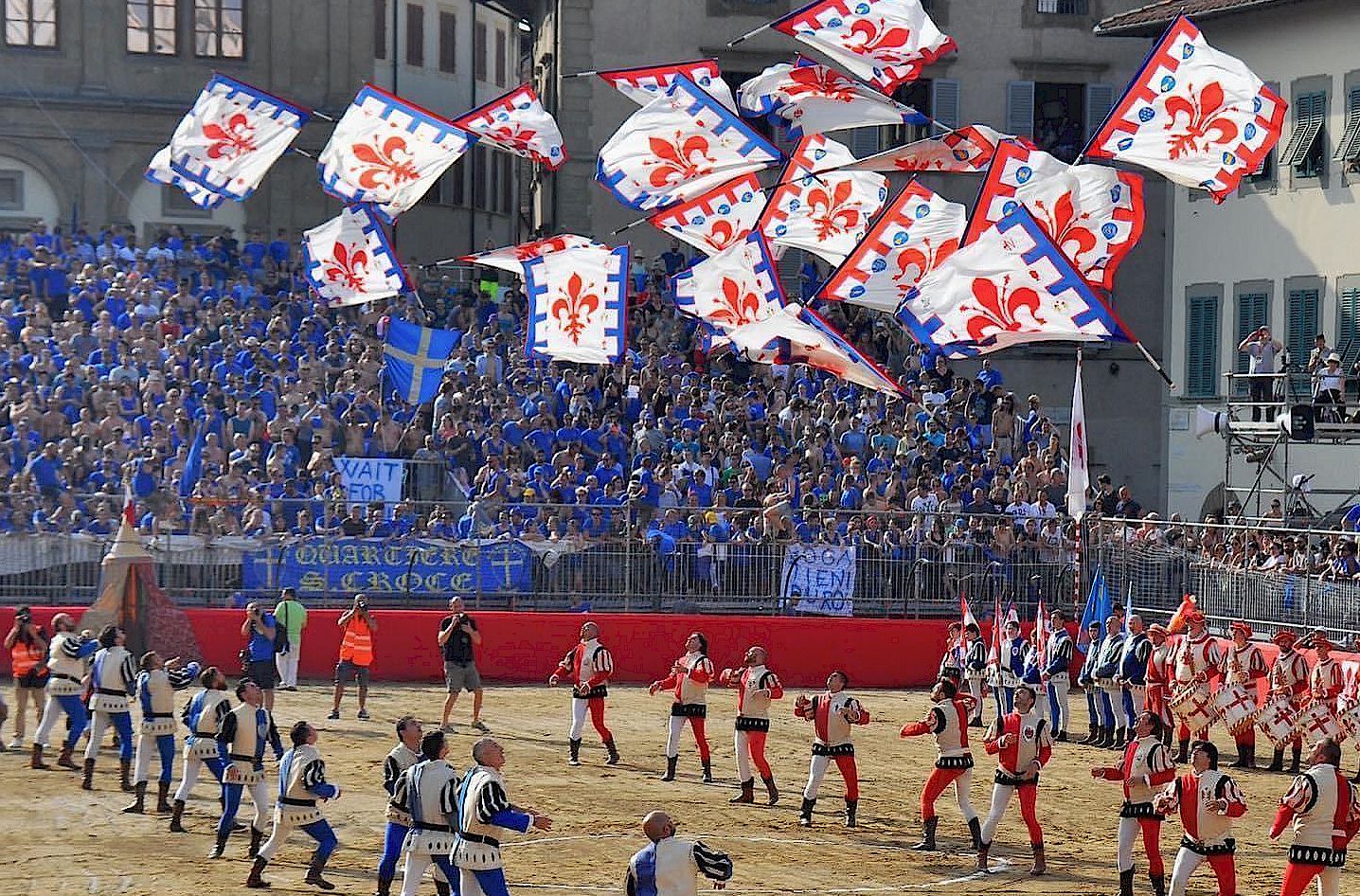
I guess almost every one has heard of the Calcio Storico Fiorentino, and in fact it's worth seeing this spectacle (once). Also don't forget that before the calcio itself there will be a splendid display of Tuscany flag throwing. Another Tuscan speciality that is well worth seeing, either on this occasion or another.

Flag throwers at the Calcio Storico Fiorentino in Florence

Flag throwers at the Calcio Storico Fiorentino in Florence

The Calcio Storico Fiorentino originated in the 16C in Florence and is played today in historical costume. The four teams are: Santa Croce (Azzurri, or Blues), Santo Spirito (Bianchi, or Whites), Santa Maria Novella (Rossi, or Reds), and San Giovanni (Verdi, or Greens). The game was invented by rich aristocreats and took place every night between Epiphany and Lent. The rules of the Calcio Storico were first published in 1580 by Giovanni de’ Bardi. These days it's a somewhat rougher event - actually, brutal is the appropriate expression and I sometimes wonder whether there are any "rules" at all. It's even rumoured that some players are released from jail for a day to participate - I don't think that's true.

On 24 June at 4 pm, the feast day of St. John the Baptist, the patron saint of Florence, a spectacular parade in historical costume starts in Piazza Santa Maria Novella and wends its way through the centre of Florence to Piazza Santa Croce. The four contrade of Florence are represented and you’ll see the players going by as they go to play the final, even those who won’t be playing the final. The parade starts roughly around 4pm since the final should start around 5 pm.

Calcio Storico Fiorentino 2022

To watch the match in Piazza Santa Croce, you need a ticket and they don't come cheap. Tickets cost 80 for Tribuna Onore Centrale, 60 for Tribuna Onore Laterale, 40 for Tribuna C and 29 Curve colori. These need to be bought in advance at the headquarters of BoxOffice Toscana on via delle Vecchie Carceri, 1, or at Teatro Verdi.

These are the hours:

  • Monday 6 June from 4 pm BoxOffice (at 9 am can pick up numbers for line) 
  • Tuesday, Wednesday and Thursday7, 8, 9 June 9 am - 4 pm BoxOffice
  • Friday, 10 June from 12 - 7 pm only at Teatro Verdi (Via Ghibellina 99)
  • Saturday 11 June at Teatro Verdi, from 12 - 6 pm.
You can also watch on Toscana TV, channel 18, and various streaming services.

Tuscany Toscana
Don't forget to visit my Tuscany
Travel Guide!

Up-to-date news on what to see and where to stay in Chianti and all of Tuscany.

Tuscany Travel Guide

vacation accommodations in Tuscany


Author: Anna Maria Baldini

All content copyright © ammonet Italian Web Site Promotion 2022. All rights reserved.

Wednesday, 18 May 2022

Open gardens day in Florence: Cortili e Giardini Aperti a Firenze

As my faithful readers will remember, I am an enthusiast for the formal gardens of Tuscany, especially those of the larger villas of Tuscany. I therefore always look forward to Open gardens day in Florence (Cortili e Giardini Aperti a Firenze) which in 2022, takes place on 22 May, when the private gardens of Florence are open to the public - see the list here. In 2018, I took the opportunity to visit some gardens in the Oltrarno which I either hadn't seen before at all or only a long time ago.

The one I want to describe in some detail is the Giardino San Francesco di Paola which extends upwards and away from the former home of Harry Brewster, "the last of the cosmopolites of Florence". Brewster, a descendent of William Brewster of the Mayflower, was also the grandson, on his mother's side, of the German sculptor Adolf von Hildebrandt, whose studio occupied part of the former Minimite convent of San Francesco di Paola. The convent is located at the foot of Bellosguardo, the beautiful hill that dominates the Oltrarno. It was an evocative experience for me to walk up Via Villani to the circular Piazza San Francesco di Paola. Although there are 19 C and modern buildings on two sides of the piazza, the old church and the wall and gate of the convent are still there, just as described by Brewster. The main structure was long ago divided up into apartments and, alas, the building is looking much the worse for wear. Indeed, so are some of the remaining Hildebrandt sculptures standing in the loggia at the back of the villa.

Villa of San Francesco di Paola
The loggia of the Villa of San Francesco di Paola - much in need of some restoration

However, the garden is beautifully kept up, as is the hay shed (fienile) which Brewster converted into a neat, strangely English-looking, cottage covered in roses and surrounded by a small lawn, where he himself lived in frugal simplicity writing his books. One continues up a series of irregular steps to Brewster's beloved belvedere from which there is a beautiful view of Florence, which because of its lower altitude, is almost more beautiful than the vista from the top of Bellosguardo.

Giardino San Francesco di Paola
View of Florence from the belvedere in the Giardino San Francesco di Paola

Next I walked to entrance of the Giardini Torrigiani not far from the Pitti palace. I have often passed the fine iron gates of these gardens - little did I know that there are 17 acres of gardens hidden behind the walls in the centre of the Oltrarno. In fact, the Torrigiani gardens are the largest private gardens within city limits in all Europe.

Torrigiani gardens in Florence, Italy
A view of a small part of the Torrigiani Gardens, In Florence

The Torrigiani gardens were originally planted by the founder of the Italian Botanical Society, the oldest such society, and the garden still has an uncommonly wide variety of trees, especially exotic species, in keeping with its 19 C “English Landscape” style. The gardens were designed at the height of the Romantic movement in the early 19 C, forming an idyllic oasis of green around the original 16 C villa. The garden hosts rare tree species, wide English-style lawns, herb and vegetables gardens, sculpted lions, a beautifully restored greenhouse and remains of the city walls built under Cosimo I in 1544. The layout of the garden is also profoundly symbolic and I strongly advise visiting it with a good Tuscan garden guide book in hand.

Giardino Torrigiani a Firenze
The astronomical tower in the Torrigiani gardens

Last but not least, I visited that exquisite jewel of a garden, the Giardino Corsi Annalena, nearby on via Romana. This garden is located on land formerly owned by the monastery of San Vincenzo which was founded in around 1441 by Countess Anna Elena (Annalena) Malatesta. During the long struggle for supremacy between Florence and Sienna, the area was dominated by the fortifications created by Cosimo I de’ Medici, including an underground passage that until this day connects the Boboli, Corsi and Torrigiani gardens. Following the destruction of the fortifications in 1571, the area was left abandoned for many years. In 1790, the Marquis Tommaso Corsi purchased the land, then known as the "Moors’ Garden", and the architect Giuseppe Manetti designed what can be considered the first English garden in Florence. It was completed during the years 1801 to 1810. If you have the chance to visit this beautiful garden, please don't miss it.

Giardino Corsi Annalena in Florence
The Giardino Corsi Annalena in Florence


Tuscany Toscana
Don't forget to visit my Tuscany
Travel Guide!

Up-to-date news on what to see and where to stay in Chianti and all of Tuscany.

Tuscany Travel Guide


vacation accommodations in Tuscany

Author: Anna Maria Baldini

All content copyright © ammonet Infotech website promotion 2015 - 2022. All rights reserved.

Tuesday, 17 May 2022

Donatello exhibition in Florence

This year's block-buster exhibition in Florence is dedicated to Donatello and goes under the not unjustifiably immodest name of "Donatello, the Renaissance." As for some of the previous exhibitions at the Palazzo Strozzi, the Donatello show is partially housed also at the Bargello (separate ticket required). Opening hours are 10 am to 8 pm every day except Thursday when the doors remain open until 11 pm. Donatello, the Renaissance stays in Florence until 31 July 2022, after which it will travel, with variations on the loans and probably the catalogue, to the Staatliche Museen in Berlin and the Victoria & Albert Museum in London. Tickets are linked to an entry time slot and can be booked on-line at https://palazzostrozzi.vivaticket.it/.

Donatello Exhibition in Florence 2022

Donatello Exhibition in Florence 2022

I strongly recommend this exhibition to any one interested in Renaissance art - indeed, to almost any art lover. The aim of the exhibition is to reconstruct the artistic development of Donatello throughout his long life (1386 to 1466) and to confirm him as one of the most important and influential masters of the Italian Renaissance by exhibiting his work next to workd by other Italian Renaissance masters such as Brunelleschi, Masaccio, Andrea Mantegna, Giovanni Bellini, Raphael and Michelangelo. A remarkable number of Donatello's works, normally never loaned, have made their way to the Palazzo Strozzi for this exhibition, making it far more ambitious than the two exhibitions organised in 1985 and 1986 commemorating the 600th anniversary of Donatello's birth. Not much is missing and two pieces that are mssing can be seen nearby - the Magdalene of the Duomo Museum and the Giuditta of the Palazzo Vecchio.

Donatello Exhibition at the Palazzo Strozzi in Florence

Donatello Exhibition in Florence 2022

It's a great exhibition - don't miss it if at all possible!


Tuscany Toscana
Don't forget to visit my Tuscany
Travel Guide!

Up-to-date news on what to see and where to stay in Chianti and all of Tuscany.

Tuscany Travel Guide

Author: Anna Maria Baldini

All content copyright © ammonet Italian Web Site Promotion 2022. All rights reserved.

Sunday, 20 February 2022

The Roman origin of the street plan of central Florence

I think everyone knows that Florence was founded by the Romans - and not by the Etruscans, who established themselves in the cooler heights at Fiesole. Perhaps not everyone is aware of the Roman origin of the street plan of central Florence.

Florence was founded by the veterans of Julius Caesar's legions, to whom, in 46 BC, under the Lex Julia Agraria, cultivatable land was assigned as part of their severance pay. As with a great many newly created Roman towns, Florentia was laid out by the ex-legionaries with the same ground plan as a military castrum (camp), meaning a rectangle crossed by two main roads: the cardo, from north to south and the decumano from east to west. New Roman towns followed this format wherever the terrain allowed it, and excellent examples are scattered all over the flat coastal regions of North Africa, for example, and, closer to home, the Roman city of Casulae in Umbria. As with many other Roman towns, the location was very probably determined by the option to build a bridge, in this case across the Arno, very near where the Ponte Vecchio is today, with the aim of both protecting and taxing a popular river crossing on the via Cassia trade route.

Today, in the centre of Florence, visitors can easily detect evidence of the ancient settlement. Florentia was originally a rectangular area of about 450 m by 550 m, in which all the roads still meet at right angles and are divided by via Roma-via Calimala (from north to south) and via Strozzi-via degli Speziale-via del Corso (from east to west) that meet in the centre, where the forum was located and where today we find the Piazza della Repubblica. The urban perimeter stretched from via Tornabuoni to via Proconsolo (west to east), and from Via Cerretani - piazza del Duomo to piazza della Signoria (north to south). The main buildings of the city were the temples dedicated to Jupiter, Juno, and Minerva, the forum, the amphitheatre, the theatre, the public baths, the temple of Isis and the temple consecrated to Mars.

Location in modern Florence of the Roman town of Florentia.

The Roman theatre of Florentia was located more or less where the Palazzo Vecchio stands today, some 4 m above the level of the Roman town. There are remains of the public baths are under Torre della Pagliazza, and other remnants have been excavated under the Duomo and under the Baptistery.

Remains of the Roman theatre under the Palazzo Vecchio in Florence.

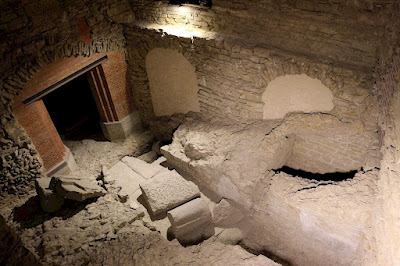
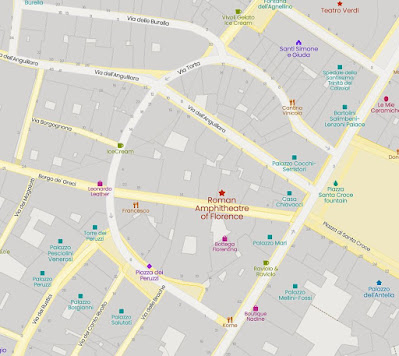
Between Piazza della Signoria and Piazza Santa Croce there is a curiously curved street, via Torta, which originated as part of the perimeter of the Roman amphitheatre. The latter had a diameter of 125 m, with a capacity of 20,000 seats. It was built in the 130 AD outside the walls and marked the point of maximum expansion of the town to the east. More of the outline of the amphitheatre is preserved in the curved Piazza dei Peruzzi.

Location of the Roman amphitheatre in Florence.

 
Roman streets in Florence
 

During the rule of the Emperor Hadrian, Florentia was enlarged, and by the 3 C it was a successful commercial centre. In 287, it became the capital of the region Tuscia et Umbria, and in 405 it was able to withstand the sieges of the Ostrogoths.

More complete Roman (and Etruscan) ruins can be visited in Fiesole where there were Roman baths and a Roman theatre.


Tuscany Toscana
Don't forget to visit my Tuscany
Travel Guide!

Up-to-date news on what to see and where to stay in Chianti and all of Tuscany.

Tuscany Travel Guide

vacation accommodations in Tuscany


Author: Anna Maria Baldini

All content copyright © ammonet Italian Web Site Promotion 2022. All rights reserved.

Wednesday, 27 October 2021

Florence bus tickets - tickets for the ATAF buses in Firenze


STOP PRESS! As of 1 November 2021, ATAF as such disappears and re-incarnates under the auspices of Autolinee Toscane.

ATAF, or Azienda Tranviaria Automobilistica e Filoviaria, was established on October 25, 1945 to provide public transport in and around Florence. Now the signage has been taken down at the depot in viale dei Mille and the branding is being removed from the buses. On 31 October 2021, management of Florence’s bus service will shift to Autolinee Toscane, which will be in charge of bus services throughout Tuscany.

From 1 November, all times and services are expected to remain unchanged. Tickets may be purchased digitally by sending a SMS stating “Firenze” to 488.01.05 or by using the Tabnet app downloadable from the App Store or Google Play. Passengers will still be able to purchase tickets from official ticket offices, machines and authorised retailers that display the Autolinee Toscane sticker. Existing tickets will no longer be valid after 31 October, but refunds can be requested at Desks 8 and 9 at the Santa Maria Novella bus station ticket office.

STOP PRESS! As of 18th July 2019, Florence's ATAF buses allow contactless payment, meaning credit card touch technology. The system is installed on 355 buses within the city plus the airport bus, and currently accepts MasterCard, VISA, Maestro and V Pay. The ticket price of 1.50 euros and the validity duration of 90 minutes remain unchanged. When asked to produce your ticket by an inspector, simply tell him give the last four digits of the card with which you made the payment.This is an enormous time-saver and obviates the need to validate and manage paper tickets which tend to accumulate in the pockets of busy tourists. We await news on when the system will be installed on the trams.

There are a few simple but important things to know about using the city buses in Florence, Italy.


ATAF bus ticket
ATAF 90 minute bus ticket

ATAF bus tickets should be bought BEFORE you board the bus. They are available from any kiosk (news stand) and from many cafés (bars), and at tobacconists. There are also two ATAF offices very near the SMN railway station where you can buy tickets. The most useful ATAF office is the one at via Alamanni 20r. You can get to it from inside the station by going down the steps leaving the station on the right (when facing away from the platforms), turn right again at the bottom of the steps, go past the very useful Conad supermarket, a florist shop and a post office. The ATAF office is the next place and is open Monday through Saturday 7.15am to 7pm.

In extremity, you can buy a ticket from the driver. Note that he's not obliged to provide change and sales are suspended if an inspector is on board.

how to buy an ATAF bus ticket in Florence

Etiquette indicating that ATAF tickets are sold inside.


Sign indicating a tobacconist - they usually also sell bus tickets

Sign indicating a tobacconist - they usually also sell bus tickets

IMPORTANT Florence ATAF bus tickets must be validated as you enter the bus. You do this by inserting the ticket into the franking machine located beside or just behind the driver, and another near the rear entrance to the bus. Insert the pink strip uppermost and first into the machine. Check your ticket to make sure it was stamped with the date and time. Inspectors have no mercy on those without a ticket or with an unvalidated ticket or with an expired ticket - the fine is on-the-spot and painful (50 euros). If one machine is not working, try the other one. You only escape a fine if both machines are inoperative.

There is a good range of tickets available. Most commonly used is the 90 minute ticket. Using this you can get on and off as many buses as you like in any direction for the 90 minutes from when you validated the ticket.

Other tickets are good for four 90 minute rides. These tickets can be shared as long as they are validated the requisite number of times. For example, two people taking the number 7 bus to Fiesole could frank such a ticket twice to go and again twice to come back later in the day. These tickets have four strips for validation. Be sure not to overwrite your validation.

There are also 24 hours tickets and tickets for several days. Since these tickets are not meant to be passed from one person to another, YOU MUST WRITE YOUR NAME ON LONG DURATION ATAF TICKETS, such as 24 hour and three day tickets.

ATAF tickets are good for the small, electric buses that follow routes mainly through otherwise traffic-free lanes, and also for the trams. They are NOT valid for the bus that runs to and from SMN railway station and the airport. You can buy those tickets on the bus. Note that a taxi from the airport costs a fixed price of 20 euros plus baggage and late hours fees.

Last but not least, there are pickpockets on the buses and trams in Florence, especially when they are crowded and on routes favoured by tourists. Please read this article on pickpockets in Italy to understand what you can do to protect your valuables from these thieves. It's not as bad as in Rome, but they are here in Florence for sure.


Tuscany Toscana
Don't forget to visit my Tuscany
Travel Guide!

Up-to-date news on what to see and where to stay in Chianti and all of Tuscany.

Tuscany Travel Guide


vacation accommodations in Tuscany

Author: Anna Maria Baldini

All content copyright © ammonet Infotech website promotion 2016 - 2026. All rights reserved.