Showing posts with label Sights. Show all posts

Thursday, 14 May 2026

Restoration of San Miniato al Monte completed

One of the most beautiful churches in Florence (Michelangelo's favorite) has been under restoration during the past eighteen months. The repairs made to the facade, campanile and roof of the Basilica of San Miniato al Monte, which were covered in scaffolding and transparent plastic for most of that time, are now complete (May 2026). My faithful, intelligent and aestheticly sensitive readers can now once more have an unobstructed view of the facade of this wonderful church next time they are in Florence.

Basilica of San Miniato al Monte in Florence, Italy

Basilica of San Miniato al Monte

The restoration was financed by Italy’s National Recovery and Resilience Plan and cost 3.6 million euros - money well spent! The whole structure has been reinforced and sensors have been put in place to monitor any changes in the north side of the church where gradual structural movement has been detected in the past.

The Basilica of San Miniato al Monte should not be missed during your visit to Florence. The Basilica is one of the most beautiful Romanesque churches anywhere and its interior is even more spectacular than the facade, richly decorated with marble columns and, especially, mosaics. The mosaic in the bowl-shaped vault of the apse (ca.1260) portrays Christ the Pantocrator between Mary, St. Minias and the symbols of the four Evangelists. The figures stand out Byzantine-style against a gold background in a field populated with oriental birds (symbolizing souls).

The interior of the Basilica of San Miniato al Monte, Florence, Italy

The interior of the Basilica of San Miniato al Monte

The Basilica is situated on one of the highest locations in Florence, directly above Piazza Michelangelo. Although it can be reached on foot from central Florence in a reasonable time, it's better to take a bus (line 12 is usually the fastest).

More about the Basilica of San Miniato al Monte

More about the churches, abbeys, monasteries and basilicas of Tuscany.


Tuscany Toscana
Don't forget to visit my Tuscany
Travel Guide!

Up-to-date news on what to see and where to stay in Chianti and all of Tuscany.

Tuscany Travel Guide

vacation accommodations in Tuscany

Author: Anna Maria Baldini

All content copyright © ammonet Italian Web Site Promotion 2013 - 2026. All rights reserved.


Wednesday, 6 May 2026

Open day of the villas and gardens in Florence 24 May 2026

Those of you who are enthusiasts for the villas and gardens of Tuscany have a great opportunity on Sunday 24 May 2026 to visit a great many of the villas and gardens that are usually closed to the public. Entrance is free. I can't emphasise enough what a wonderful opportunity this is to see some splendid architecture and historical gardens.

Palazzo Corsini and its garden in Florence

Open gardens in the Florence historical centre – opening hours 10 am to 1 pm – 3 pm to 7 pm. Sunday 24 May 2026. 

Giardino Torrigiani in Florence

San Francesco di Paola Garden, piazza San Francesco di Paola 3

Giardino Torrigiani, via dei Serragli 144

Palazzo Ricasoli Firidolfi (no reservation required), via Maggio 7

Palazzo Antinori di Brindisi Aldobrandini (no reservation required), via dei Serragli 9

Palazzo Frescobaldi (no reservation required), via Santo Spirito 11

Antica Torre Terrace (Fiesole Music School concert, 11 pm), via Tornabuoni 1

Palazzo Bartolini Salimbeni (no reservation required), piazza Santa Trinita 1

Palazzo Corsini (no reservation required), lungarno Corsini 10

Palazzo Rucellai (no reservation required), via della Vigna Nuova 18

Palazzo Antinori, piazza Antinori 3

Palazzo Gondi, via dei Gondi 2 and piazza San Firenze 1

Antellesi Garden (no reservation required), piazza Santa Croce 21

Fondazione Mello – Le Colonne Art Studio, borgo Pinti 24

Palazzo Leopardi – Marcello Tommasi Art Studio, via della Pergola 57

Palazzo Ximenes Panciatichi (Fiesole Music School concert, 3 pm), Borgo Pinti 68

Palazzo Grifoni Budini Gattai (Fiesole Music School concert, 4 pm), piazza Santissima Annunziata 1

Palazzo Niccolini (Fiesole Music School concert, 12pm, no reservation required), via dei Servi 15

Palazzo Pucci, via de’ Pucci 4

Palazzo Ginori (Fiesole Music School concert, 5 pm), via de’ Ginori 11

Read my post on the Florence open day gardens I visited in 2015. 

Palazzo Antinori in Florence


Tuscany Toscana
Don't forget to visit my Tuscany
Travel Guide!

Up-to-date news on what to see and where to stay in Chianti and all of Tuscany.

Tuscany Travel Guide


vacation accommodations in Tuscany

Author: Anna Maria Baldini

All content copyright © ammonet Infotech website promotion 2016 - 2026. All rights reserved.

Friday, 1 May 2026

The iris garden in Florence is open from April 25 to May 20, 2026.

One of the most pleasing sights in Florence at this time of year is the Iris Garden, located just below Piazza Michelangelo and the Basilica of San Miniato al Monte on the southern heights overlooking Florence. The Iris garden will be open to the public from 25 April 2026 until 20 May 2026.

The Iris Garden of Florence is the only one in Europe dedicated to the iris and it houses over 1500 varieties of the iris, which is, of course, the symbol of Florence.

Irises in Florence

The garden is managed by the Italian Iris Society and is open to the public for one month a year between April and May, the period of the spring flowering. This year, 2026, the opportunity to stroll through the avenues and hills covered with irises and olive trees will be from 25 April 2026 until 20 May 2026, from 10:00 am to 6:00 PM (with last entry at 5.30 pm).

The Iris Garden in Florence, Italy

As always, admission is free, but for those who want it, scheduled guided tours are held every Sunday and on public holidays at 11 am and 4 pm, with a contribution of 5 euros per person.


Tuscany Toscana
Don't forget to visit my Tuscany
Travel Guide!

Up-to-date news on what to see and where to stay in Chianti and all of Tuscany.

Tuscany Travel Guide

vacation accommodations in Tuscany


Author: Anna Maria Baldini

All content copyright © ammonet Italian Web Site Promotion 2021- 2026. All rights reserved.

Wednesday, 4 March 2026

A preliminary drawing and a final painting by Filippo Lippi in Florence

I want to present here an example of how a bit of enjoyable homework can help art-lovers gain some extra insight into how a masterpieces were created by Renaissance artists. Before a recent visit to the Palatine Gallery at Palazzo Pitti in Florence, I was idly looking through a book of Renaissance drawings held in the Gabinetto dei Disegni e delle Stampe at the Uffizi Gallery. Among them was a very delicate, three quarters sketch of a female head, surely intended to be a Madonna, depicting an absorbed and very sweet expression, and, among other features, a refined hairstyle embellished with veils. At the same time, I had a look at a catalogue of the holdings at the Palatine Gallery, and - lo and behold! - the Madonna in the wonderful Tondo Bartolini turned out to be the final version of the Uffizi sketch.

Both the preliminary drawing and the final painting are by Filippo Lippi. The Tondo has long been thought to have been commissioned from Filippo, who was Carmelite friar, by the ambitious and wealthy Florentine merchant, Leonardo di Bartolomeo Bartolini. More recent investigation by Jeffrey Ruda interprets the coat of arms on the reverse of the Tondo as that of a member of the Martelli family and re-dates the painting to between 1465 and 1470 based on similarities to Filippo's final frescoes in the Capella Maggiore at Prato Cathedral.

By looking at a good reproduction of the drawing, one can see that Filippo used first a silver point on paper prepared with a warm, yellow ochre ground, and then refined the silver point outline with thin and light lines of white lead applied with a brush, giving the physiognomy and hairstyle a lovely softness.

The preliminary sketch matches the painted figure down to the most minute folds of the cap and in the ribbon that holds and twists the hair at the top under the veil. One can also see that Filippo was experimenting on the ochre paper with the effects of the light coming from the left, by applying a white wash. 

However, my aim here is not to argue the fine details of art history and connoisseurship, but rather to encourage visitors to Florence who plan to tour the galleries, to spend some time with some art books as a preparation to seeing the works themselves. You never can tell what serendipitous insights will strike you!

Tuscany Toscana
Don't forget to visit my Tuscany
Travel Guide!

Up-to-date news on what to see and where to stay in Chianti and all of Tuscany.

Tuscany Travel Guide

vacation accommodations in Tuscany


Author: Anna Maria Baldini

All content copyright © ammonet Italian Web Site Promotion 2021 - 2026. All rights reserved.

Saturday, 14 February 2026

The newly renovated Vasari Corridor is opened to all

The newly renovated Vasari Corridor opened to all in May 2024. As my always intelligent and attentive readers will know, access to the Vasari Corridor, which runs from the Palazzo Vecchio, via the Uffici Galleries and over the Ponte Vecchio, to the Pitti Palace in Florence, has always been problematic. The renovated Vasari Corridor re-opened 450 years after the death of its creators: the Grand Duke Cosimo I dei Medici, who commissioned the Corridor on the occasion of the wedding of his son Francesco I and who passed away on 21 April 1574, and Giorgio Vasari, who designed and built it and who died on 27 June 1574, just two months after Cosimo I.

Entry to the renovated Vasari Corridor is available to everyone who has a ticket to enter the Uffizi Galleries and who has paid the Corridor visit supplement. Pre-booking a time slot and prepaying the supplement to access the Corridor is highly recommended. Visitors are grouped (groups of 25 persons) by time of entry and accompanied by two Uffizi staff members. You cannot leave the group nor linger long in the Corridor.

I am no longer enthusiastic about paying the extra to walk through the Vasari Corridor. The corridor is one-way. You enter from inside the Uffizi, walk over Ponte Vecchio through a 760 m hallway and exit at the Pitti Palace courtyard. You cannot walk back to the Uffizi through the corridor. You cannot retrieve anything from the Uffizi cloakroom. The museum is closed to you for the day. In addition, your Uffizi entry is locked to 2 hours before your corridor slot. Not earlier. The Uffizi needs 3 to 5 hours to explore thoroughly. This ticket caps you at 2 hours. You will rush the Botticelli rooms, skip the Caravaggios, and end the visit staring at your watch.
And what do you get for all this. A hallway. The famous self-portrait collection that made the corridor interesting is gone. 

Renovated Vasari corridor opens in 2024

The renovated Vasari Corridor

The ready accessibility of the corridor is very positive but I have to admit to feeling a bit sad about the relocation of the largest, oldest and most important collection of self-portraits in the world, which used to line the walls of the Corridor towards the Pitti Palace end. This collection, which was admirably displayed in the Corridor and directly linked to the creators of the Corridor, has been transferred to the Uffizi Galleries. The self-portraits have been replaced in the Corridor by a series of Roman epigraphs related to the Florence founded by Julius Caesar in 59 BC, and later becoming the capital of the VI Roman Legio that included Tuscany and Umbria. Obviously, these marble plaques are nowhere near as fragile as the paintings, so I suppose this is the price we must pay for free access to the Vasari Corridor.

 The old Varari Corridor

The Vasari Corridor before renovation.

This, of course, is by no means the first time the Vasari Corridor has been renovated. Up until the late 19 C, there were artisanal workshops built into the arches supporting the Corridor between the Uffizi and the Ponte Vecchio. Those were removed during the 1880's.

Workshops below the Vasari Corridor 1880s

View of the Vasari Corridor in the 1880's with workshops still in place.

For full official details for visits to the Vasari Corridor, click here.

More about the Vasari Corridor.


Tuscany Toscana
Don't forget to visit my Tuscany
Travel Guide!

Up-to-date news on what to see and where to stay in Chianti and all of Tuscany.

Tuscany Travel Guide

vacation accommodations in Tuscany

Author: Anna Maria Baldini

All content copyright © ammonet Italian Web Site Promotion 2026. All rights reserved.

Friday, 13 February 2026

Poppies in Tuscany

Poppies in Tuscany

Be sure to include the beautiful Val d'Orcia in your Tuscany vacation itinerary!

When do the poppies appear in the Val d'Orcia of Tuscany?


Tuscany Toscana
Don't forget to visit my Tuscany
Travel Guide!

Up-to-date news on what to see and where to stay in Chianti and all of Tuscany.

Tuscany Travel Guide

vacation accommodations in Tuscany


Author: Anna Maria Baldini

All content copyright © ammonet Italian Web Site Promotion 2026. All rights reserved.

Monday, 5 January 2026

Events and festivals in Tuscany during 2026

The new year has begun and now is the moment to think about events and festivals in Tuscany during 2026. If you're planning a trip to Tuscany, do look at our lists of folkloric festivals, jousts, archery and crossbow contests and numerous other events that take place in Tuscany during the course of the year. These range from the massive float parades of the Carnevale in Viareggio through the great mediaeval costume festivals to simple village food feste.

Events and festivals in Tuscany
Huge processional float at Viareggio Carnevale

The festivals of Tuscany have become more and more polished and exciting in their presentation and yet remain genuine folk festivals dependent entirely on the enthusiasm of the local organisers, in many cases these being competing local contrade, rioni etc. These latter are clubs and societies based on the various residential quarters of villages, towns and cities, the most famous being the contrade of Sienna which enter their horses (and riders) in the famous Siena palio twice every year.

Siena palio
 The Palio in Sienna, Tuscany

In addition to annual or twice yearly events, there are always "unscheduled" occasions to see and even participate in Tuscan folkoric activities. Keep your eyes open for posters advertising upcoming local events in the town you are visiting or where you are staying. They are very often extremely worthwhile attending. One of the most popular of these activities in Tuscany, especially in Florence, are flag tossing groups - bandierai or sbandieratori - who train to become expert in synchronised flag throwing.

Bandierai degli Uffizi di Firenze performing in Piazza Santa Maria Nuova, Florence 
 Bandierai degli Uffizi di Firenze performing in Piazza Santa Maria Novella, Florence 

The competitions are almost always costume events with processions, and very often dinners and food stands play an important role. Look through our lists for local events taking place near where you will be staying, and in addition try to attend at least one major event during your stay.

The main Tuscan festivals.

A comprehensive list of local events and festivals in Tuscany.


Tuscany Toscana
Don't forget to visit Elena Spolaor's
Travel Guide!

Up-to-date news on what to see and where to stay in Chianti and all of Tuscany & Umbria.

Chianti Travel Guide


vacation accommodations in Tuscany

Tuscany tourist information - tourist information

Author: Anna Maria Baldini

All content copyright © ammonet Infotech website promotion 2026. All rights reserved.

Tuesday, 30 December 2025

Deer species commonly sighted in Tuscany

Deer are now so common in Tuscany that they have become pest species, along with the wild boar (cinghiale, pl. cinghiali). Only twenty years ago, deer were infrequently sighted in Tuscany and even then only in forested areas or on roads through the forest. Currently, when you drive almost anywhere through the countryside at dawn or dusk, or hike through the Apennine foothills, you are likely to encounter one of Tuscany’s three primary deer species, the Roe deer, the Fallow deer and the Red deer. These Tuscan deer will be commonly sighted not only in forests but in and near vineyards where they cause significant damage by eating grapes and tearing down vines as the grape harvest approaches. With the explosion of the deer population, wolves (lupo, pl. lupi) are repopulating the cultivated areas of Tuscany. Wolves are less commonly seen in Tuscany but they are present and photos of them near populated areas appear in the news papers monthly.


Wolf photographed in Chianti, Tuscany
A wolf photographed in Chianti, Tuscany


The Roe Deer (capriolo, pl. caprioli), Capreolus capreolus


The Roe Deer (capriolo, pl. caprioli), Capreolus capreolus
The Roe Deer

The Roe deer is the most abundant and iconic deer in Tuscany. They are small, elegant creatures, somewhat larger than a very large goat. They have a distinctive reddish-brown coat in the summer that turns a thick, grizzled grey in winter. Look for their white rump which flashes when they bound away. They are quite shy but you’ll often spot them in the buffer zones between dense woods and open vineyards, particularly in the Chianti and Val d’Orcia regions. Younger caprioli are easily tamed and can be fed by hand. They especially enjoy freshly harvested nettles (ortica). Their "barking" alarm call is often mistaken for a dog barking but is somewhat hoarse and has a lower bark frequency than a barking dog.

The Fallow Deer (daino, pl. daini), Dama dama


The Fallow Deer (daino, pl. daini), Dama dama
The Fallow Deer

The Fallow deer is historically native to Turkey and possibly the Italian Peninsula, Balkan Peninsula and the island of Rhodes near Anatolia. During the Pleistocene period, it inhabited much of Europe, and has been reintroduced to its prehistoric distribution by humans. They are more social than Roe deer and are often seen in larger herds. They are easily recognised by their white-spotted coats (which many keep into adulthood) and the male's broad, shovel-like (palmate) antlers. They favour the coastal forests and Mediterranean scrub, such as in the Maremma Regional Park.

The Red Deer (cervo or cervo rosso, pl. cervi), Cervus elaphus


The Red Deer (cervo or cervo rosso, pl. cervi), Cervus elaphus
The Red Deer

The Red deer is the undisputed giant of the Italian woods. A mature stag can weigh over 200 kg - nearly eight times the size of a Roe deer. They prefer the high-altitude forests of the Apennines, specifically the Casentinesi Forests National Park on the border of Tuscany and Emilia-Romagna. They try to avoid humans and so are rarely seen running along side or across roads. If you visit in late September, you can hear the astonishingly loud, guttural roar of the stags echoing through the valleys as they call their females.

IMPORTANT!

When driving through Tuscany, watch for the sign below. Deer, while very attractive animals, especially when small, are also - how can I put this? - quite stupid. I have seen them many times dash through the grass along a road, parallel with a car or bus, and then suddenly turn and race across the road in front of the vehicle. You don't want to run into a deer - the damage to your car and maybe to you will be considerable.


More about fauna of the Val d'Elsa.

More about Tuscan wildlife and domestic animals.


Tuscany Toscana
Don't forget to visit my Tuscany
Travel Guide!

Up-to-date news on what to see and where to stay in Chianti and all of Tuscany.

Tuscany Travel Guide

vacation accommodations in Tuscany


Author: Anna Maria Baldini

All content copyright © ammonet Italian Web Site Promotion 2026. All rights reserved.

Saturday, 12 October 2024

Il Palazzo di Bianca Cappello in the Oltrarno of Florence, Tuscany

Il Palazzo di Bianca Cappello in the Oltrarno of Florence, Tuscany

Il Palazzo di Bianca Cappello

During the first half of the 15 C, at Via Maggio 26, in the Oltrarno area of Florence, there was a palazzo belonging to the Corbinelli family, purchased in 1566 by Piero Buonaventuri, husband of the Venetian noblewoman Bianca Cappello. This palazzo was a setting of one of the most talked about love stories of the Renaissance, that between Bianca Cappello and Grand Duke Francesco de' Medici, son of Cosimo de' Medici. During the period in which they were still clandestine lovers, to meet secretly, Bianca and Francesco used an underground passage that starts from the cellars of the palazzo and reaches the Palazzo Pitti, a block away. During World War II, numerous art works from the Vasari corridor were stored in the passage for safekeeping. Today the passage is no longer passable.

Bianca Cappello

 Bianca Cappello

After Bianca was widowed, she was able to modernise and embellish her palazzo under the supervision of Bernardo Buontalenti and with financial support from Francesco. The façade was renovated with rich graffito decoration created by Bernardino Poccetti.

On 12 October 1579, Francesco I de’ Medici and Bianca Cappello married for the second time amongst great celebrations, despite the hostility of the Medici family. The ceremony between the Grand Duke and the "Daughter of Venice" followed the one that had taken place secretly in June of the same year.
After the wedding, Bianca donated the palazzo to the Hospital of Santa Maria Nuova and subsequently the grotesques were painted on the façade.

Grand Duke Francesco I de' Medici

This story remains intriguing right up until the present day, not least because of the tragic deaths of both Bianca and Francesco, within 24 hours of one another, at the Medici villa of Poggio a Caiano under suspicious circumstances that have never been clarified.

More about Francesco I de’ Medici and Bianca Cappello.

More about the Villas and palazzi of Tuscany.

Tuscany Toscana
Don't forget to visit my Tuscany
Travel Guide!

Up-to-date news on what to see and where to stay in Chianti and all of Tuscany.

Tuscany Travel Guide

vacation accommodations in Tuscany

Author: Anna Maria Baldini

All content copyright © ammonet Italian Web Site Promotion 2024. All rights reserved.

Tuesday, 30 April 2024

How to visit the Vasari Corridor in Florence

Update May 2024: Visiting of the Vasari Corridor.

In May 2024, the Vasari Corridor re-opened to the public in completely renovated form. It is necessary to reserve a time slot and to hold an Uffizi entry ticket and Vasari Corridor supplmentary tciket to enter and enjoy the Corridor.

The latest information on the renovated Vasari Corridor.


Update 14 October 2021: Visiting of the Vasari Corridor.

In an interview published by Corriere della Sera on 21 October 2021, the director of the Uffizi, Eike Schmidt, expounded on his vision of the "contemporary" Uffizi. One question that interests me and probably a lot of my readers was:"There's been a long wait for the reopening (of the Vasari Corridor) but isn't 45 euros for a ticket to visit the Corridor too much?", Schmidt explained that the price is much lower than the one demanded by the private agencies (essentially ticket scalpers) who routinely snatched up the few tickets available before the corridor closed in 2016. In essence, his reply continued to the effect that the price is determined by the market. 

I'm not all that convinced by the Director's neo-con economics response.The Vasari Corridor, with 125 admissions at a time, will obviously have more demand than supply during high season, and therefore can impose high prices (even much more than 45 euros). In low season, the price will drop to 20 euros to be competitive. And it is clear that these prices make both the museum's accountants and the ticket scalpers, who will ask for a large share of tickets, happy. It is a pity, however, that the Uffizi, as a public service, does not work more for the benefit of the tax payers who have invested 10 million euros into renovation of the Corridor, rather than for the bank balances of the museum and the scalpers. The taxpayers have invested rightly, given that citizens must be able to benefit from the heritage that belongs to them, but wouldn't it be reasonable that they don't have to pay a lot of money all over again to enjoy this heritage?

Update 18 March 2021: Tours of the Vasari Corridor.

IMPORTANT: there are no legitimate tours of the Vasari Corridor being offered currently but it looks like that the Vasari Corridor will re-open on 27 May, 2022, and will be accessible by ticket. Apparently it will not be necessary to be part of a tour group.

Eike Schmidt, the director of the Uffizi Gallery, has announced that the Vasari Corridor will officially become a part of the Uffizi after reopening in 2022. Visitors will then be able to enter the Uffizi, stroll through the Vasari Corridor and then explore the Boboli Gardens or the Pitti Palace. Tickets will cost €45 in high season, €20 in low season and will be free for students.
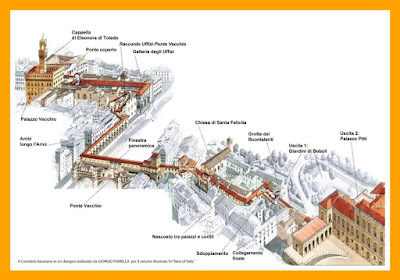
Route of the Vasari Corridor in Florence

One disappointing aspect is that the many excellent self-portraits currently hanging in the Vasari Corridor will be removed because it won't be possible to climate control the corridor suitable for paintings on canvas and wood.

The Vasari Corridor from above

According to the official Uffizi website, no tours of the Vasari Corridor are now available, and anybody who offers such a tour is committing a fraud:

"False information concerning nocturnal visits of the Uffizi and Vasari Corridor
The Administration of the Uffizi Galleries confirms that these promotional contents are totally unfounded. From 1 December 2016 until further notice the Corridor remains closed for works of safety regulatory compliance. Consequently no bookings will be accepted.
False information is spreading on Facebook about nocturnal openings of the Uffizi and Vasari Corridor on various dates with visits organized by associations/groups which are unknown to us, such as Firenze Vista di Notte. The Administration of the Uffizi Galleries has already filed a lawsuit against the fraudsters and confirms that these promotional contents are totally unfounded."

The official website for the Uffizi tickets is https://www.uffizi.it/en/tickets - once again note that many other official-looking web sites offer Uffizi tickets at enormous markups.

Vasari corridor Uffizi Florence
Interior of the Vasari Corridor in Florence as it was until closed in 2016.

The corridor was lined with paintings, the more interesting ones being an amazing series of self-portraits by famous and not so famous artists, including a surprising number of the Pre-Raphaelites - for example, a very fine self-portrait of William Holman Hunt. These pictures will now be displayed elsewhere in the Uffizi and will be replaced by thirty ancient sculptures along with a space dedicated to 16th century frescoes. 

Empty interior of the Vasari Corridor

The corridor had a doorway and still has a window opening into a balcony high up in the church of Santa Felicita so that the Medici family could attend mass privately, without being seen or subject to attack. The especially large windows overlooking the Ponte Vecchio were specially created for a visit by Mussolini in the late 30's. Part of the corridor snakes around the Torre Mannelli which belonged to the only family that Cosimo I was unable to buy out. Instead of building through the tower, Vasari built around it using a system of supporting brackets. Cosimo was quite sanguine about this - every man is king in his own house, he reportedly observed. The meat market on Ponte Vecchio was moved to avoid its smell permeating the passage, its place being taken by the goldsmith shops that still occupy the bridge.

More about the Vasari Corridor in the 19th and 20th centuries.

More about what to see and do in Florence.

More about Florence Museum Cards and Florence Museum Passes.


Author: Anna Maria Baldini

All content copyright © ammonet Infotech 2010 - 2024. All rights reserved.

Sunday, 14 January 2024

Pieve di San Cresci

The Italian word "pieve" means "parish church" in English, and the pievi of Chianti are in many ways a similar phenomenon to the ubiquitous Norman churches of England. They were built in large numbers during the period of rapid population growth that took place in Tuscany at the end of the Dark Age (the Early Mediaeval period), from roughly the year 950 onward, and they are dotted, often in ruins, all over the region. 

Pieve di San Cresci - the parish church

Today, I want to talk about the Pieve di San Cresci which is thought to be one of the oldest pievi in Chianti. The nearby Pieve di San Pietro a Sillano might be older. The latter is mentioned in scrolls dating from the year 884 held at the nearby Abbey of Passignano. The Pieve di San Cresci is referred to in a document dated 963 which is held in the same library. A stone, carved in Longobard style, was found embedded in the wall of the nave during restoration, and this suggests that the Pieve di San Cresci was built on the site of a Longobard villa, perhaps incorporating part of the original structure.

Pieve di San Cresci

The Pieve di San Cresci

The Pieve di San Cresci is located across the valley of the Becherale torrent from the fortified village of Montefioralle, about 2 km from Greve in Chianti, in the middle of the Chianti Classico wine zone. In fact, although Montefioralle houses the ancient church S. Stefano, rebuilt in the 17 C and 18 C, the Pieve of San Cresci is the original parish church of Montefioralle. The church is well worth a visit and can be reached easily by car or on foot from Greve along the road that passes by Villa Zano.

The interior of the church was completely rebuilt in Baroque style. However, part of the facade belongs to the original Romanesque church. The very photogenic lower part consists of two mullioned windows and is decorated with a dichromic motif in the archivolts.

Pieve di San Cresci facade

 The facade of the Pieve di San Cresci

Pieve di San Cresci - the winery

It's very common in Tuscany and especially in Chianti to see secular structures built onto churches (and also onto former military structures such as watch towers). The Pieve of San Cresci is no exception. The home of the Ballini family, wine makers here for at least six generations, is built onto the Pieve di San Cresci, and their winery, formerly Podere San Cresci but now named after the church, occupies cellars that were once a part of the church.

Pieve di San Cresci wines

Pieve di San Cresci wines

Listen to me, my dear intelligent and discerning readers! The red wines of Pieve di San Cresci winery are outstanding, even in a wine zone famous for its excellent wines. If you will be in the area of Greve in Chianti, I strongly recommend that you phone Pieve di San Cresci winery and make an appointment to taste their wines and maybe even pay a visit to the wine cellars. You won't regret it! They make a range of red wines,including of course Chianti Classico, Chianti Classico Riserva and Chianti Classico Gran Selezione (the new top-level denomination for Chianti wines), plus some very good Indicazione Geografica Tipica wines which have this designation because of their original grape composition, not because they are lesser wines.

Contact details and directionss for Pieve di San Cresci winery

More about Greve in Chianti.

Tuscany Toscana
Don't forget to visit my Tuscany
Travel Guide!

Up-to-date news on what to see and where to stay in Chianti and all of Tuscany.

Tuscany Travel Guide

vacation accommodations in Tuscany

Author: Anna Maria Baldini

All content copyright © ammonet Italian Web Site Promotion 2024. All rights reserved.