Showing posts with label churches. Show all posts

Sunday, 14 January 2024

Pieve di San Cresci

The Italian word "pieve" means "parish church" in English, and the pievi of Chianti are in many ways a similar phenomenon to the ubiquitous Norman churches of England. They were built in large numbers during the period of rapid population growth that took place in Tuscany at the end of the Dark Age (the Early Mediaeval period), from roughly the year 950 onward, and they are dotted, often in ruins, all over the region. 

Pieve di San Cresci - the parish church

Today, I want to talk about the Pieve di San Cresci which is thought to be one of the oldest pievi in Chianti. The nearby Pieve di San Pietro a Sillano might be older. The latter is mentioned in scrolls dating from the year 884 held at the nearby Abbey of Passignano. The Pieve di San Cresci is referred to in a document dated 963 which is held in the same library. A stone, carved in Longobard style, was found embedded in the wall of the nave during restoration, and this suggests that the Pieve di San Cresci was built on the site of a Longobard villa, perhaps incorporating part of the original structure.

Pieve di San Cresci

The Pieve di San Cresci

The Pieve di San Cresci is located across the valley of the Becherale torrent from the fortified village of Montefioralle, about 2 km from Greve in Chianti, in the middle of the Chianti Classico wine zone. In fact, although Montefioralle houses the ancient church S. Stefano, rebuilt in the 17 C and 18 C, the Pieve of San Cresci is the original parish church of Montefioralle. The church is well worth a visit and can be reached easily by car or on foot from Greve along the road that passes by Villa Zano.

The interior of the church was completely rebuilt in Baroque style. However, part of the facade belongs to the original Romanesque church. The very photogenic lower part consists of two mullioned windows and is decorated with a dichromic motif in the archivolts.

Pieve di San Cresci facade

 The facade of the Pieve di San Cresci

Pieve di San Cresci - the winery

It's very common in Tuscany and especially in Chianti to see secular structures built onto churches (and also onto former military structures such as watch towers). The Pieve of San Cresci is no exception. The home of the Ballini family, wine makers here for at least six generations, is built onto the Pieve di San Cresci, and their winery, formerly Podere San Cresci but now named after the church, occupies cellars that were once a part of the church.

Pieve di San Cresci wines

Pieve di San Cresci wines

Listen to me, my dear intelligent and discerning readers! The red wines of Pieve di San Cresci winery are outstanding, even in a wine zone famous for its excellent wines. If you will be in the area of Greve in Chianti, I strongly recommend that you phone Pieve di San Cresci winery and make an appointment to taste their wines and maybe even pay a visit to the wine cellars. You won't regret it! They make a range of red wines,including of course Chianti Classico, Chianti Classico Riserva and Chianti Classico Gran Selezione (the new top-level denomination for Chianti wines), plus some very good Indicazione Geografica Tipica wines which have this designation because of their original grape composition, not because they are lesser wines.

Contact details and directionss for Pieve di San Cresci winery

More about Greve in Chianti.

Tuscany Toscana
Don't forget to visit my Tuscany
Travel Guide!

Up-to-date news on what to see and where to stay in Chianti and all of Tuscany.

Tuscany Travel Guide

vacation accommodations in Tuscany

Author: Anna Maria Baldini

All content copyright © ammonet Italian Web Site Promotion 2024. All rights reserved.

Sunday, 25 July 2021

Romanesque Parish Churches of Chianti

A one day driving tour of the Romanesque parish churches (Pievi) of Chianti is a great way to introduce yourself to the highways and byways of Chianti Italy as well as, of course, to see some of the oldest and most evocative architecture and works of art in Tuscany. One good route is simply to follow the Via Chiantigiana and make the appropriate detours.

Romanesque Parish Churches of Chianti
Pieve di San Cresci - a romanesque parish church in Chianti


The historic pievi (singular: pieve) are for the most part mediaeval although the Pieve di San Vincenti near Castelnuovo Berardenga dates from the Dark Age - it was a Basilica in the 7 C. They range from the magnificent (e.g. San Polo in Rosso) to the simple, single nave structures such as the Pieve di Santa Maria a Pacina, dating from the 8 C and characterised by a highly unusual cylindrical campanile (bell tower). 

If you are a Tuscan wine lover, you can combine visiting what is probably the oldest extant parish church in Chianti with a visit to a winery that takes its name from the church - namely, the Pieve di San Cresci winery. This wine producer belongs to the Ballini family who have been making wine here for almost two hundred years. Their wines are personal favorites of mine and I recommend them highly, especially the three Chianti Classicos. The winery has a wine tasting facility just in front of the church.

Author: Anna Maria Baldini


Tuesday, 23 May 2017

The parish church of Santa Maria and San Leonardo in Artimino, Carmignano, Tuscany

Today I want to return to one of my obsessions, the abbeys, monasteries and churches of Tuscany, in this case, specifically, the parish church of Santa Maria and San Leonardo in Artimino, at Carmignano in the Province of Prato (in Italian, La pieve di S. Maria e S. Leonardo ad Artimino, Comune di Carmignano, Prato). We are lucky in Tuscany that stone is readily available (ref. my husband's fields) and consequently almost every building in Tuscany is, in essence, a skilfully assembled pile of stones that lasts for millennia. Some of these structures are aesthetically indifferent - some are works of genius, even when they are pure vernacular art - meaning erected by now anonymous workmen with no special skills other than a miraculous feeling for beauty. The Pieve di S. Maria e S. Leonardo ad Artimino is one of these works of genius. It's located deep in the countryside and consequently rarely visited by visitors to Tuscany. This church has miraculously remained embedded in a pristine natural environment. If you're in the area, on no account miss paying it a visit.

La pieve di S. Maria e S. Leonardo ad Artimino, Comune di Carmignano, Prato
The parish church of S. Maria e S. Leonardo ad Artimino
This pieve is referred to in the famous decree of Emperor Otto III, dating from 998, which lists the privileges of the Bishop of Pistoia, also noting "plebs ... in Artimino", which is perhaps referring to a time before the existence of the inhabited settlement of Artimino. The latter was a walled town, documented, however, as "castle" since the 11 C. The then church of San Leonardo was located outside the walls of the castle. This was commonplace during that period, because territorial organisation was characterised by scattered settlements and distinct power centres: the castle and the pieve. The Rinaldeschi of Prato and then the Frescobaldi were the patrons for a long time.

The church was first devoted to the Virgin only during the 16 C and from then onwards was co-dedicated to the Virgin and San Leonardo. In its role as a parish church, the pieve of Santa Maria and San Leonardo in Artimino was the headquarters of several suffragan churches. In the 19 C, it had as its dependencies Santo Stefano alle Brusche at Poggio alla Malva, San Michele in Comeana and San Martino in Campo.

Interior of the Pieve di S. Maria e S. Leonardo ad Artimino

The pieve as a structure is one of the most complete, evocative and early examples of Romanesque architecture of the 11 C in Tuscany. The original buildings have remained intact over the centuries, apart from the construction of the vault cover in the 14 C and the construction of the canonical and "della Compagnia" buildings. The impression formed by the Romanesque elements has been enormously enhanced by the radical restoration of 1971 that eliminated additions of little value and also resulted in the removal of interior decorations of the 17 C and 18 C.

More about the Basilicas, Pievi, Abbeys, Monasteries and Hermitages of Tuscany.


Tuscany Toscana
Don't forget to visit my Tuscany
Travel Guide!

Up-to-date news on what to see and where to stay in Chianti and all of Tuscany.

Tuscany Travel Guide

vacation accommodations in Tuscany


Author: Anna Maria Baldini

All content copyright © ammonet Italian Web Site Promotion 2017. All rights reserved.

Tuesday, 4 November 2014

Visit the archaeological site under the Duomo of Florence

Since October this year (2014), it has been possible to visit the archaeological site under the Duomo of Florence and the new display there.The excavations under the Duomo allow visitors to grasp, in a very immediate way, the fascinating history of the Duomo area and, indeed, of all of Florence, from Roman times until the 14 C. Beneath the Duomo (Cathedral of Santa Maria del Fiore), the levels of stratification correspond to four consecutive periods in the history of Florence, namely the Roman period (1 to 4 C), lasting until the construction of the first church on the site in early Christian era (4 to 7 C), the early mediaeval period (8 to 10 C) and the Romanesque period (11 to 14C ).

All the coins that were found in the Roman soil belong to the period from the reign of emperor Gordianus III (238 to 244) to the reign of emperor Honorius (395 – 423). The evidence suggests that the first Basilica was built at the end of the fourth century or during the first decades of the following century, after the victory of the Roman army over Radagaisus.

This Basilica of Santa Reparata was possibly the first construction of a complex including the Bishop’s palace, the Baptistry of San Giovanni (Florence Baptistry), a hospital, a parsonage, a graveyard and two other churches. (Yes, the Baptistry of Florence is of extremely ancient origin and much of the present structure long pre-dates the Duomo).

Santa Reparata, the Baptistry and associated buildings in early Florence
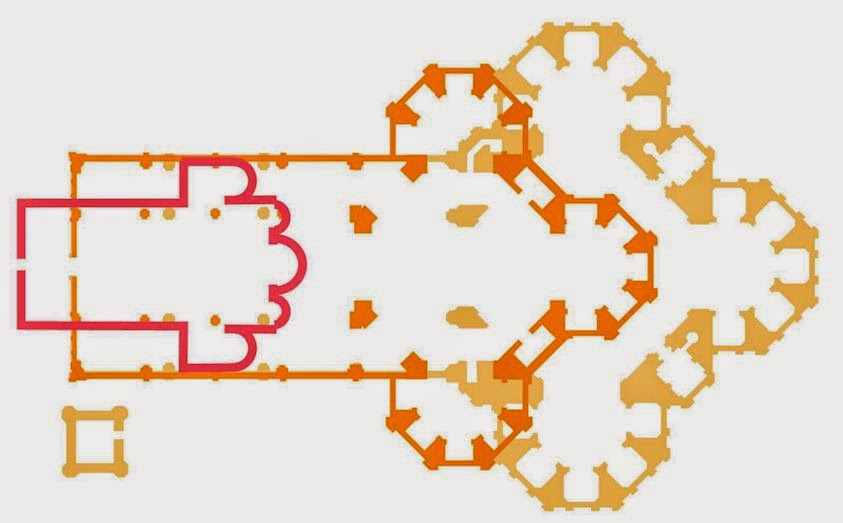
Santa Reparata was one of the major early Christian complexes in the region of Tuscia, its importance being indicated by its position directly in front of the baptistry, 8 m closer than the present Duomo. It was rebuilt in Carolingian times, in the 8 to 9 C, after being severely damaged in the wars between the Goths and Byzantium. The new basilica was built partially on top of the antique paleo-Christian church, with some of the same walls, but located further away from the Baptistry (the orange floor plan in the illustration above). Santa Reparata was well lit and similar in appearance to S. Apollinare Nuovo in Ravenna, with elegant arcades and marble columns. The basilica was also used as a meeting hall by the Parliament of the Republic of Florence before the construction of Palazzo Vecchio. On 4 June, 1055, Pope Victor II opened the first council of Florence in Santa Reparata. The council included of 120 bishops together with the Holy Roman Emperor, Henry III. The widening of the crypt, the addition of two apses and the construction of an arcade might have been carried out in preparation for this event.
Map showing the floor plans and relative positions of the three churches of the Duomo area in Florence
Map showing the floor plans and relative positions of the three successive churches of the Duomo area.

But, as Giovanni Villani says in his 14 C Nuova Cronica, Santa Reparata at a certain point began to seem too rough and too small for the newly ambitious of Florence of the 13 C, so much so that in 1293 it was decided to reconstruct the building. On the 8 September, 1296 the cornerstone was laid to the new cathedral. This new Basilica di Santa Maria del Fiore (Il Duomo di Firenze, as it is normally called), was begun in 1296 in the Gothic style to the design of Arnolfo di Cambio. By 1375, the old church Santa Reparata had been pulled down and the new Cathedral finished in 1436 with final completion of the dome engineered by Filippo Brunelleschi (the yellow floor plan above), the construction of this vast project having lasted 140 years, the collective efforts of several generations, interrupted by the Black Death.

Basilica di Santa Maria del Fiore (Il Duomo di Firenze)
The excavations are entered down a staircase situated in the nave of the cathedral.

A single 10 Euro ticket allows you access to all parts of the Duomo, including the crypt.

Crypt of Santa Reparata Hours:
Monday, Tuesday, Wednesday, Friday: 10am-5pm
Thursday: May and October 10am-4pm, July through September 10am-5pm, January through April and November and December 10am-4.30pm
Saturday: 10am-4.45pm

Closed: Sunday, Christmas Day, New Year’s Day, Epiphany, Maundy Thursday, Good Friday and Holy Saturday, Easter Sunday, Feast of St. John (24 June), Feast of the Assumption (15 August), Nativity of the Blessed Virgin Mary (8 September), All Saints’ Day (1 November).

Tuscany Toscana
Don't forget to visit my Tuscany
Travel Guide!

Up-to-date news on what to see and where to stay in Chianti and all of Tuscany.

Tuscany Travel Guide

Author: Anna Maria Baldini

All content copyright © ammonet Italian Web Site Promotion 2014. All rights reserved.