Showing posts with label baptistry. Show all posts

Thursday, 22 October 2015

Museo dell'Opera del Duomo in Florence re-opens on 29 October 2015 after extensive renovations

Great news for art enthusiasts! One of the most interesting art museums in Italy, the Museo dell'Opera del Duomo in Florence, re-opens on 29 October 2015 after extensive renovations. Opera del Duomo in this case means works of art from the cathedral, and the museum is located very near the Duomo, in the same building in which Michelangelo carved his famous marble "David". Many important art works have been moved over the years from the interior of the Duomo, from its facade, from Giotto's campanile and from the Baptistry to keep them safe from the elements, pigeons and humans. The majority of the larger works are sculptures and the smaller works are beautiful liturgical objects. Many of these art works have been restored during the work on the museum, and are very creatively displayed within. My favorite among them are the original and restored "Gates of Paradise" doors from the Bapistry, the result of 27 years of work by Ghiberti.

Museo dell'Opera del Duomo in Florence
Detail from a panel of Ghiberti's "Doors of Paradise"
There are around 750 works of art in the museum and, of those, some 200 are being displayed after being restored. Among the works on display are sculptures by Michelangelo, Donatello and Arnolfo di Cambio. There are also large scale reconstructions that provide a glimpse into the history of the Duomo, including the facade before it received its current decorations towards the end of the 19th century.

Pietà dell'Opera del Duomo, Michelangelo, Firenze, Italy
Michelangelo's mysterious Pietà

Note that you can obtain a wonderful view of the dome of the cathedral from a small room at the top of the museum and from the outdoor terrace on the third floor.


Tuscany Toscana
Don't forget to visit my Tuscany
Travel Guide!
Up-to-date news on what to see and where to stay in Chianti and all of Tuscany.

Tuscany Travel Guide


All content copyright © ammonet Infotech website promotion 2015. All rights reserved.

Tuesday, 4 November 2014

Visit the archaeological site under the Duomo of Florence

Since October this year (2014), it has been possible to visit the archaeological site under the Duomo of Florence and the new display there.The excavations under the Duomo allow visitors to grasp, in a very immediate way, the fascinating history of the Duomo area and, indeed, of all of Florence, from Roman times until the 14 C. Beneath the Duomo (Cathedral of Santa Maria del Fiore), the levels of stratification correspond to four consecutive periods in the history of Florence, namely the Roman period (1 to 4 C), lasting until the construction of the first church on the site in early Christian era (4 to 7 C), the early mediaeval period (8 to 10 C) and the Romanesque period (11 to 14C ).

All the coins that were found in the Roman soil belong to the period from the reign of emperor Gordianus III (238 to 244) to the reign of emperor Honorius (395 – 423). The evidence suggests that the first Basilica was built at the end of the fourth century or during the first decades of the following century, after the victory of the Roman army over Radagaisus.

This Basilica of Santa Reparata was possibly the first construction of a complex including the Bishop’s palace, the Baptistry of San Giovanni (Florence Baptistry), a hospital, a parsonage, a graveyard and two other churches. (Yes, the Baptistry of Florence is of extremely ancient origin and much of the present structure long pre-dates the Duomo).

Santa Reparata, the Baptistry and associated buildings in early Florence
Santa Reparata was one of the major early Christian complexes in the region of Tuscia, its importance being indicated by its position directly in front of the baptistry, 8 m closer than the present Duomo. It was rebuilt in Carolingian times, in the 8 to 9 C, after being severely damaged in the wars between the Goths and Byzantium. The new basilica was built partially on top of the antique paleo-Christian church, with some of the same walls, but located further away from the Baptistry (the orange floor plan in the illustration above). Santa Reparata was well lit and similar in appearance to S. Apollinare Nuovo in Ravenna, with elegant arcades and marble columns. The basilica was also used as a meeting hall by the Parliament of the Republic of Florence before the construction of Palazzo Vecchio. On 4 June, 1055, Pope Victor II opened the first council of Florence in Santa Reparata. The council included of 120 bishops together with the Holy Roman Emperor, Henry III. The widening of the crypt, the addition of two apses and the construction of an arcade might have been carried out in preparation for this event.
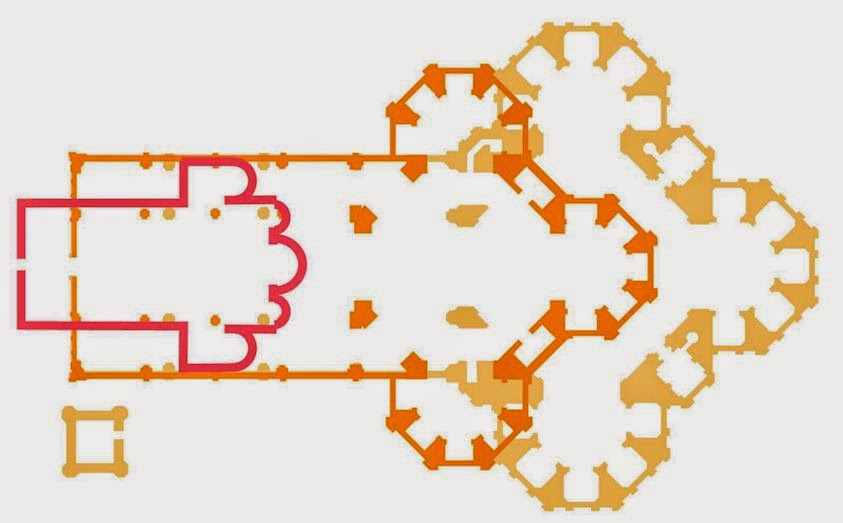
Map showing the floor plans and relative positions of the three churches of the Duomo area in Florence
Map showing the floor plans and relative positions of the three successive churches of the Duomo area.

But, as Giovanni Villani says in his 14 C Nuova Cronica, Santa Reparata at a certain point began to seem too rough and too small for the newly ambitious of Florence of the 13 C, so much so that in 1293 it was decided to reconstruct the building. On the 8 September, 1296 the cornerstone was laid to the new cathedral. This new Basilica di Santa Maria del Fiore (Il Duomo di Firenze, as it is normally called), was begun in 1296 in the Gothic style to the design of Arnolfo di Cambio. By 1375, the old church Santa Reparata had been pulled down and the new Cathedral finished in 1436 with final completion of the dome engineered by Filippo Brunelleschi (the yellow floor plan above), the construction of this vast project having lasted 140 years, the collective efforts of several generations, interrupted by the Black Death.

Basilica di Santa Maria del Fiore (Il Duomo di Firenze)
The excavations are entered down a staircase situated in the nave of the cathedral.

A single 10 Euro ticket allows you access to all parts of the Duomo, including the crypt.

Crypt of Santa Reparata Hours:
Monday, Tuesday, Wednesday, Friday: 10am-5pm
Thursday: May and October 10am-4pm, July through September 10am-5pm, January through April and November and December 10am-4.30pm
Saturday: 10am-4.45pm

Closed: Sunday, Christmas Day, New Year’s Day, Epiphany, Maundy Thursday, Good Friday and Holy Saturday, Easter Sunday, Feast of St. John (24 June), Feast of the Assumption (15 August), Nativity of the Blessed Virgin Mary (8 September), All Saints’ Day (1 November).

Tuscany Toscana
Don't forget to visit my Tuscany
Travel Guide!

Up-to-date news on what to see and where to stay in Chianti and all of Tuscany.

Tuscany Travel Guide

Author: Anna Maria Baldini

All content copyright © ammonet Italian Web Site Promotion 2014. All rights reserved.

Sunday, 7 July 2013

The Baptistry in Florence is open during the evening three nights each week during summer 2013

As an addition to my post about museum cocktail evenings in Florence, it has just been announced that the Baptistry in Florence is open during the evening three nights each week during summer 2013. The Baptistry of San Giovanni, located next to the Duomo and Giotto's campanile, will stay open until 11pm on Thursday, Friday and Saturday nights until 28 September. Entry is still by ticket, but you will have the opportunity to gaze up at some of the most beautiful mosaics in Italy outside of Ravenna in much less crowded and cooler conditions than by day.

Baptistry in Florence is open during the evening three nights each week
The Baptistry of San Giovanni in Florence
A stroll around central Florence during a warm summer evening is always a pleasure - the Italian expression passeggiata encapsulates this quality perfectly. The baptistry is artfully illuminated at night to emphasize its Romanesque architecture - it is, in fact, not only one of the best-loved structures in Florence but also one of the oldest, having been built in its current form between 1059 and 1128. An earlier octagonal baptistry was erected here in the late fourth or early fifth century, very likely over the remains of a Roman watch tower, and, according to some sources, at the behest of Theodolinda, queen of the Lombards (570-628), to commemorate the conversion of her husband, King Authari.

Mosaics in the Baptistry of San Giovanni in Florence

From outside, you can admire the exquisite bronze doors by Ghiberti and Pisano but, to me, the interior, with its magnificent cycles of mosaics, is without equal. The various panels tell stories from the Bible, most famously a representation of the Last Judgement and the grisly punishments that await those sinners consigned to Hell. And don't forget to give some attention to the mosaic marble pavement which was begun in 1209. There was also an octagonal font in the Baptistry, its footprint is still clearly visible in the middle of the floor. This font, which originated in the church of Santa Reparata, was placed here in 1128 and was taken away again in 1571.

In summary, the Baptistry is now joins the many other enjoyable activities available during the evening this summer in Florence.

Vacation accommodation in Tuscany
www.bella-toscana.com
Author: Anna Maria Baldini

All content copyright © ammonet Italian Web Site Promotion 2013. All rights reserved.