Showing posts with label exhibition. Show all posts

Tuesday, 17 May 2022

Donatello exhibition in Florence

This year's block-buster exhibition in Florence is dedicated to Donatello and goes under the not unjustifiably immodest name of "Donatello, the Renaissance." As for some of the previous exhibitions at the Palazzo Strozzi, the Donatello show is partially housed also at the Bargello (separate ticket required). Opening hours are 10 am to 8 pm every day except Thursday when the doors remain open until 11 pm. Donatello, the Renaissance stays in Florence until 31 July 2022, after which it will travel, with variations on the loans and probably the catalogue, to the Staatliche Museen in Berlin and the Victoria & Albert Museum in London. Tickets are linked to an entry time slot and can be booked on-line at https://palazzostrozzi.vivaticket.it/.

Donatello Exhibition in Florence 2022

Donatello Exhibition in Florence 2022

I strongly recommend this exhibition to any one interested in Renaissance art - indeed, to almost any art lover. The aim of the exhibition is to reconstruct the artistic development of Donatello throughout his long life (1386 to 1466) and to confirm him as one of the most important and influential masters of the Italian Renaissance by exhibiting his work next to workd by other Italian Renaissance masters such as Brunelleschi, Masaccio, Andrea Mantegna, Giovanni Bellini, Raphael and Michelangelo. A remarkable number of Donatello's works, normally never loaned, have made their way to the Palazzo Strozzi for this exhibition, making it far more ambitious than the two exhibitions organised in 1985 and 1986 commemorating the 600th anniversary of Donatello's birth. Not much is missing and two pieces that are mssing can be seen nearby - the Magdalene of the Duomo Museum and the Giuditta of the Palazzo Vecchio.

Donatello Exhibition at the Palazzo Strozzi in Florence

Donatello Exhibition in Florence 2022

It's a great exhibition - don't miss it if at all possible!


Tuscany Toscana
Don't forget to visit my Tuscany
Travel Guide!

Up-to-date news on what to see and where to stay in Chianti and all of Tuscany.

Tuscany Travel Guide

Author: Anna Maria Baldini

All content copyright © ammonet Italian Web Site Promotion 2022. All rights reserved.

Sunday, 5 December 2021

Medioevo a Pistoia - the Middle Ages in Pistoia - an art exhibition not to be missed

From 27 November, 2021 until 8 May, 2022, an excellent art exhibition is taking place in Pistoia: Medioevo a Pistoia - the Middle Ages in Pistoia.

In 1140 at the behest of Bishop Atto, the relic of San Jacopo arrived in Pistoia, placing this Tuscan town onto one of the most important European pilgrimage routes, and eventually making it an international economic and artistic centre. This art exhibition features 60 Pistoian masterpieces from the Romanesque and Gothic periods, illustrating for the first time the extraordinary panorama of the arts in Pistoia from the 12 C to the beginning of the 15 C. Many of these works have been restored especially for this exhibition and they are absolutely worth seeing.


 Altarpiece by Taddeo Gaddi on show in Pistoia at Medioevo a Pistoia.

During the period covered by the exhibition, Pistoia was well provided with enlightened patrons who attracted artists such as the sculptors Guglielmo, Guido da Como, and Nicola and Giovanni Pisano. At the end of the 12 C, two great though anonymous artists were in the Pistoia: the Master of the Crucifix (n. 434 of the Uffizi) and the Master of Santa Maria Primerana. Not only sculptors and painters were attracted to Pistoia but, as in other Tuscan cities of the time, also goldsmiths, resulting in works like the Silver Altar of San Jacopo. There were also highly skilled miniaturists active during this period, especially in the workshop of the Master of Sant’Alessio in Bigiano, and the elegant illustrations by the Master of the Bracciolini Chapel in the Divine Comedy preserved in the National Library of Naples were produced in Pistoia during the 15 C.

Pistoia exhibition manuscript with miniatures

Pistoia exhibition manuscript with miniatures

During the 14 C, Pistoia was the home of artists of the calibre of Lippo di Benivieni, Taddeo Gaddi and Niccolò di Tommaso, who place Pistoia among the leading art cities of Tuscany - not to mention the Majesty and Angels by Pietro Lorenzetti. The latter is on loan from the Uffizi, and was restored for this exhibition.

Romolo di Senuccio Salvi, Reliquary of the Cross (1379-1383)

 Romolo di Senuccio Salvi, Reliquary of the Cross (1379-1383)

The works of art displayed at the "Middle Ages in Pistoia" exhibition are all the more interesting for their web of relationships with the masterpieces preserved in the churches and museums of Pistoia. The exhibition provides its visitors with a route by which they may discover mediaeval Pistoia via the churches of Sant'Andrea and San Giovanni Fuorcivitas (free admission with the exhibition ticket), the cathedral of San Zeno (see the Silver Altar of San Jacopo), and the churches of San Bartolomeo in Pantano, San Paolo, San Domenico, San Francesco, the church of Tau and the Baptistery.

Medioevo a Pistoia is an opportunity to spend an entire day exploring beautiful art works in a relatively concentrated area of a town that is often unjustly neglected by visitors. Don't miss it!

Medioevo a Pistoia takes place in the Antico Palazzo dei Vescovi piazza del Duomo, 3 and in the Museo Civico Piazza del Duomo, 1. Reservations and covid Green Passes (or equivalent) are required and tickets can be bought online at https://www.fondazionepistoiamusei.it/biglietteria/en/.

Tuscany Toscana
Don't forget to visit my Tuscany
Travel Guide!

Up-to-date news on what to see and where to stay in Chianti and all of Tuscany.

Tuscany Travel Guide

vacation accommodations in Tuscany


Author: Anna Maria Baldini

All content copyright © ammonet Italian Web Site Promotion 2021. All rights reserved.

Friday, 19 February 2016

A fascinating Etruscan exhibition in Cortona focussed on the interpretation of Etruscan script

From 19 March 2016 until 31 July 2016, a fascinating Etruscan exhibition focussed on the script used in Etruscan writing is taking place at the Museo dell'Accademia Etrusca e della Città di Cortona, in Cortona - itself an Etruscan foundation, site of several Etruscan tombs and a member of the Etruscan dodecapoli. I strongly recommend this exhibition to anyone with an interest in this fascinating people.

Etruscan tessera d'ospitalità
The aspect of the Etruscan language that most immediately springs to mind is that even now, despite intensive study, it is still not well understood, even though it can be read fairly easily when written down, as it usually is, in a variant of the Greek alphabet. This is especially the case with regard to the specific meanings of individual words, which are unrelated to the vocabulary of the Indo-European languages such as the Greek and Latin. This reduced level of comprehension of the Etruscan language is the result of the paucity of extant long texts - the entire Etruscan literary corpus has been lost - and of the brevity and repetitiveness of Etruscan funerary, legal and commercial texts.This has helped to create an aura of mystery around the Etruscan language and the Etruscan people. The mystery of the origin of the Etruscans draws nourishment from a language that seemed incomprehensible and archaic, even to contemporary ears. In addition, this air of mystery was exacerbated by 19th century archaeological excavations that were mainly investigations of graves and everything that goes with them, including the meticulous Etruscan funerary rituals in preparation for the afterlife. Lists of Etruscan gods and goddesses are well-established, but little else.

Etruscan perfume jar
The spread of Etruscan language and its script is an unusual topic since we (or, anyway, I) generally think of the Etruscans as a static people whiling away their time quaffing wine and playing double pipes in the Tuscan sunshine. However, it seems there was probably a degree of diffusion of the Etruscan language through conquests, trade contacts and, especially, the spread of Etruscan religion around the Mediterranean basin between the 7th century and the 1st century BC. Recent discoveries of Etruscan inscriptions at a site near Lattes, in the south of the prefecture of Montpellier, suggest the presence of Etruscan merchants in France, possibly for an extended period. It is even possible that Germanic runes (Futharc) are derived from the Etruscan alphabet.

Etruscan Tabula cortonensis
This exhibition and its catalogue beautifully illustrate the latest research in the field of of Etruscan syntax, grammar and vocabulary, based on numerous inscriptions, some of them completely new. Some major examples of Etruscan epigraphy are displayed together for the first time. Progress in the comprehension of the Etruscan language was assisted by the discovery in Cortona a few years ago of the Tabula cortonensis, the third longest Etruscan text so far known (after the Liber lintaeus of Zagreb and the Capua Tablet). The Tabula cortonensis is a land transfer agreement, some 40 lines long.  Of the longer inscriptions, the most important is the Zagreb mummy wrapping or Liber Lintaeus found in Egypt in the 19th century and carried back to Yugoslavia by a traveler. It had originally been a book made of linen, which was cut up into strips to be wrapped around a mummy. With about 1,300 words, written in black ink on the linen, it is the longest existing Etruscan text. It contains a calendar and instructions for sacrifice, which are sufficient to convey some idea of Etruscan religious literature.

Etruscan liber lintaeus
Of course, bilingual texts are the key to interpretation of an unknown language, and for Etruscan there is a single important example, namely the Pyrgi Lamellae, two inscribed gold plaques found at the site of the ancient sanctuary of Pyrgi, the port city of Caere, modern Cerveteri, 50-60 km NNW of Rome. These plates provide two texts of significant length (about 40 words) and of similar content, one in Etruscan and the other in Phoenician. They offer substantial data for the elucidation of Etruscan by way of Phoenician, a known language. The find is also an important historical document that records the dedication to the Phoenician goddess Astarte of a "sacred place" in the Etruscan sanctuary of Pyrgi by Thefarie Velianas, king of Caere, early in the 5th century BC.

The Etruscan Pyrgi Lamellae


My review of the Etruscan exhibition in Cortona, March through July 2014.


Tuscany Toscana
Don't forget to visit my Tuscany
Travel Guide!

Up-to-date news on what to see and where to stay in Chianti and all of Tuscany.

Tuscany Travel Guide


vacation accommodations in Tuscany

Author: Anna Maria Baldini

All content copyright © ammonet Infotech website promotion 2016. All rights reserved.

Thursday, 22 October 2015

Museo dell'Opera del Duomo in Florence re-opens on 29 October 2015 after extensive renovations

Great news for art enthusiasts! One of the most interesting art museums in Italy, the Museo dell'Opera del Duomo in Florence, re-opens on 29 October 2015 after extensive renovations. Opera del Duomo in this case means works of art from the cathedral, and the museum is located very near the Duomo, in the same building in which Michelangelo carved his famous marble "David". Many important art works have been moved over the years from the interior of the Duomo, from its facade, from Giotto's campanile and from the Baptistry to keep them safe from the elements, pigeons and humans. The majority of the larger works are sculptures and the smaller works are beautiful liturgical objects. Many of these art works have been restored during the work on the museum, and are very creatively displayed within. My favorite among them are the original and restored "Gates of Paradise" doors from the Bapistry, the result of 27 years of work by Ghiberti.

Museo dell'Opera del Duomo in Florence
Detail from a panel of Ghiberti's "Doors of Paradise"
There are around 750 works of art in the museum and, of those, some 200 are being displayed after being restored. Among the works on display are sculptures by Michelangelo, Donatello and Arnolfo di Cambio. There are also large scale reconstructions that provide a glimpse into the history of the Duomo, including the facade before it received its current decorations towards the end of the 19th century.

Pietà dell'Opera del Duomo, Michelangelo, Firenze, Italy
Michelangelo's mysterious Pietà

Note that you can obtain a wonderful view of the dome of the cathedral from a small room at the top of the museum and from the outdoor terrace on the third floor.


Tuscany Toscana
Don't forget to visit my Tuscany
Travel Guide!
Up-to-date news on what to see and where to stay in Chianti and all of Tuscany.

Tuscany Travel Guide


All content copyright © ammonet Infotech website promotion 2015. All rights reserved.

Tuesday, 9 June 2015

Antiques fair in Florence: 29th Biennale Internazionale dell’Antiquariato di Firenze

This year, 2015, the Biennale Internazionale dell’Antiquariato di Firenze will take place in the Palazzo Corsini in Florence from 26 September until 4 October. This Biennale is the oldest continuously running art and antiques fair in Europe and is now without doubt the most prestigious and international of all the Italian art and antiques fairs. It was originally located in the Palazzo Strozzi and since 1997 has found a home in the Palazzo Corsini, a fine 17 C palace on the Arno. In fact, the beauty of the Palazzo is an additional reason to visit this antiques fair in Florence.

Biennale Internazionale dell’Antiquariato di Firenze at the Palazzo Corsini in Florence
Palazzo Corsini in Florence viewed across the Arno

A reported 74 dealers will offer top of the line sculpture, porcelain, furniture and old master paintings and drawings for sale. Here is a painted wooden Bust of a Young Woman by the Renaissance master Antonio del Pollaiolo, dated between 1465 and 1470, and offered for sale that the 2013 Florence biennale.

Bust of a Young Woman by the Renaissance master Antonio del Pollaiolo
We cannot know until the show what the dealers will have for us this year, but there are sure to be some spectacular treasures available for those with a few thousand to spare. And all displayed in the beautiful interior of the Palazzo Corsini.

Antiques fair in Florence


See you in Florence late September, early October!

Tuscany Toscana
Don't forget to visit my Tuscany
Travel Guide!

Up-to-date news on what to see and where to stay in Chianti and all of Tuscany.

Tuscany Travel Guide


vacation accommodations in Tuscany

Author: Anna Maria Baldini

All content copyright © ammonet Infotech website promotion 2015 - 2016. All rights reserved.

Saturday, 22 March 2014

Etruscan exhibition in Cortona, March through July 2014

A not to be missed Etruscan exhibition in Cortona has just opened!

Etruscan Enchantment. From the secrets of Holkham Hall to the wonders of the British Museum.

Palazzo Casali, Cortona. 22 March through 31 July 2014.
 
Etruscan exhibition in Cortona, March through July 2014
Etruscan terracotta head from the Etruscan exhibition in Cortona, March through July 2014
Cortona was one of the cities making up the Etruscan Dodecapoli league and parts of the Etruscan walls and gateways, as well as several Etruscan tombs are still to be seen there. In 1727, inspired by the publication of Dempster's De Etruria Regali, the Etruscan Academy was founded in Cortona by three brothers, Marcello, Filippo and Ridolfino Venuti. With the foundation of a museum that houses splendid Etruscan artifacts, the Etruscan Academy of Cortona became the first institution in Europe that specialised in the rediscovery and study of the Etruscans. In 2005, the museum was doubled in size to become the Museum of the Etruscan Academy and of the City of Cortona (MAEC).

During the second quarter of 2014, there is an excellent exhibition devoted to the Etruscans taking place at MAEC in Cortona. This exhibition, Etruscan Enchantment. From the secrets of Holkham Hall to the wonders of the British Museum, was inspired by recent archival finds related to the Grand Tour of Thomas William Coke, 1st Earl of Leicester (1754 – 1842). During the first years of the 18 C., Coke, known as Coke of Norfolk or Coke of Holkham and who later became an immensely popular MP and an agricultural reformer, was sent on the Grand Tour by his father and his great-aunt. The latter offered him £500 to not go to university, which she regarded as a den of vice, and he used the money to finance his tour.

Bronze masterpiece of Etruscan art at the Cortona Etruscan exhibition
Bronze masterpiece of Etruscan art at the Cortona exhibition

Coke was entranced by the Etruscan artifacts that he saw in Italy, both in public displays and private collections. Upon his return to England, he organised and paid for the publication, in 1726, of the manuscript De Etruria Regali by Thomas Dempster (1579 – 1625). A century earlier, Dempster had been the first to assemble a history of the Etruscan people, creating the first “handbook of Etruscology” and summarising everything that was known about Etruscan civilisation up to that time. Dempster was a Cambridge-educated and very quarrelsome Scotch aristocrat. Recommended by Pope Paul V, who had previously incarcerated him as a spy (which he probably was), Dempster eventually found refuge and patronage under Grand Duke Cosimo II. The latter made him a professor in Pisa and commissioned his work on the Etruscans. After three years of intense research, Dempster presented Cosimo with his magnum opus, the manuscript of De Etruria Regali Libri Septem, "Seven Books about Royal Etruria", written in Latin. It was considered a brilliant work by all who saw it.
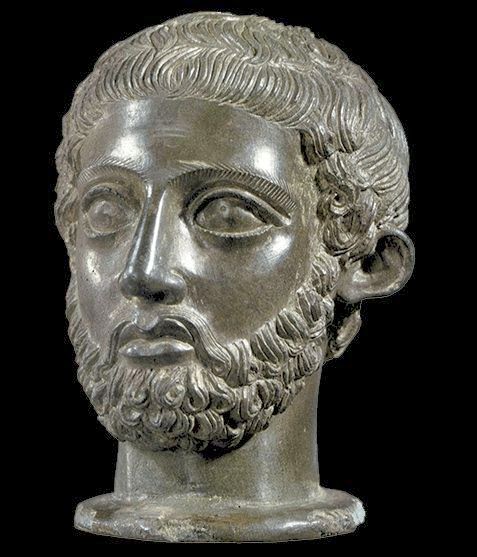
Etruscan bronze portrait bust at the Cortona exhibition
Etruscan bronze portrait bust
After publication, the manuscript remained at Coke's Holkham Hall and recently the preparatory drawings and copper plates used for the printing of the De Etruria were found in the archives there. These illustrations formed the inspiration for the present exhibition which shows many of the drawings and paintings from Holkham Hall plus over fifty works from the British Museum, never lent before, and many more from Etruscan museum galleries all around Italy.

Etruscan ceramic from the Cortona exhibition

The exhibition recreates the atmosphere of excitement that followed the publication of De Etruria, and documents the role of the Grand Tour to Italy in the 18 C and 19 C, and the fascination with the Etruscans and the Etruscan style in Britain during that period. It presents to the public for the first time ever some iconic masterpieces of that ancient people - such as the Aule Metele and the Graziani Putto - alongside the original drawings for De Etruria as well as the Etruscan masterpieces gathered together by the British Museum during the course of three centuries. Many of these Etruscan artifacts are wonderful works of art in their own right, and displayed together form a show that should not be missed.

Exhibition website.

The Etruscans – who were they and where did they come from?

Vacation accommodation in Tuscany
www.bella-toscana.com


All content copyright © ammonet Italian Web Site Promotion 2014. All rights reserved.

Wednesday, 1 May 2013

"The Springtime of the Renaissance" - a great exhibition currently showing in Florence

The Strozzi Palace is currently hosting a wonderful art exhibition under the title "The Springtime of the Renaissance" (La Primavera del Rinascimento. La scultura e le arti a Firenze 1400-1460. Palazzo Strozzi.). Everyone with an interest in the history of art, especially Renaissance art, should seize the opportunity to spend half a day (or a whole day) at this exhibition here in Florence or, from September, at the Louvre in Paris, if they possibly can. Every year there is a very good exhibition at the Palazzo Strozzi, but this year (2013), the Bargello and the Louvre have put together a truly fabulous show of early Florentine masterpieces displayed alongside equally beautiful Classical and late Gothic works of the kind from which the Florentines drew inspiration.

La Primavera del Rinascimento. La scultura e le arti a Firenze 1400-1460
The modern, the renaissance and the classical - a study in character.

The creators of this exhibition suggest that it was from sculpture more than painting that the Renaissance sprang, and they see the initial glimmer in the form of the two bronze relief panels submitted in 1401 by Brunelleschi and Ghiberti for the competition to create a set of new bronze doors of the Florentine baptistery. Sculpting scenes based on an identical biblical story, both artists combined Gothic elegance of costume and scenery with human figures inspired by classical sculpture. From this point on, the exhibition is dominated by the sculpture and spirit of Donatello, who did his apprenticeship in the workshops of Brunelleschi and Ghiberti. Donatello strongly influenced his contemporaries, both sculptors and painters, among whom we may count Michelozzo, Masaccio, Filippo Lippi, Paolo Uccello and Andrea del Castagno, stylistically and through his introduction of perspective in his low relief works.
Donatello at the Palazzo Strozzi in Florence
Single point perspective, classical depiction of the human form and draperies
- Donatello's St George and the Dragon in very shallow relief.

The spatial organisation of the exhibition is excellent, not least with the placement of a huge, 4th century BC, bronze horse's head, the Medici Protome, visible through an arch from the first room of the show. Later, when we enter this room, Donatello's Carafa Protome, is revealed, and we can easily see why it was long thought to be a classical work.
Donatello's Carafa Protome
Donatello or ancient Greek? Visit this exhibition to find out which!

At the appropriate points in the exhibition, Classical sculpture including portrait busts and sarcophagus friezes, are juxtaposed with early Renaissance works in which the artists were evidently struggling to relearn the artistic skills of the Greeks and Romans, especially in depicting the human form. At other points, the juxtapositions of contemporary paintings and sculptures emphasize how painters set out to make their paintings more sculptural

The Springtime of the Renaissance
Painters set out to make their paintings more sculptural.

During my visit at the end of April, viewers were sparse and I often had entire rooms to myself. You can also view the exhibits close up, with a magnifying glass if you wish (and have one with you). In most of their native museums, this is surely not possible. Try to attend this show early or at least in Florence. It will definitely be packed out when it moves to Paris

More about La Primavera del Rinascimento.

Recommended vacation accommodation in Chianti towns, villages and countryside.


Author: Anna Maria Baldini

All content copyright © ammonet Web Site Promotion 2012 - 2013. All rights reserved.

Tuesday, 9 April 2013

"The treasure of the Lombards" - “Il Tesoro dei Longobardi” - an exhibition in Cortona 2013

If you spend a bit of time reading about the history of Tuscany (or of anywhere in northern Italy) during the Italian Dark Age, you will soon encounter the Lombards or Longobards (sometimes written Langobards) and Longobardi in Italian. These were a Germanic tribe who established a kingdom in Italy that lasted from 568 to 774. Their castles dot Tuscany and their names are still preserved in the appellations of towns like Radicondoli and, of course, in the name of the region of Lombardy. The Lombards were like the Normans, a small tribe that originated somewhere in the far north of Europe and which seem never to have stayed in one place for more than a generation. Instead, they migrated and conquered, adopting the language of their subjects and leaving their architectural legacy as far south as Sicily. The Lombard Kingdom of Italy wrested northern Italy from the Byzantines and was in turn conquered by Charlemagne and integrated into his Empire. However, Lombard nobles continued to rule parts of the Italian peninsula until well into the 11 C. It seems appropriate that the last of the Italian Lombards were conquered by the Normans and incorporated into their County of Sicily.

“Il Tesoro dei Longobardi
A Lombard brooch

An excellent exhibition on the art of the Longobards, under the title Il Tesoro dei Longobardi, will be on display in Cortona at the Palazzo Casali (MAEC - Museo dell'Accademia Etrusca) from 12 April until 30 June 2013. This is the second exhibition devoted to ancient gold work in Italy, the 2007 exhibition having been devoted to the Etruscans. This show brings together Lombard decorative gold work from a number of Italian museums and presents it both to throw light on the artistic culture of the Italian Dark Age and also in relation to contemporary jewellery that has been inspired by Lombard work.

The treasure of the Longobards
The Treasure of the Longobards Exhibition in Cortona

The first part of the exhibition is an introduction to the history and customs of the Lombards in Italy based heavily on the amazing finds from two recent tomb excavations at the "Necropoli della Ferrovia" near Cividale in Friuli plus finds in the area of Cortona.

The second part presents different objects from the 19 C excavations of the necropolis of Cividale del Friuli, including coins, clasps, broaches, belt buckles and pendants, as well as a copy of the famous golden disc ornament decorated with the image of a knight, together a series of objects from the coin cabinet of the National Archaeological Museum in Florence.

Longobard clasp
Longobard gold work

The third part of the exhibition includes about 30 pieces of fine craftsmanship, inspired by the world of the Lombards, created by master goldsmiths from Arezzo.

Highly recommended to anyone interested in a fascinating period of history and/or gold workmanship and the decorative arts.

More about Cortona.

More about the Etruscan Museum of Cortona.

My recommended places to stay in Tuscany.


Author: Anna Maria Baldini