Showing posts with label museums. Show all posts

Saturday, 2 April 2022

Free entry to state museums in Florence on the first Sunday of each month

Starting on the 3rd of April, 2022, there will be free access for all visitors to state museums, archaeological parks and cultural sites in Florence and elsewhere in Tuscany on the first Sunday of the every month. This might not apply to municipal museums and other sights that belong to the city of Florence.

Free entry into Florence museums

 Florence is one of several cities in Italy that have had, for several years, a  day of the month when entry to many museums is free for residents. In Florence the programme is known as Domenica Metropolitana. All of this was disrupted by the COVID-19 pandemic. However, as the severity of the pandemic declines and the rules are slowly relaxed, state-owned sights are being added to the municipal ones that are included in the Domenica Metropolitana programme. In Florence, this allows residents of the metropolitan city of Florence to visit city museums for free on first Sunday of every month, and all visitors to enter state-owned sights free.

Although it has been reported that from the 1st of April 2022, access to historical sights, museums, galleries and gardens no longer requires the covid vacination Green Pass (or equivalent document providing evidence that you have been vaccinated and have received a booster shot within the past 6 months), it is unclear whether this applies everywhere. It therefore remains advisable for you to have your Green Pass with you. The requirement to wear a face mask remains in place in all instances.

Tuscan sights open to all for free on the first Sunday of every month include: 

Antiquarium nazionale di Sestino
Via Marche - 52038 Sestino (AR)

Area archeologica di Vetulonia
vie Case di Siena, s.n.c. - 58043 Castiglione della Pescaia (GR)

Basilica di San Francesco
piazza San Francesco, 1 - 52100 Arezzo (AR)
    
Cenacolo di Andrea del Sarto a San Salvi
via di San Salvi, 16 - 50135 Firenze (FI)

Eremo di San Leonardo al Lago
strada dell'Osteriaccia, 4 - 53035 Monteriggioni (SI)

Galleria dell'Accademia di Firenze
via Ricasoli - 50122 Firenze (FI)

Gallerie degli Uffizi – Gli Uffizi
piazzale degli Uffizi - 50122 Firenze (FI)

Gallerie degli Uffizi - Tesoro dei Granduchi (Palazzo Pitti)
piazza Pitti - 50125 Firenze (FI)
    
Gallerie degli Uffizi - Museo della Moda e del Costume (Palazzo Pitti)
piazza Pitti - 50125 Firenze (FI)
    
Gallerie degli Uffizi - Galleria Palatina e Appartamenti Reali e Imperiali (Palazzo Pitti)
piazza Pitti - 50125 Firenze (FI)
    
Gallerie degli Uffizi - Giardino di Boboli
piazza Pitti - 50125 Firenze (FI)
    
Gallerie degli Uffizi - Museo delle porcellane
piazza Pitti - 50125 Firenze (FI)

Gallerie degli Uffizi – Galleria d’Arte Moderna (Palazzo Pitti)
piazza Pitti - 50125 Firenze (FI)

Museo archeologico nazionale ed Area archeologica di Cosa
via delle Ginestre, s.n.c. - 58015 Orbetello (GR)

Museo archeologico nazionale di Firenze
piazza S.S. Annunziata, 9b - 50122 Firenze (FI)

Museo archeologico nazionale “Gaio Cilnio Mecenate” e Anfiteatro romano
via Margaritone, 10 - 52100 Arezzo (AR)

Museo delle arti e tradizioni popolari dell’Alta Valle del Tevere - Palazzo Taglieschi
piazza Mameli, s.n.c. - 52031 Anghiari (AR)
    
Museo di Casa Vasari
via XX settembre, 55 - 52100 Arezzo (AR)

Museo nazionale della Certosa monumentale di Calci
via Roma, 79 - 56011 Calci (PI)
    
Museo nazionale delle residenze Napoleoniche Palazzina dei Mulini
piazzale Napoleone, 1-3 - 57037 Portoferraio (LI)

Museo nazionale delle residenze Napoleoniche Villa S. Martino
via di San Martino - 57037 Portoferraio (LI)
    
Museo nazionale di Casa Giusti
viale Vincenzo Martini, 18 - 51015 Monsummano Terme (PT)
    
Museo nazionale di Palazzo Mansi
via Galli Tassi, 43 - 55100 Lucca (LU)
    
Museo nazionale di San Matteo
piazza S. Matteo In Soarta - 56126 Pisa (PI)

Museo nazionale di Villa Guinigi
via della Quarquonia s.n.c. - 55100 Lucca (LU)

Museo nazionale etrusco e necropoli di Chiusi
via Porsenna, 93 - 53043 Chiusi (SI)
    
Museo nazionale etrusco, Necropoli di Poggio Renzo e Tomba del Colle
via della Pellegrina - 53043 Chiusi (SI)
    
Musei del Bargello - Museo nazionale del Bargello
via del Proconsolo, 4 - 50122 Firenze (FI)
    
Parco di Villa Il Ventaglio
via Giovanni Aldini, 10/12 - 50131 Firenze (FI)
    
Pinacoteca nazionale di Siena
via San Pietro, 29 - 53100 Siena (SI)
    
Villa medicea della Petraia
via della Petraia, 40 - 50141 Firenze (FI)
    
Villa medicea di Cerreto Guidi e Museo storico della Caccia e del Territorio
via Ponti Medicei, 7 - 50050 Cerreto Guidi (FI)

Free entry on the first Sunday of every month in Florence
 

Tuscany Toscana
Don't forget to visit Elena Spolaor's
Travel Guide!

Up-to-date news on what to see and where to stay in Chianti and all of Tuscany & Umbria.

Chianti Travel Guide

Author: Anna Maria Baldini

All content copyright © ammonet Web Site Promotion 2015 - 2022. All rights reserved.

Monday, 26 April 2021

Are the museums open in Florence?

As the traditional tourism season approaches and we all hope for Italy to be able to re-open to visitors, the question is "Are the museums open in Florence?" The answer is YES some sights opened today since Tuscany, along with most but not all of Italy, is now in Covid status "orange", and others will open during the course of May 2021. The Regions are opening up and relaxing their anti-covid precautions as the number of new infections continues to drop.

The Duomo (Cathedral) of Florence is open for visitors from Monday to Saturday, 10:15 am - 5:00 pm and access to the dome itself is possible daily 12:45 - 7:00 pm; Saturday and Sunday 12:45 - 5:30 pm. 


 On 16 May, Giotto’s Campanile will reopen daily 12:45 - 7:00 pm, and the Opera del Duomo Museum will be open on Saturdays, Sundays and Mondays 10:15 am - 5 pm. The Baptistery remains closed for restoration. 


On Tuesday, April 27, the Boboli Gardens reopen daily (apart from the first Monday of the month) 8:15 am - 6:30 pm.


The Uffizi and Palazzo Pitti will reopen on 4 May. Opening hours (Uffizi): 8:15 am - 6:30 pm. Opening hours (Palazzo Pitti): 1:30 - 6:30 pm. Booking is now required at weekends to limit numbers, but bookings are not required for other days.


The Palazzo Vecchio is open daily 9:00 am - 7:00 pm and 9:00 am - 2:00 pm on Thursdays. 

The Museo Novecento is open daily 11:00 am - 7:00 pm and 1100 am - 2:00 pm on Thursdays. 

The Brancacci Chapel is open on Wednesdays, Thursdays and Fridays 10:00 am - 5:00 pm.


The Bardini Gardens are open 10:00 am - 6:00 pm until at least the end of May. Booking is required on the weekend and on holidays.


Tuscany Toscana
Don't forget to visit my Tuscany
Travel Guide!

Up-to-date news on what to see and where to stay in Chianti and all of Tuscany.

Tuscany Travel Guide

vacation accommodations in Tuscany


Author: Anna Maria Baldini

All content copyright © ammonet Italian Web Site Promotion 2021. All rights reserved.

Sunday, 7 April 2019

Exhibition of drawings at the Museum Horne, Florence

A wonderful exhibition of drawings at the Museum Horne, Florence under the title "Souvenir d'Italie" has just opened and will continue to be on show until 30 July, 2019. These drawings, selected around the theme of travels in Italy, are from the collection of Herbert Horne.

exhibition of drawings at the Museum Horne, Florence
An exhibition of drawings at the Museum Horne, Florence until 30 July 2019

Herbert Percy Horne was born in London in 1864. He was an amazing man who crammed a huge amount into a tragically short life (he was only 52 years old when he passed away in Florence in 1916). Horne was an architect and a man of many interests in the fields of art, including font design, literature and music. He was an associate of the Rhymers' Club in London and he edited the magazines The Century Guild Hobby Horse and The Hobby Horse for the Century Guild of Artists.

Herbert Percy Horne
Herbert Percy Horne
Horne first visited Italy in 1889 and kept an illustrated journal of his travels, and art and architectural research. His monograph on Sandro Botticelli from 1908 is still recognised as of exceptional quality and thoroughness. Later in life, he settled in Florence, restoring a Renaissance palazzo into which he eventually moved. He donated his collection of arts and handicrafts of the 14 C and 15 C to create the Museo della Fondazione Horne in Florence.

A room in the Museo Horne, Florence
The museum is housed in the Palazzo Corsi. The Palazzo, the seat of the Museo Horne since 1921, was built on the site of a 13 C building belonging to the Alberti family. It owes its current appearance to a plan for renovation and enlargement commissioned by the brothers Luigi and Simone Corsi from Simone del Pollaiolo, nicknamed ‘il Cronaca’, between 1495 and 1502. The Palazzo Corsi was the property of the Corsi for three centuries, until it passed to the Nencini family in 1812, then to the Fossi family, and in 1896 to the Burgisser family who sold it to Herbert Horne. Horne bought this 15 C “palagetto”, or small palace, in via de’ Benci in 1911 and proceeded to restore it with the aim of creating not so much a museum as a perfect example of the kind of house in which a wealthy Renaissance noble or merchant would have lived. The furnishing of the rooms was completed after his death in 1916 by Count Carlo Gamba and Giovanni Poggi.

A watercolour of the Arno at Firenze looking towards the Ponte alla Carraia, by John Thomas Serres 1790.
Detail of a watercolour of the Arno at Firenze looking towards the Ponte alla Carraia,by John Thomas Serres 1790.

"St. Stephen" by Giotto in the Horne Museum, Florence

The museum houses a unique and extremely valuable collection of paintings, sculptures, ceramics, goldsmith’s work and other artefacts, furniture, plaquettes, seals, fabrics, cutlery and a variety of household and kitchen utensils dating back for the most part from the 14 C to 16 C. The Horne Museum should not be missed during a visit to Florence, and the current exhibition of drawings from Horne's collection makes a visit all the more worthwhile.

More about the Museo Horne.


Tuscany Toscana
Don't forget to visit my Tuscany
Travel Guide!

Up-to-date news on what to see and where to stay in Chianti and all of Tuscany.

Tuscany Travel Guide

Author: Anna Maria Baldini

All content copyright © ammonet Italian Web Site Promotion 2019 - 2021. All rights reserved.

Wednesday, 30 March 2016

Florence Museum Cards :: Florence Museum Passes

Visitors to Florence might want to consider buying a Florence museum pass if they're planning an intensive immersion in Florentine art during their stay. The idea is partly to save money but, more importantly, to not have to join the sometimes long queues outside popular museums. A pass allows you to bypass these queues. There are now two museum passes available - see below.

 Amici degli Uffizi

As of 15 June 2015, the Amici degli Uffizi card gets you into the Uffizi Galleries only. It is valid until the end of the year in which you buy it. You can pick up your Amici degli Uffizi pass at the welcome desk at the Uffizi - don't forget to bring a passport-sized photo for each person to be included. This is a distinct downgrade from the previous rules which allowed entry into numerous other museums and, in my opinion, makes this card useful only for individuals who plan to visit the Uffizi intensively, perhaps throughout the year.

Individual: valid for one adult cost 60 euro.
Family: two adults and two children up to 18 years of age costs 100 euros.
Young people: up to 26 years of age costs 40 euros.

Firenze Card

The Florentine mayor's office announced a new type of museum card, the Florence Museum Card, known as the Firenze Card, that is now available. National and Florentine municipal museums are all included and the pass costs 72 euros for 3 days (72 hours) (tourist pass).

The Firenze Card is valid for 72 hours from the moment of its first use in a museum or on city public transportation. So, for example, if you use it for the first time at 3pm on a Tuesday, you'll be able to enter the museums until 3pm of the following Friday.

The Florence Museum Card provides entry into at least 33 museums, reservations included. The museums are the Palazzo Vecchio, the Uffizi, the Accademia, the Pitti Palace - Boboli Gardens, Opificio delle Pietre Dure, Museo Archeologico, Palazzo Medici Riccardi, Stibbert, Horne, Bardini, Cappella Brancacci, Alinari Photo Museum and others. Private and other museums are still in negotiation.

However, although 33 is a lot of museums, not all are included. Note that the Museo dell'Opera del Duomo, for example, does NOT participate in this programme.

The Firenze Card allows you to enter the Uffizi even when there are no time slots left on the official booking site. Waiting time at the "reserved" queue of the Uffizi will probably be not more than 10 min and sometimes no waiting at all, compared with an hour or more on the open queue at popular times of day. That means the card is essentially as good as having reserved a particular timespot on-line - better, actually, since you don't have to show up at a particular time.

IMPORTANT NOTE: you must obtain separate tickets (free, of course) to climb the cupola of the Duomo (Cathedral), to enter the Baptistry and to enter the associated Museum. You do this by presenting your Firenze card at the appropriate ticket counters BEFORE lining up to enter any of these three venues. Tickets for the Baptistry and Museum can be obtained inside the museum.

The Firenze card allows you to use public ATAF city buses free. There seems to be some confusion on this issue, even among some drivers, Nevertheless, the Firenze card is good for ATAF city buses during its period of validity. It CANNOT be used on the Hop-on Hop-off (HoHo) tourist buses which are run by a private company.

Note that children who under 18 enter free when accompanied by an adult cardholder ONLY if they are citizens of the EU. IMPORTANT STOP PRESS: ask about this if you are non-EU. There has been a confusing news release stating that all STATE-OWNED museums now have free entry to all under 18's. This will sooner or later become law and it seems to apply now to many STATE-OWNED museums. Bring passports to establish age.

Note also that an ordinary ticket and a Firenze card allow you to enter any given museum once only. With the Amici degli Uffizi card you can enter as often as you wish.

The Firenze Card can be bought online - click the link Firenze Card. Some local sales points do not accept credit cards, but the information opposite SMN railway station, for example, does accept credit cards.

It will be important for you to do your arithmetic. For example, for a family of four, the Amici degli Uffizi pass costs 100 euros and is good until 31 December of the year you buy it. The Museum Card, good for three days, will cost 288 euros for the same family but gets you into a great many more museums and galleries. And of course it can save you hours because you skip the queues at ticket offices.

By the way, the OFFICIAL website for the Bargello, the Uffizi and other museums in Florence is: http://www.polomuseale.firenze.it/en/

And the OFFICIAL website for buying tickets is: www.b-ticket.com/b-ticket/Uffizi/default.aspx

There are a number of other websites with official-sounding names and domain names that are agencies charging exorbitant prices for tickets, reservations and other services.

Firenze Card can be purchased in the following sales points in Florence:
  • Tourist Info Point, Piazza Stazione 4 - From Monday to Saturday 8.30 am - 7.00 pm; Sunday 9.00 am - 2.00 pm. Closed on 1 January, 1 May, 25 December.
  • Tourist Info Point, Via Cavour 1 red - From Monday to Saturday 8.30 am - 6.30 pm. Closed Sundays and holidays.
  • Museo di Palazzo Vecchio Info Point, Piazza della Signoria - From Monday to Sunday 9.00 am - 11.00 pm - Thursday and midweek holidays 9.00 am - 1.00 pm
  • Palazzo Pitti, Piazza Pitti 1 - From Tuesday to Sunday 8.15 am - 6.20 pm - Closed on Monday; 1 January, 1 May, 25 December.
  • Museo del Bargello, Via del Proconsolo 4 - Every day  8.15 am - 4.20 pm - Closed on the 1st, 3rd and 5th Sunday and 2nd and 4th Monday of each month
  • Uffizi Gallery, Piazzale degli Uffizi - Tel. +39 (0)55 290249 - From Wednesday to Sunday 8.15am - 6.20pm; on Tuesday 8.15 am - 9.30 pm - Closed Monday, 1 January, 1 May, 25 December.

And, finally, many museums offer free entry for everyone on the last Tuesday of the month.


Vacation accommodation in Tuscany
www.bella-toscana.com
  Vacation villas, houses and B&Bs in Chianti  

All about Chianti, Italy

The sights of Tuscany, Italy


Tuscany Toscana
Don't forget to visit Elena Spolaor's
Travel Guide!

Up-to-date news on what to see and where to stay in Chianti and all of Tuscany & Umbria.

Chianti Travel Guide


All content copyright © ammonet Infotech 2011 - 2016. All rights reserved.

Friday, 19 February 2016

A fascinating Etruscan exhibition in Cortona focussed on the interpretation of Etruscan script

From 19 March 2016 until 31 July 2016, a fascinating Etruscan exhibition focussed on the script used in Etruscan writing is taking place at the Museo dell'Accademia Etrusca e della Città di Cortona, in Cortona - itself an Etruscan foundation, site of several Etruscan tombs and a member of the Etruscan dodecapoli. I strongly recommend this exhibition to anyone with an interest in this fascinating people.

Etruscan tessera d'ospitalità
The aspect of the Etruscan language that most immediately springs to mind is that even now, despite intensive study, it is still not well understood, even though it can be read fairly easily when written down, as it usually is, in a variant of the Greek alphabet. This is especially the case with regard to the specific meanings of individual words, which are unrelated to the vocabulary of the Indo-European languages such as the Greek and Latin. This reduced level of comprehension of the Etruscan language is the result of the paucity of extant long texts - the entire Etruscan literary corpus has been lost - and of the brevity and repetitiveness of Etruscan funerary, legal and commercial texts.This has helped to create an aura of mystery around the Etruscan language and the Etruscan people. The mystery of the origin of the Etruscans draws nourishment from a language that seemed incomprehensible and archaic, even to contemporary ears. In addition, this air of mystery was exacerbated by 19th century archaeological excavations that were mainly investigations of graves and everything that goes with them, including the meticulous Etruscan funerary rituals in preparation for the afterlife. Lists of Etruscan gods and goddesses are well-established, but little else.

Etruscan perfume jar
The spread of Etruscan language and its script is an unusual topic since we (or, anyway, I) generally think of the Etruscans as a static people whiling away their time quaffing wine and playing double pipes in the Tuscan sunshine. However, it seems there was probably a degree of diffusion of the Etruscan language through conquests, trade contacts and, especially, the spread of Etruscan religion around the Mediterranean basin between the 7th century and the 1st century BC. Recent discoveries of Etruscan inscriptions at a site near Lattes, in the south of the prefecture of Montpellier, suggest the presence of Etruscan merchants in France, possibly for an extended period. It is even possible that Germanic runes (Futharc) are derived from the Etruscan alphabet.

Etruscan Tabula cortonensis
This exhibition and its catalogue beautifully illustrate the latest research in the field of of Etruscan syntax, grammar and vocabulary, based on numerous inscriptions, some of them completely new. Some major examples of Etruscan epigraphy are displayed together for the first time. Progress in the comprehension of the Etruscan language was assisted by the discovery in Cortona a few years ago of the Tabula cortonensis, the third longest Etruscan text so far known (after the Liber lintaeus of Zagreb and the Capua Tablet). The Tabula cortonensis is a land transfer agreement, some 40 lines long.  Of the longer inscriptions, the most important is the Zagreb mummy wrapping or Liber Lintaeus found in Egypt in the 19th century and carried back to Yugoslavia by a traveler. It had originally been a book made of linen, which was cut up into strips to be wrapped around a mummy. With about 1,300 words, written in black ink on the linen, it is the longest existing Etruscan text. It contains a calendar and instructions for sacrifice, which are sufficient to convey some idea of Etruscan religious literature.

Etruscan liber lintaeus
Of course, bilingual texts are the key to interpretation of an unknown language, and for Etruscan there is a single important example, namely the Pyrgi Lamellae, two inscribed gold plaques found at the site of the ancient sanctuary of Pyrgi, the port city of Caere, modern Cerveteri, 50-60 km NNW of Rome. These plates provide two texts of significant length (about 40 words) and of similar content, one in Etruscan and the other in Phoenician. They offer substantial data for the elucidation of Etruscan by way of Phoenician, a known language. The find is also an important historical document that records the dedication to the Phoenician goddess Astarte of a "sacred place" in the Etruscan sanctuary of Pyrgi by Thefarie Velianas, king of Caere, early in the 5th century BC.

The Etruscan Pyrgi Lamellae


My review of the Etruscan exhibition in Cortona, March through July 2014.


Tuscany Toscana
Don't forget to visit my Tuscany
Travel Guide!

Up-to-date news on what to see and where to stay in Chianti and all of Tuscany.

Tuscany Travel Guide


vacation accommodations in Tuscany

Author: Anna Maria Baldini

All content copyright © ammonet Infotech website promotion 2016. All rights reserved.

Thursday, 22 October 2015

Museo dell'Opera del Duomo in Florence re-opens on 29 October 2015 after extensive renovations

Great news for art enthusiasts! One of the most interesting art museums in Italy, the Museo dell'Opera del Duomo in Florence, re-opens on 29 October 2015 after extensive renovations. Opera del Duomo in this case means works of art from the cathedral, and the museum is located very near the Duomo, in the same building in which Michelangelo carved his famous marble "David". Many important art works have been moved over the years from the interior of the Duomo, from its facade, from Giotto's campanile and from the Baptistry to keep them safe from the elements, pigeons and humans. The majority of the larger works are sculptures and the smaller works are beautiful liturgical objects. Many of these art works have been restored during the work on the museum, and are very creatively displayed within. My favorite among them are the original and restored "Gates of Paradise" doors from the Bapistry, the result of 27 years of work by Ghiberti.

Museo dell'Opera del Duomo in Florence
Detail from a panel of Ghiberti's "Doors of Paradise"
There are around 750 works of art in the museum and, of those, some 200 are being displayed after being restored. Among the works on display are sculptures by Michelangelo, Donatello and Arnolfo di Cambio. There are also large scale reconstructions that provide a glimpse into the history of the Duomo, including the facade before it received its current decorations towards the end of the 19th century.

Pietà dell'Opera del Duomo, Michelangelo, Firenze, Italy
Michelangelo's mysterious Pietà

Note that you can obtain a wonderful view of the dome of the cathedral from a small room at the top of the museum and from the outdoor terrace on the third floor.


Tuscany Toscana
Don't forget to visit my Tuscany
Travel Guide!
Up-to-date news on what to see and where to stay in Chianti and all of Tuscany.

Tuscany Travel Guide


All content copyright © ammonet Infotech website promotion 2015. All rights reserved.

Thursday, 27 November 2014

Modigliani exhibition at the Palazzo Blu in Pisa October 2014 - February 2015

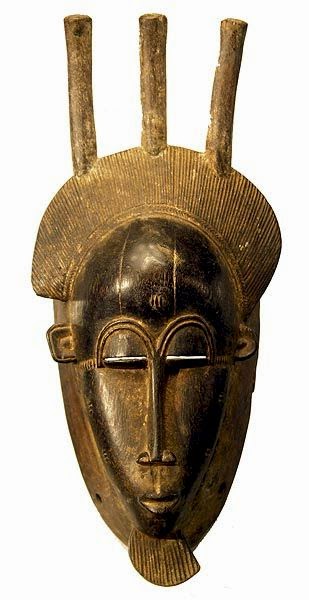
Among the artists whose works exert a strong attraction on me, Amedeo Modigliani ranks high among those still designated "modern" (even though he died in 1920). I came across him through a quite amazing coincidence. For my fourteenth birthday, my father gave me a Baule mask that he had brought back from the Ivory Coast. I was enchanted by it and went straight out to show it to one of my male friends who liked "curios". On the way to his place, I passed a bookshop displaying in its window a new book on the art of Modigliani, who was totally unknown to me. The resemblance between the picture on the cover and my mask was astonishing. I was instantly captivated (and my father was easily persuaded to buy me the book as well). Later I learnt that Modigliani was well-known for making sketches of the elongated faces of Baule masks, often heart-shaped and narrowing to a point at the chin beneath a small mouth placed unnaturally low on the face, and adapting this style to his paintings and sculptures.

African mask adapted by Modigliani
Baule African mask
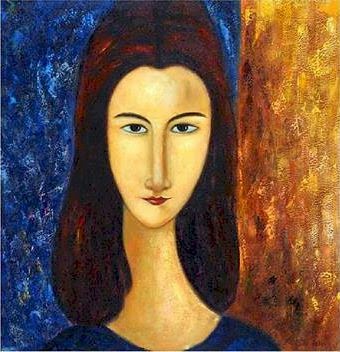
Jeanne Hébuterne by Modigliani

This month (November, 2014), I had the chance to see up close a wonderful range of Modigliani's paintings. For the past few years, the Palazzo Blu in Pisa has mounted some extremely good modern art exhibitions - Chagall, Mirò, Picasso, Kandinsky, Warhol - and this year (extending into 2015), they are showing works by Modigliani and some of his contemporaries, mainly from the collection of the Pompidou Centre in Paris: Modigliani in Palazzo Blu 3 October 2014 - 15 February 2015: "Amedeo Modigliani et ses amis".

Amedeo Modigliani was born into the large Jewish community of Livorno in 1884. His family had been rich and successful but were hit hard by a collapse in metal ore prices during 1883-1884, coinciding exactly with the birth of Amedeo. His youth was plagued by illness, including the onset, at age 16, of the tuberculosis that eventually killed him. Modigliani studied at Guglielmo Micheli's Art School in Livorno from 1898 to 1900, then in Florence and later in Venice. Micheli was one of the Macchiaioli and although Modigliani did not take up their style, he was influenced by their palette. In 1906, he moved to Paris. This move was crucial to his artistic development but unfortunately allowed him to give free rein to his self-destructive tendencies. He started smoking hashish in Venice and continued in Paris where he added excess alcohol, including absinthe, to his "repertoire", none of which helped with his tuberculosis.

Jeanne Hébuterne
Jeanne Hébuterne
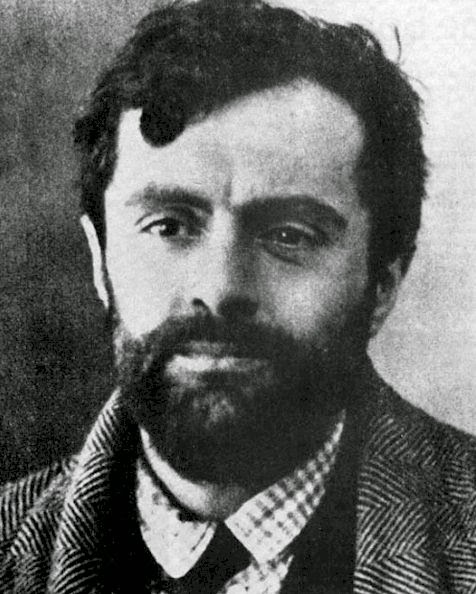
Amedeo Modigliani
Amedeo Modigliani near the end of his life

Modigliani had endless love affairs and liaisons but in 1917 he met the beautiful Jeanne Hébuterne who became his mistress and muse. Their relationship was amazingly fruitful in terms of art but truly tragic in human terms. He painted endless portraits of her - or rather, inspired by her, since they bore little or no resemblance to Jeanne, other than being female and beautiful. She bore him a daughter and was pregnant with their second child when, distraught, she killed herself on the day of his death from tuberculosis, 24 January, 1920.

Modigliani was a key contact between the School of Paris and the Futurist artists based in Italy, and his fame has far eclipsed both the Futurists and the Macchiaioli who are hardly known outside of Italy today. His highly recognisable style and the prodigious number of variations that he painted provided opportunities for art forgers that they were quick to seize. Even his sculptures were copied and passed off as originals. Three of them are concurrently on display (as fakes, I hasten to add!) at the Museo Nazionale di San Matteo in Pisa.

Modigliani nude


Palazzo Blu Pisa

Shore excursions from Livorno.

Tuscany Toscana
Don't forget to visit my Tuscany
Travel Guide!

Up-to-date news on what to see and where to stay in Chianti and all of Tuscany.

Tuscany Travel Guide

Author: Anna Maria Baldini

All content copyright © ammonet Italian Web Site Promotion 2014. All rights reserved.

Saturday, 22 March 2014

Etruscan exhibition in Cortona, March through July 2014

A not to be missed Etruscan exhibition in Cortona has just opened!

Etruscan Enchantment. From the secrets of Holkham Hall to the wonders of the British Museum.

Palazzo Casali, Cortona. 22 March through 31 July 2014.
 
Etruscan exhibition in Cortona, March through July 2014
Etruscan terracotta head from the Etruscan exhibition in Cortona, March through July 2014
Cortona was one of the cities making up the Etruscan Dodecapoli league and parts of the Etruscan walls and gateways, as well as several Etruscan tombs are still to be seen there. In 1727, inspired by the publication of Dempster's De Etruria Regali, the Etruscan Academy was founded in Cortona by three brothers, Marcello, Filippo and Ridolfino Venuti. With the foundation of a museum that houses splendid Etruscan artifacts, the Etruscan Academy of Cortona became the first institution in Europe that specialised in the rediscovery and study of the Etruscans. In 2005, the museum was doubled in size to become the Museum of the Etruscan Academy and of the City of Cortona (MAEC).

During the second quarter of 2014, there is an excellent exhibition devoted to the Etruscans taking place at MAEC in Cortona. This exhibition, Etruscan Enchantment. From the secrets of Holkham Hall to the wonders of the British Museum, was inspired by recent archival finds related to the Grand Tour of Thomas William Coke, 1st Earl of Leicester (1754 – 1842). During the first years of the 18 C., Coke, known as Coke of Norfolk or Coke of Holkham and who later became an immensely popular MP and an agricultural reformer, was sent on the Grand Tour by his father and his great-aunt. The latter offered him £500 to not go to university, which she regarded as a den of vice, and he used the money to finance his tour.

Bronze masterpiece of Etruscan art at the Cortona Etruscan exhibition
Bronze masterpiece of Etruscan art at the Cortona exhibition

Coke was entranced by the Etruscan artifacts that he saw in Italy, both in public displays and private collections. Upon his return to England, he organised and paid for the publication, in 1726, of the manuscript De Etruria Regali by Thomas Dempster (1579 – 1625). A century earlier, Dempster had been the first to assemble a history of the Etruscan people, creating the first “handbook of Etruscology” and summarising everything that was known about Etruscan civilisation up to that time. Dempster was a Cambridge-educated and very quarrelsome Scotch aristocrat. Recommended by Pope Paul V, who had previously incarcerated him as a spy (which he probably was), Dempster eventually found refuge and patronage under Grand Duke Cosimo II. The latter made him a professor in Pisa and commissioned his work on the Etruscans. After three years of intense research, Dempster presented Cosimo with his magnum opus, the manuscript of De Etruria Regali Libri Septem, "Seven Books about Royal Etruria", written in Latin. It was considered a brilliant work by all who saw it.

Etruscan bronze portrait bust at the Cortona exhibition
Etruscan bronze portrait bust
After publication, the manuscript remained at Coke's Holkham Hall and recently the preparatory drawings and copper plates used for the printing of the De Etruria were found in the archives there. These illustrations formed the inspiration for the present exhibition which shows many of the drawings and paintings from Holkham Hall plus over fifty works from the British Museum, never lent before, and many more from Etruscan museum galleries all around Italy.

Etruscan ceramic from the Cortona exhibition

The exhibition recreates the atmosphere of excitement that followed the publication of De Etruria, and documents the role of the Grand Tour to Italy in the 18 C and 19 C, and the fascination with the Etruscans and the Etruscan style in Britain during that period. It presents to the public for the first time ever some iconic masterpieces of that ancient people - such as the Aule Metele and the Graziani Putto - alongside the original drawings for De Etruria as well as the Etruscan masterpieces gathered together by the British Museum during the course of three centuries. Many of these Etruscan artifacts are wonderful works of art in their own right, and displayed together form a show that should not be missed.

Exhibition website.

The Etruscans – who were they and where did they come from?

Vacation accommodation in Tuscany
www.bella-toscana.com


All content copyright © ammonet Italian Web Site Promotion 2014. All rights reserved.

Wednesday, 26 February 2014

Another two newly-renovated rooms open at the Uffizi Gallery in Florence, Italy

The Uffizi gallery has opened a further two renovated rooms, "Green" Rooms numbers 33 and 34, located next to Room 35, the Michelangelo Room (Sala di Michelangelo), on the second floor. The two new rooms, which, before restoration, used to house works by 16 C Tuscan and Lombard painters, display Roman copies of Greek sculptures, as well as paintings, related to the famous Giardino di San Marco which was created as a kind of art school or academy by Lorenzo de' Medici, il Magnifico, and where Michelangelo did some of his early training.

New rooms at the Uffizi Gallery in Florence
Roman copy of a Greek original, in a new room at the Uffizi Gallery, Florence
The Giardino di San Marco was dotted with classical marble statues, portraits and sarcophagi to instruct the sculptors of the early Renaissance about what the ancient Greeks were capable of doing, with the aim of replicating those skills in Florence.

The restoration of these rooms forms a part of the commemoration of the 450th anniversary of death of Michelangelo last week on 18 February.

Among the 39 works displayed in the Green Rooms, there are 35 works that have come out of storage, providing yet another reasons to visit or revisit this fabulous art museum.

Tuscany Toscana
Don't forget to visit my Tuscany
Travel Guide!

Up-to-date news on what to see and where to stay in Chianti and all of Tuscany.

Tuscany Travel Guide


Author: Anna Maria Baldini

All content copyright © ammonet Italian Web Site Promotion 2014. All rights reserved.

Sunday, 7 July 2013

The Baptistry in Florence is open during the evening three nights each week during summer 2013

As an addition to my post about museum cocktail evenings in Florence, it has just been announced that the Baptistry in Florence is open during the evening three nights each week during summer 2013. The Baptistry of San Giovanni, located next to the Duomo and Giotto's campanile, will stay open until 11pm on Thursday, Friday and Saturday nights until 28 September. Entry is still by ticket, but you will have the opportunity to gaze up at some of the most beautiful mosaics in Italy outside of Ravenna in much less crowded and cooler conditions than by day.

Baptistry in Florence is open during the evening three nights each week
The Baptistry of San Giovanni in Florence
A stroll around central Florence during a warm summer evening is always a pleasure - the Italian expression passeggiata encapsulates this quality perfectly. The baptistry is artfully illuminated at night to emphasize its Romanesque architecture - it is, in fact, not only one of the best-loved structures in Florence but also one of the oldest, having been built in its current form between 1059 and 1128. An earlier octagonal baptistry was erected here in the late fourth or early fifth century, very likely over the remains of a Roman watch tower, and, according to some sources, at the behest of Theodolinda, queen of the Lombards (570-628), to commemorate the conversion of her husband, King Authari.

Mosaics in the Baptistry of San Giovanni in Florence

From outside, you can admire the exquisite bronze doors by Ghiberti and Pisano but, to me, the interior, with its magnificent cycles of mosaics, is without equal. The various panels tell stories from the Bible, most famously a representation of the Last Judgement and the grisly punishments that await those sinners consigned to Hell. And don't forget to give some attention to the mosaic marble pavement which was begun in 1209. There was also an octagonal font in the Baptistry, its footprint is still clearly visible in the middle of the floor. This font, which originated in the church of Santa Reparata, was placed here in 1128 and was taken away again in 1571.

In summary, the Baptistry is now joins the many other enjoyable activities available during the evening this summer in Florence.

Vacation accommodation in Tuscany
www.bella-toscana.com
Author: Anna Maria Baldini

All content copyright © ammonet Italian Web Site Promotion 2013. All rights reserved.

Thursday, 27 June 2013

Evening drinks at Florence Museums - "Aperitivo ad Arte"

Last year a number of the top museums in Florence stayed open late on certain summer evenings and offered a glass of wine and a snack buffet along with a close-up view of some of their famous works of art. I reviewed the Palazzo Davanzati cocktail evenings with enthusiasm. Evening drinks at Florence Museums "Aperitivo ad Arte" has been announced again for summer 2013, starting with three museums, the Uffizi, the Bargello and, new this year, the Accademia, including the tribuna where the statue of David is displayed. If you'll be in Florence this year, try not to miss these wonderful occasions! They're a chance to see some great art in a very enjoyable ambiance. What better way to pass a summer evening in Florence?

Evening drinks at Florence museums
The Palazzo Vecchio seen from the Uffizi aperitivo
on the terrace above the Loggia dei Lanzi.
The Galleria dell’Accademia Aperitivo ad Arte takes place every Wednesday from 7-10 pm, from 5 June until 25 September. The exhibition areas that will be open are the Gallery of Prisons with the Tribuna of David. The aperitivo will be offered in the flowered courtyard of the Galleria.

The Uffizi Gallery Aperitivo ad Arte takes place every Thursday from 7-10 pm, from 6 June until 26 September. The Sale del Cinquecento, including works by Raphael, Bronzino, Allori, Vasari, Andrea del Sarto, Rosso Fiorentino and Pontormo will be open. The aperitivo will be offered on the terrace above the Loggia dei Lanzi.

The Bargello Aperitivo ad Arte takes place every Tuesday from 7-10 pm, from 6 August to 24 September. The Sala di Michelangelo, Rinascimento, and the Sala di Donatello will be open. The aperitivo will be offered in the courtyard of Museum. There will also be performances by the Compagnia delle Seggiole about the secrets of the Bargello and its role during the course of seven centuries of Florentine history.

Aperitivo ad Arte Firenze

Tickets cost €15 and should be reserved (no reservation fee), by calling 055 29 48 83.
 

If you are an ATAF card holder, you are entitled to a 30% discount!

STOP PRESS! The Florence Baptistry will also be open during the evening for three nights a week during summer 2013.

"NON-COCKTAIL" LATE OPENINGS: The Uffizi and the Accademia are open until 10 pm (last entry probably 9.35 pm) on Tuesdays.

Vacation accommodation in Tuscany
www.bella-toscana.com
Author: Anna Maria Baldini

All content copyright © ammonet Italian Web Site Promotion 2013. All rights reserved.