Sunday, 4 August 2013

Why is the Conca d'Oro of Panzano in Chianti called the Conca d'Oro?

The rich history of Tuscany not only manifests itself in ancient towns, abbeys and castles, but also in the place names of villages, hills and rivers and many other topographical features. One of the most beautiful names for a beautiful area is the Conca d'Oro below Panzano. Conca d'oro means "golden basin", so looking at the picture of the vineyards of the Conca d'Oro below, we have to ask ourselves why is the Conca d'Oro of Panzano in Chianti called the Conca d'Oro? Why isn't it called the Conca Verde - the green basin - for example?

Conca d'Oro of Panzano in Chianti
View over the Conca d'Oro towards Panzano in Chianti
The answer to this riddle is quite simple (once you've been told). For centuries, Florence and Sienna fought for control of the historical Chianti area (now the Chianti Classico wine zone) that forms the territory between them. They did this in large part because of the critical value of its agricultural production. Wine? Olive oil? Only in small part. Until the middle of the 19 C, agriculture in Chianti was given over principally to grain production, meaning wheat. Most of the population of both Chianti and Florence subsisted on bread as their staple diet - and, indeed, bread is still an important part of every Tuscan meal. As a consequence, every piece of land that supported wheat was used to grow it. Even into the pre-war 20 C, wheat was grown in the spaces between the rows of grape vines. One of the most productive areas for wheat was in fact the Conca d'Oro of Panzano, and as harvest time approached it was exactly what its name says, a golden basin of ripening wheat. It was only in the post-war years that wheat was replaced by the increasingly lucrative crops yielding olive oil and wine. This change coincided with the reclamation of the Maremma and the modernisation of agriculture in the Val d'Orcia (described by Iris Origo in her wonderful book, War in the Val d'Orcia) and the consequent increase in the wheat harvest in those areas.

More about what to see in and near Panzano in Chianti.

My recommended vacation rentals in Tuscany.

Tuscany Toscana
Don't forget to visit my Tuscany
Travel Guide!

Up-to-date news on what to see and where to stay in Chianti and all of Tuscany.

Tuscany Travel Guide

Author: Anna Maria Baldini

All content copyright © ammonet Italian Web Site Promotion 2013. All rights reserved.

Sunday, 7 July 2013

The Baptistry in Florence is open during the evening three nights each week during summer 2013

As an addition to my post about museum cocktail evenings in Florence, it has just been announced that the Baptistry in Florence is open during the evening three nights each week during summer 2013. The Baptistry of San Giovanni, located next to the Duomo and Giotto's campanile, will stay open until 11pm on Thursday, Friday and Saturday nights until 28 September. Entry is still by ticket, but you will have the opportunity to gaze up at some of the most beautiful mosaics in Italy outside of Ravenna in much less crowded and cooler conditions than by day.

Baptistry in Florence is open during the evening three nights each week
The Baptistry of San Giovanni in Florence
A stroll around central Florence during a warm summer evening is always a pleasure - the Italian expression passeggiata encapsulates this quality perfectly. The baptistry is artfully illuminated at night to emphasize its Romanesque architecture - it is, in fact, not only one of the best-loved structures in Florence but also one of the oldest, having been built in its current form between 1059 and 1128. An earlier octagonal baptistry was erected here in the late fourth or early fifth century, very likely over the remains of a Roman watch tower, and, according to some sources, at the behest of Theodolinda, queen of the Lombards (570-628), to commemorate the conversion of her husband, King Authari.

Mosaics in the Baptistry of San Giovanni in Florence

From outside, you can admire the exquisite bronze doors by Ghiberti and Pisano but, to me, the interior, with its magnificent cycles of mosaics, is without equal. The various panels tell stories from the Bible, most famously a representation of the Last Judgement and the grisly punishments that await those sinners consigned to Hell. And don't forget to give some attention to the mosaic marble pavement which was begun in 1209. There was also an octagonal font in the Baptistry, its footprint is still clearly visible in the middle of the floor. This font, which originated in the church of Santa Reparata, was placed here in 1128 and was taken away again in 1571.

In summary, the Baptistry is now joins the many other enjoyable activities available during the evening this summer in Florence.

Vacation accommodation in Tuscany
www.bella-toscana.com
Author: Anna Maria Baldini

All content copyright © ammonet Italian Web Site Promotion 2013. All rights reserved.

Thursday, 27 June 2013

Evening drinks at Florence Museums - "Aperitivo ad Arte"

Last year a number of the top museums in Florence stayed open late on certain summer evenings and offered a glass of wine and a snack buffet along with a close-up view of some of their famous works of art. I reviewed the Palazzo Davanzati cocktail evenings with enthusiasm. Evening drinks at Florence Museums "Aperitivo ad Arte" has been announced again for summer 2013, starting with three museums, the Uffizi, the Bargello and, new this year, the Accademia, including the tribuna where the statue of David is displayed. If you'll be in Florence this year, try not to miss these wonderful occasions! They're a chance to see some great art in a very enjoyable ambiance. What better way to pass a summer evening in Florence?

Evening drinks at Florence museums
The Palazzo Vecchio seen from the Uffizi aperitivo
on the terrace above the Loggia dei Lanzi.
The Galleria dell’Accademia Aperitivo ad Arte takes place every Wednesday from 7-10 pm, from 5 June until 25 September. The exhibition areas that will be open are the Gallery of Prisons with the Tribuna of David. The aperitivo will be offered in the flowered courtyard of the Galleria.

The Uffizi Gallery Aperitivo ad Arte takes place every Thursday from 7-10 pm, from 6 June until 26 September. The Sale del Cinquecento, including works by Raphael, Bronzino, Allori, Vasari, Andrea del Sarto, Rosso Fiorentino and Pontormo will be open. The aperitivo will be offered on the terrace above the Loggia dei Lanzi.

The Bargello Aperitivo ad Arte takes place every Tuesday from 7-10 pm, from 6 August to 24 September. The Sala di Michelangelo, Rinascimento, and the Sala di Donatello will be open. The aperitivo will be offered in the courtyard of Museum. There will also be performances by the Compagnia delle Seggiole about the secrets of the Bargello and its role during the course of seven centuries of Florentine history.

Aperitivo ad Arte Firenze

Tickets cost €15 and should be reserved (no reservation fee), by calling 055 29 48 83.
 

If you are an ATAF card holder, you are entitled to a 30% discount!

STOP PRESS! The Florence Baptistry will also be open during the evening for three nights a week during summer 2013.

"NON-COCKTAIL" LATE OPENINGS: The Uffizi and the Accademia are open until 10 pm (last entry probably 9.35 pm) on Tuesdays.

Vacation accommodation in Tuscany
www.bella-toscana.com
Author: Anna Maria Baldini

All content copyright © ammonet Italian Web Site Promotion 2013. All rights reserved.

Saturday, 15 June 2013

Enchanting Tuscany - it's in the details. Tuscan vernacular art in cast iron, carved wood and sculpted stone

Every visitor to Tuscany experiences the power of fine architecture and paintings on the grand scale, but let's not forget the endless enchanting details of Tuscan vernacular art that reflect the love of fine workmanship that has characterised Tuscany since at least the end of the Dark Age. Among the most prolific and accessible anonymous works of art in Tuscany are those in cast iron, carved wood and sculpted stone. And the age of the digital camera makes these miniature masterpieces all the more accessible since many of them are in locations often too high to be seen other than by means of a zoom lens. Not all of course - door knockers and door wood carvings are right there to be observed close up by those with a sharp eye for detail.
Tuscany door knocker
Tuscan art deco door-knocker
Tuscany door wood carving
Exquisite door wood-carving

Vernacular stone carving is often less visible since so much of it is the quirky and humorous production of the mediaeval artisans who turned out decorated capitals and pilastres by the thousands. When visiting any of the numerous romanesque churches that dot the Tuscany countryside, look high up both inside and outside and the chances are you will see some fascinating and completely unique stone carving, possibly from the hand of a workman a thousand years gone.

Stone carving at Villa Viganamaggio
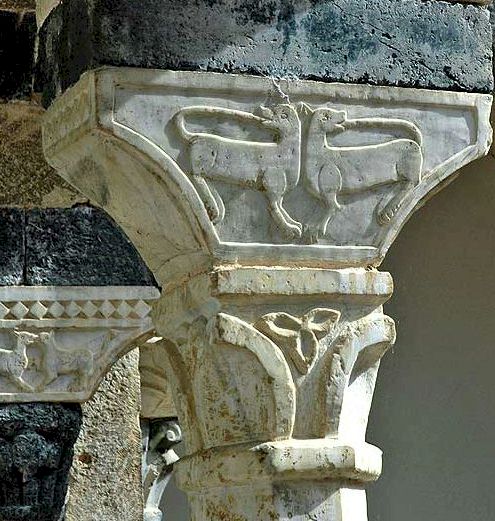
Carved capital at the Abbey of Santa Mustiola
Capital at the Abbey of Santa Mustiola
As you will no doubt notice, Tuscany is a very "stony" region and stone or stone-faced buildings outnumber those made entirely of brick, with wooden buildings being almost non-existent. It turns out that workable stone is quite common so, not surprisingly, stone carving embellishes buildings magnificent and humble throughout the area. Workable wood is for the most part imported from elsewhere but skilled wood carving has been a part of Tuscan art since the Renaissance and earlier when the Gothic art of fine woodcarving was introduced from Flanders.
Carved capital at the Abbey of Sant' Antimo
Capital at the Abbey of Sant' Antimo
Mediaeval stonework at Borgo di Vagli hamlet
Stonework at Borgo di Vagli hamlet
Cast iron decorative elements became extremely popular in the late Victorian and art deco periods and continue to be right up to the present day. Wrought iron work is also extremely common in Tuscany and is most commonly visible in the form of iron grills over windows. Wrought iron bedsteads, candelabra and chandeliers are typical of "Tuscan country style". The streets of Sienna are particularly well-endowed with wrought and cast iron decorations, including lamp supports and flag holders.
Cast iron door sign Sienna
Cast iron shop sign in Sienna
All of these details contribute to the charm of Tuscan cities, towns and villages. They repay attention!

More about what to see in Tuscany.

More about Borgo di Vagli.

My recommended vacation rentals in Tuscany.

Tuscany Toscana
Don't forget to visit Elena Spolaor's
Travel Guide!

Up-to-date news on what to see and where to stay in Chianti and all of Tuscany & Umbria.

Chianti Travel Guide

Author: Anna Maria Baldini

All content copyright © ammonet Italian Web Site Promotion 2013 - 2014. All rights reserved.

Wednesday, 12 June 2013

Famous Tuscan butchers Falorni in Greve in Chianti and Cecchini in Panzano in Chianti

In ancient times, meaning before WWII, most of the contadini in Tuscany ate meat only once a week, mostly in the form of a selection of salumi. For the remainder of the week they ate ribollita in winter and panzanella in summer - both dishes being based on Tuscan bread and Tuscan olive oil with the addition of whatever fresh vegetables were available. In fact, that's how it's been for the past thousand years, at the very least. Nowadays, the meat-based dishes of Tuscan cuisine are much more prominent and famous, and as a consequence so are some wonderful Tuscan butchers shops (macellerie). In this post, I will say something about just two among many, the famous Tuscan butchers Falorni in Greve in Chianti and Cecchini in Panzano in Chianti.

Antica Macelleria Falorni Greve in Chianti
Antica Macelleria Falorni in Greve in Chianti
Antica Macelleria Falorni, located on Piazza Matteotti of Greve in Chianti, claims to be the oldest butchers shop (macelleria) in Italy. The shop was founded by Gio Batta in 1729. Today Antica Macelleria Falorni is run by the eighth generation, brothers Lorenzo and Stefano Bencistà, related by marriage to the founding family. Along with fresh meat, Falorni sells a fine range of salami, prosciutto and other prepared meats and in fact the company has a large production that is sold throughout Italy and abroad. When you visit Greve in Chianti, be sure to drop in to look at the amazing display of Tuscan meat specialities on show at Macelleria Falorni, taste some samples if they're on offer and, of course, buy some great food!

Dario Cecchini in his butchers shop in Panzano in Chianti

Macellaria Cecchini, located ten minutes drive away in Panzano in Chianti, is entirely different in style from Macellaria Falorini. Macellaria Cecchini is, simply, Dario Cecchini, the mad butcher of Panzano. Cecchini specialises in prepared meats, one could almost say, anything other than salumi. And in contrast to the export-oriented business of Falorni, Cecchini has entered the restaurant trade in a very original way, particularly in his Panzano restaurant Solociccia. Dario Cecchini very often serves in his shop and welcomes visitors, even those just coming to look. While the display of meat products is amazing, you're basically coming to see Dario perform - and of course to buy some excellent eats.

Dario Cecchini is famous as a promoter of bistecca alla fiorentina and both of these butchers shops sell excellent cuts of beef suitable for grilling.

More about Piazza Matteotti in Greve in Chianti.

More about Macellaria Cecchini in Panzano in Chianti.

More about bistecca alla fiorentina.

More about Tuscan culinary specialities.

More about places to stay in Chianti.

Tuscany Toscana
Don't forget to visit Elena Spolaor's
Travel Guide!

Up-to-date news on what to see and where to stay in Chianti and all of Tuscany & Umbria.

Chianti Travel Guide

Author: Anna Maria Baldini

All content copyright © ammonet Web Site Promotion 2013 - 2022. All rights reserved.

Saturday, 25 May 2013

Radda in Chianti, a classic Chianti wine village

Today I would like to introduce you to one of the small towns located near where I live, namely Radda in Chianti, a classic Chianti wine village. Radda, along with Castellina and Gaiole, was one of the three counties that formed the original Lega del Chianti from the 15 C onwards until the league was dissolved in the late 18 C. Today, clustered around its church, it is a tranquil village that serves the numerous wineries and agriturismi (farmhouse vacation rentals) in the surrounding countryside. The area is famous for the numerous castles, both ruined and inhabited, that dot the hills.

Radda in Chianti
View of Radda in Chianti, Tuscany, Italy
Radda is a place to buy your supplies or dine out while spending your vacation in one of the many places to stay in and near Radda in Chianti. The Palazzo del Podestà is the principal building in Radda, aside from the romanesque Church of San Niccolò, which houses a venerated wooden Crucifix dating from the 15 C. Nearby is the convent Santa Maria al Prato which dates from the mediaeval period. It now houses an art museum. Another interesting sight is the "Ice House" of the Grand Duke, built at the end of the 19 C to store snow and turn it into ice for cooling purposes.

More about Radda in Chianti and its environs.

Tuscany Toscana
Don't forget to visit Elena Spolaor's
Travel Guide!

Up-to-date news on what to see and where to stay in Chianti and all of Tuscany & Umbria.

Chianti Travel Guide

Author: Anna Maria Baldini

All content copyright © ammonet Web Site Promotion 2013 - 2014. All rights reserved.

Wednesday, 1 May 2013

"The Springtime of the Renaissance" - a great exhibition currently showing in Florence

The Strozzi Palace is currently hosting a wonderful art exhibition under the title "The Springtime of the Renaissance" (La Primavera del Rinascimento. La scultura e le arti a Firenze 1400-1460. Palazzo Strozzi.). Everyone with an interest in the history of art, especially Renaissance art, should seize the opportunity to spend half a day (or a whole day) at this exhibition here in Florence or, from September, at the Louvre in Paris, if they possibly can. Every year there is a very good exhibition at the Palazzo Strozzi, but this year (2013), the Bargello and the Louvre have put together a truly fabulous show of early Florentine masterpieces displayed alongside equally beautiful Classical and late Gothic works of the kind from which the Florentines drew inspiration.

La Primavera del Rinascimento. La scultura e le arti a Firenze 1400-1460
The modern, the renaissance and the classical - a study in character.

The creators of this exhibition suggest that it was from sculpture more than painting that the Renaissance sprang, and they see the initial glimmer in the form of the two bronze relief panels submitted in 1401 by Brunelleschi and Ghiberti for the competition to create a set of new bronze doors of the Florentine baptistery. Sculpting scenes based on an identical biblical story, both artists combined Gothic elegance of costume and scenery with human figures inspired by classical sculpture. From this point on, the exhibition is dominated by the sculpture and spirit of Donatello, who did his apprenticeship in the workshops of Brunelleschi and Ghiberti. Donatello strongly influenced his contemporaries, both sculptors and painters, among whom we may count Michelozzo, Masaccio, Filippo Lippi, Paolo Uccello and Andrea del Castagno, stylistically and through his introduction of perspective in his low relief works.
Donatello at the Palazzo Strozzi in Florence
Single point perspective, classical depiction of the human form and draperies
- Donatello's St George and the Dragon in very shallow relief.

The spatial organisation of the exhibition is excellent, not least with the placement of a huge, 4th century BC, bronze horse's head, the Medici Protome, visible through an arch from the first room of the show. Later, when we enter this room, Donatello's Carafa Protome, is revealed, and we can easily see why it was long thought to be a classical work.
Donatello's Carafa Protome
Donatello or ancient Greek? Visit this exhibition to find out which!

At the appropriate points in the exhibition, Classical sculpture including portrait busts and sarcophagus friezes, are juxtaposed with early Renaissance works in which the artists were evidently struggling to relearn the artistic skills of the Greeks and Romans, especially in depicting the human form. At other points, the juxtapositions of contemporary paintings and sculptures emphasize how painters set out to make their paintings more sculptural

The Springtime of the Renaissance
Painters set out to make their paintings more sculptural.

During my visit at the end of April, viewers were sparse and I often had entire rooms to myself. You can also view the exhibits close up, with a magnifying glass if you wish (and have one with you). In most of their native museums, this is surely not possible. Try to attend this show early or at least in Florence. It will definitely be packed out when it moves to Paris

More about La Primavera del Rinascimento.

Recommended vacation accommodation in Chianti towns, villages and countryside.


Author: Anna Maria Baldini

All content copyright © ammonet Web Site Promotion 2012 - 2013. All rights reserved.

Tuesday, 30 April 2013

What is the origin of those photogenic glades of cypress trees in the Val d'Orcia?

A number of readers returning from visits to Tuscany south of Siena have asked me about the origin of those photogenic glades of cypress trees in the Val d'Orcia. I have enthused about the Val d'Orcia more than once in this blog and for photographers (and others), among the visual attractions of the Val d'Orcia are the cypress trees artfully planted in rows on either side of roads leading up to isolated farmhouses and the small clusters of cypresses standing alone among the crops on otherwise bare hillsides. Why are they there?

cypress trees in the Val d'Orcia

Probably the most photographed glade of cypress trees in the whole world,

located between San Quirico d'Orcia and Montalcino in the Val d'Orcia of Tuscany, Italy.

These clusters of cypresses where, in fact, planted as bird traps. Among the trees, some of the branches and twigs, as well as artificial perches, were coated with birdlime, a sticky substance that prevents small birds flying away once they have landed on it. Italian birdlime was made by a complicated process of boiling and pounding from mistletoe berries. These birds, especially blackbirds and thrushes, were harvested as often as twice a day during the season and provided a significant part of the protein diet of the poor farmers who struggled to make a living from the clay soil here (the famous crete senesi). As in many parts of the world, trapping birds using birdlime has long been prohibited in Italy but these beautiful cypress glades remain, to the delight of visitors to this part of Tuscany.

Strada di Valoresi as seen from from Villa La Foce

The Strada di Valoresi as seen from from Villa La Foce

More about the Val d'Orcia.

More about “Villa La Foce” and Iris Origo.


Recommended vacation accommodation in Chianti towns, villages and countryside.


Author: Anna Maria Baldini

All content copyright © ammonet Web Site Promotion 2012 - 2026. All rights reserved.

Wednesday, 10 April 2013

The new top level Chianti Classico wine category - useful, confusing or both?

A few days ago, I had something to say about the new Chianti Classico Gallo Nero logo, and promised to look also at the modified classification of Chianti Classico wines that was released by the Consorzio at the same time. So - the new top level Chianti Classico wine category - useful, confusing or both?

Most wine makers in Chianti Classico belong to a consortium known as the Consorzio Vino Chianti Classico which is principally a collective marketing cooperative and which also sets the rules regarding the composition, classification and labelling of Chianti Classico wines.

The Consorzio's new, top level classification is designated "Gran Selezione" and is effectively a designation for single-estate wines which must be produced solely from grapes grown by the estate, cannot be sold within less than 30 months of the harvest (6 months longer than Riserva) and must receive at least three months of pre-sale bottle maturation. Yields must be 52.5 hectolitres or less per hectare, the same as for Riserva.

new top level Chianti Classico wine category

Many wine producers that I have spoken to are worried that this is going to introduce further confusion into buyers' minds regarding Chianti wines. Part of the problem is that Chianti Classico is only one of eight Chianti wine zones. Chianti Classico corresponds to the historical Chianti area located between Florence and Siena, while the other Chianti zones are distributed all over northern Tuscany. There is something to be said for this sense of dismay among some of the wine makers. However, if the labelling is consistent - in other words, the general appellation Chianti Classico is prominent and always has the same physical location on the label in relation to the subclassification appellations (IGT, Riserva) - my feeling is that Gran Selezione will allow buyers to distinguish between "ordinary" IGT (previously, vino da tavola) and Classico on the one hand, and the producers' top-of-the-range wines on the other. Gran Selezione provides greater specificity than DOCG (Denominazione di Origine Controllata) where the grapes just have to come from the wine region, not the producers' vineyards, but I would like to see the actual vineyard specified as well.

Sometimes I suspect that the new logo and the new classification have been introduced by the Consorzio not just with buyers in mind, but also their own members. The Consorzio recently lost a prolonged and very expensive court struggle with Gallo Bros. of the USA over the use of the Gallo Nero (Black Rooster) trademark on their bottles of wine sold outside Europe. Their members have not been happy about any aspect of that issue. However, this is just personal speculation - I only know what the producers tell me.

In a blog post, David Berry Green, a buyer for Berry Bros. & Rudd, rubbished the entire concept of adding an upper level Gran Selezione appellation, basically by complaining that the Consorzio had not introduced, instead, clear-cut delimitations, alla francese, of vineyards based on their "terroir". I can't agree with this criticism at all. The trend in Chianti Classico wines for the past thirty years has been away from terrain-dominated characteristics due to the dominating role of consultant oenologists. I'm not saying that's a good thing, but it is an observable fact. A terroir-based denomination would be of use to a few big properties that employ their own oenologists but would still reflect more the style of the oenologist than the geology, altitude, slope etc. (By the way, the major contribution of the Tuscan oenologist, once the vine varieties have been selected and grown, is in blending, since Chianti Classico allows for up to 20% red, non-sangiovese varietals, and this largely masks any specific contribution by geology other than in Chiantis that are 100% sangiovese.) For a divergent opinion on the introduction of Chianti Classico subzones, see the link below to the article by Roberto Stucchi.

Green also makes the following sweeping statement: "while the term Riserva is generally regarded in the UK as passé, a massive fudge, a wine that lacks provenance, has spent too long (drying out) in wood and is often too expensive". I don't know if that's a general public perception in the UK but it's definitely not the perception among all those who regularly buy and drink Chianti. Perhaps he's referring to UK-based distributor-bottled Chianti? Obviously if you're buying an estate-bottled Chianti, its provenance will be written on the bottle in great big letters and a bit of tasting experience will soon reveal whether the winemaker uses his best grapes for the Riserva. In my experience, they almost always do. The Gran Selezione classification is specifically prohibited from being used on wine bottled by wine merchants.

In summary, I tend towards favouring the new "Gran Selezione" denomination as long as it really does refer to wine made entirely from the grapes of the winery that bottles the wine and, if possible, is also identified with a particular vineyard. I would even favour putting the name of the oenologist on the bottle, as Andre Lurton of Bordeaux does, to good effect. Strangely enough, the makers of the best Italian pasta are slightly ahead of the curve in this regard. If you have a bar-code app on your cell phone, you can take advantage of pasta sold in Italian supermarkets which is bar-coded to identify the specific field where the wheat was grown. If you want to do the same thing for Chianti Classico wine, you need to key the series number and identification mark into a form on the consorzio website. As consumers become more and more particular about what they eat and drink, a Gran Selezione indication guaranteeing quality and precise origin is very likely to be a positive development for both producers and consumers.

Note added 11 January 2014: Roberto Stucchi of Badia a Coltibuono comes out in favour of the use of subzones for Chianti Classico wines.

Some useful links for Chianti Classico fans.

More about native Tuscan grape varieties.

My recommended places to stay in Tuscany.


Author: Anna Maria Baldini

All content copyright © ammonet Web Site Promotion 2012 - 2013. All rights reserved.

Tuesday, 9 April 2013

"The treasure of the Lombards" - “Il Tesoro dei Longobardi” - an exhibition in Cortona 2013

If you spend a bit of time reading about the history of Tuscany (or of anywhere in northern Italy) during the Italian Dark Age, you will soon encounter the Lombards or Longobards (sometimes written Langobards) and Longobardi in Italian. These were a Germanic tribe who established a kingdom in Italy that lasted from 568 to 774. Their castles dot Tuscany and their names are still preserved in the appellations of towns like Radicondoli and, of course, in the name of the region of Lombardy. The Lombards were like the Normans, a small tribe that originated somewhere in the far north of Europe and which seem never to have stayed in one place for more than a generation. Instead, they migrated and conquered, adopting the language of their subjects and leaving their architectural legacy as far south as Sicily. The Lombard Kingdom of Italy wrested northern Italy from the Byzantines and was in turn conquered by Charlemagne and integrated into his Empire. However, Lombard nobles continued to rule parts of the Italian peninsula until well into the 11 C. It seems appropriate that the last of the Italian Lombards were conquered by the Normans and incorporated into their County of Sicily.

“Il Tesoro dei Longobardi
A Lombard brooch

An excellent exhibition on the art of the Longobards, under the title Il Tesoro dei Longobardi, will be on display in Cortona at the Palazzo Casali (MAEC - Museo dell'Accademia Etrusca) from 12 April until 30 June 2013. This is the second exhibition devoted to ancient gold work in Italy, the 2007 exhibition having been devoted to the Etruscans. This show brings together Lombard decorative gold work from a number of Italian museums and presents it both to throw light on the artistic culture of the Italian Dark Age and also in relation to contemporary jewellery that has been inspired by Lombard work.

The treasure of the Longobards
The Treasure of the Longobards Exhibition in Cortona

The first part of the exhibition is an introduction to the history and customs of the Lombards in Italy based heavily on the amazing finds from two recent tomb excavations at the "Necropoli della Ferrovia" near Cividale in Friuli plus finds in the area of Cortona.

The second part presents different objects from the 19 C excavations of the necropolis of Cividale del Friuli, including coins, clasps, broaches, belt buckles and pendants, as well as a copy of the famous golden disc ornament decorated with the image of a knight, together a series of objects from the coin cabinet of the National Archaeological Museum in Florence.

Longobard clasp
Longobard gold work

The third part of the exhibition includes about 30 pieces of fine craftsmanship, inspired by the world of the Lombards, created by master goldsmiths from Arezzo.

Highly recommended to anyone interested in a fascinating period of history and/or gold workmanship and the decorative arts.

More about Cortona.

More about the Etruscan Museum of Cortona.

My recommended places to stay in Tuscany.


Author: Anna Maria Baldini

Monday, 4 March 2013

Recommended family-friendly accommodations in Tuscany

Now that spring shows signs of coming (well, at least it isn't snowing here in Tuscany anymore - other than in the mountains), I'm receiving requests for recommended family-friendly accommodations in Tuscany. What parents usually have in mind by "family-friendly" is plenty of space for children to run around far away from traffic. My top recommendation goes to Piano di Montagliari, a Bed and Breakfast vacation accommodation located between Greve and Panzano on one of the rare flat areas of Chianti.

Recommended family-friendly accommodations in Tuscany
Piano di Montagliari Bed and Breakfast accommodations in Chianti, Tuscany
Chianti, as almost everyone knows, is a very hilly wine-growing area covering the territory between Florence and Sienna. One of the very few extensive flat areas lies where the river Greve emerges from the hills below Lamole before turning north to run through the town of the same name to join the Arno just west of Florence. This flat, former flood plain is known as the Piano di Montagliari after the big villa and formerly castle Montagliari nearby.

Bed and breakfast accommodations in Tuscany
Part of the extensive lawns around Piano di Montagliari - Villa Vignamaggio
is visible on the ridge in the distance.

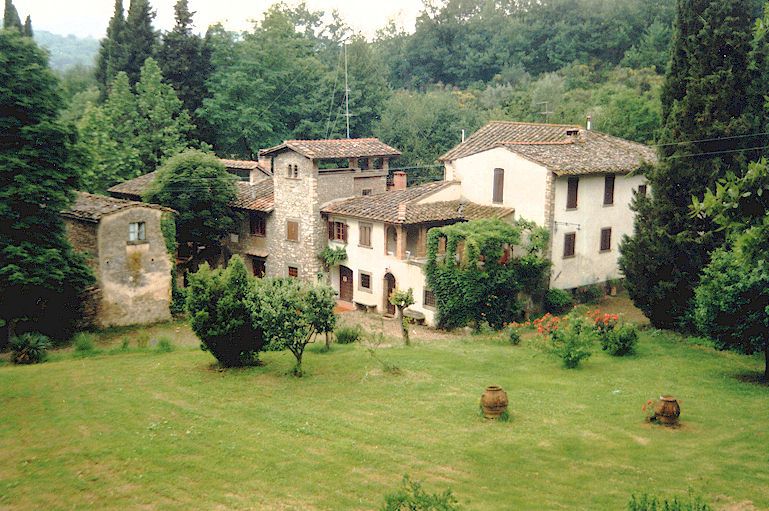
B&B Piano di Montagliari is part of an old mill and is surrounded by extensive lawns which are ideal for young people's games (soccer goal provided!) and there is almost no traffic on the adjoining road which accesses one or two houses further upstream. The location also means peace and tranquility for parents who can relax in the lovely gardens after a hard day of sightseeing. Rooms with private bathrooms as well as rooms with access to a common bathroom are available. Highly recommended!

More about B&B Piano di Montagliari.

Map of the main sights of Chianti.


Author: Anna Maria Baldini
All content copyright © ammonet Web Site Promotion 2012 - 2013. All rights reserved.

Sunday, 3 March 2013

Really excellent pizza in Florence

When my friends staying here in the Chianti countryside decide to head in to Florence for a day of sightseeing, they often ask me where they can get really excellent pizza in Florence. Although the native territory of pizza is in the south of Italy around Naples, this wonderful dish has long been made all over Italy and, if you look hard enough, you can find very good pizza in Florence.

Where to get a really excellent pizza in Florence
Pizza - one of the great dishes of the world
My recommendation for the best pizza in Florence is Il Pizzaiuolo (located at Via de' Macci 113/r, near the Sant'Ambrogio market - closed Sunday). Be warned, this place is usually very busy and they do have a bad habit of pushing the customers through. Either arrive early or make a reservation and show up on the dot. The pizza is thick in style and they have two pages of variants in the menu.

best pizza in Florence
Wood-fired pizza oven - the only way to go.

The follower up as best pizza place in Florence is Trattoria Baldovino (Via San Giuseppe 22/r, adjacent to Santa Croce). This place was opened and developed by David Gardner, owner of Villa Bordoni boutique hotel, and was his first great success in Florence.The newspapers were full of descriptions of the Scot who came to Florence to show the locals how to cook Tuscan food. He has since sold it but it remains a great place to eat.

If you're staying anywhere near Greve in Chianti, there is a fabulous pizzeria in Piazza Trento, near where the bus from Florence stops. This is Ristorante Pizzeria La Cantina which serves wonderful thin crust pizza as well as beautifully-presented traditional Tuscan dishes. There's outdoor seating as well as the large interior dining room. Open for both lunch and dinner, great food, prices extremely reasonable.

Recommended vacation accommodation in Chianti towns, villages and countryside.


Author: Anna Maria Baldini
All content copyright © ammonet Web Site Promotion 2012 - 2015. All rights reserved.

Friday, 22 February 2013

The Consorzio Vino Chianti Classico releases the new Chianti Classico wine logo

On 19 February 2013, as part of a new marketing push, the Consorzio Vino Chianti Classico released the new Chianti Classico wine logo, a modified version of the famous black rooster (gallo nero) symbol of Chianti with a border changed from the bright red to a purplish colour, presumably meant to evoke the colour of wine, even though sangiovese ("blood of Jove") grapes produce a characteristically red-coloured wine. The most frequent use of this Chianti Classico logo is on the numbered paper seal over the capsule of a bottle of Chianti Classico wine that provides a guarantee that the wine is what it claims to be.

new gallo nero chianti classico wine logo
The new Chianti Classico wine logo.
I find the new black rooster silhouette as good as the old one but regret the loss of the very recognisable and attractive bright red border. I realise there's some symbolism in the new border colour but, next to the dull green used on plain package cigarettes in Australia, purple is said by psychologists to be the most off-putting colour for marketing and I can see why they say that. The new background seems to represent the rays of the rising sun, which makes sense for a more aggressive, crowing cockerel, but seems less warm to me than the golden background.
previous gallo nero chianti classico wine logo
The previous Chianti Classico wine logo.
The new logo and marketing seem to be in part a reaction to the ruinous loss by the Consorzio in its trademark court battle against the litiginous Gallo Brothers, the largest wine producers in the USA. The Consorzio not only lost the case but had to pay costs, and the gallo nero rooster cannot be used on Chianti wines sold in the USA.

Part of the new marketing strategy involves redefining the rules for Chianti Classico wines and adding a new wine category above the Riserva level. I'll be posting on that soon.

More about Chianti Classico wine.

More about Gallo Nero wines.


All content copyright © ammonet Web Site Promotion 2012 - 2013. All rights reserved.

Wednesday, 23 January 2013

Recommend a Bed and Breakfast accommodation in Greve in Chianti

I've been asked to recommend a Bed and Breakfast accommodation in Greve in Chianti, right in town, so I'm happy to give a recommendation for three B&Bs on or within a few minute's walk of Piazza Matteotti, the main square (or, rather, triangle) of Greve. Bed & Breakfast "Nella Piazza", which is right on Piazza Matteotti near the church, plus "Chianti Rooms" Bed & Breakfast and "Casa Montechiari" which are about a 10 minute walk north of the piazza among the last houses of Greve.

Bed and Breakfast accommodation in Greve in Chianti
A view across Piazza Matteotti to B&B "Nella Piazza" on the top floor.
B&B "Nella Piazza" offers three rooms each for 2 or 3 people and each with its own bathroom. Guests have use of a sunny terrace behind the building. There is also a kitchen that guests may use to prepare their own meals. If you want to be right in the middle of things in Greve, this is the place for you!


Chianti rooms bed and breakfast in Greve in Chianti
The garden of "Chianti Rooms" Bed & Breakfast in Greve in Chianti
"Chianti Rooms" B&B offers just two double rooms with en suite bathroom. They are one of the few places in the area that take guests for just one night and are open all year round. They have a beautiful garden out the back, with a terrace and a pergola where guests can enjoy their breakfast on sunny days. There is a WiFi connection available.


"Casa Montechiare" Bed and Breakfast in Greve in Chianti
The terrace of "Casa Montechiare" Bed and Breakfast in Greve in Chianti
About 100 m beyond "Chianti Rooms", we come to "Casa Montechiare" Bed and Breakfast. The front of the house is on an urban street while the terrace and garden at the back look out over the Chianti countryside. Their accommodation consists of two double (or twin) rooms, with en suite bathroom, linked by a double door, together with a fully equipped kitchen-dining room. One bedroom contains a sofa bed that can be expanded into a bunk bed for a total of 4 persons. The Greve public swimming pool is just 5 minutes walk away.


All content copyright © ammonet Web Site Promotion 2012 - 2013. All rights reserved.