Showing posts with label art. Show all posts

Wednesday, 4 March 2026

A preliminary drawing and a final painting by Filippo Lippi in Florence

I want to present here an example of how a bit of enjoyable homework can help art-lovers gain some extra insight into how a masterpieces were created by Renaissance artists. Before a recent visit to the Palatine Gallery at Palazzo Pitti in Florence, I was idly looking through a book of Renaissance drawings held in the Gabinetto dei Disegni e delle Stampe at the Uffizi Gallery. Among them was a very delicate, three quarters sketch of a female head, surely intended to be a Madonna, depicting an absorbed and very sweet expression, and, among other features, a refined hairstyle embellished with veils. At the same time, I had a look at a catalogue of the holdings at the Palatine Gallery, and - lo and behold! - the Madonna in the wonderful Tondo Bartolini turned out to be the final version of the Uffizi sketch.

Both the preliminary drawing and the final painting are by Filippo Lippi. The Tondo has long been thought to have been commissioned from Filippo, who was Carmelite friar, by the ambitious and wealthy Florentine merchant, Leonardo di Bartolomeo Bartolini. More recent investigation by Jeffrey Ruda interprets the coat of arms on the reverse of the Tondo as that of a member of the Martelli family and re-dates the painting to between 1465 and 1470 based on similarities to Filippo's final frescoes in the Capella Maggiore at Prato Cathedral.

By looking at a good reproduction of the drawing, one can see that Filippo used first a silver point on paper prepared with a warm, yellow ochre ground, and then refined the silver point outline with thin and light lines of white lead applied with a brush, giving the physiognomy and hairstyle a lovely softness.

The preliminary sketch matches the painted figure down to the most minute folds of the cap and in the ribbon that holds and twists the hair at the top under the veil. One can also see that Filippo was experimenting on the ochre paper with the effects of the light coming from the left, by applying a white wash. 

However, my aim here is not to argue the fine details of art history and connoisseurship, but rather to encourage visitors to Florence who plan to tour the galleries, to spend some time with some art books as a preparation to seeing the works themselves. You never can tell what serendipitous insights will strike you!

Tuscany Toscana
Don't forget to visit my Tuscany
Travel Guide!

Up-to-date news on what to see and where to stay in Chianti and all of Tuscany.

Tuscany Travel Guide

vacation accommodations in Tuscany


Author: Anna Maria Baldini

All content copyright © ammonet Italian Web Site Promotion 2021 - 2026. All rights reserved.

Tuesday, 17 May 2022

Donatello exhibition in Florence

This year's block-buster exhibition in Florence is dedicated to Donatello and goes under the not unjustifiably immodest name of "Donatello, the Renaissance." As for some of the previous exhibitions at the Palazzo Strozzi, the Donatello show is partially housed also at the Bargello (separate ticket required). Opening hours are 10 am to 8 pm every day except Thursday when the doors remain open until 11 pm. Donatello, the Renaissance stays in Florence until 31 July 2022, after which it will travel, with variations on the loans and probably the catalogue, to the Staatliche Museen in Berlin and the Victoria & Albert Museum in London. Tickets are linked to an entry time slot and can be booked on-line at https://palazzostrozzi.vivaticket.it/.

Donatello Exhibition in Florence 2022

Donatello Exhibition in Florence 2022

I strongly recommend this exhibition to any one interested in Renaissance art - indeed, to almost any art lover. The aim of the exhibition is to reconstruct the artistic development of Donatello throughout his long life (1386 to 1466) and to confirm him as one of the most important and influential masters of the Italian Renaissance by exhibiting his work next to workd by other Italian Renaissance masters such as Brunelleschi, Masaccio, Andrea Mantegna, Giovanni Bellini, Raphael and Michelangelo. A remarkable number of Donatello's works, normally never loaned, have made their way to the Palazzo Strozzi for this exhibition, making it far more ambitious than the two exhibitions organised in 1985 and 1986 commemorating the 600th anniversary of Donatello's birth. Not much is missing and two pieces that are mssing can be seen nearby - the Magdalene of the Duomo Museum and the Giuditta of the Palazzo Vecchio.

Donatello Exhibition at the Palazzo Strozzi in Florence

Donatello Exhibition in Florence 2022

It's a great exhibition - don't miss it if at all possible!


Tuscany Toscana
Don't forget to visit my Tuscany
Travel Guide!

Up-to-date news on what to see and where to stay in Chianti and all of Tuscany.

Tuscany Travel Guide

Author: Anna Maria Baldini

All content copyright © ammonet Italian Web Site Promotion 2022. All rights reserved.

Sunday, 5 December 2021

Medioevo a Pistoia - the Middle Ages in Pistoia - an art exhibition not to be missed

From 27 November, 2021 until 8 May, 2022, an excellent art exhibition is taking place in Pistoia: Medioevo a Pistoia - the Middle Ages in Pistoia.

In 1140 at the behest of Bishop Atto, the relic of San Jacopo arrived in Pistoia, placing this Tuscan town onto one of the most important European pilgrimage routes, and eventually making it an international economic and artistic centre. This art exhibition features 60 Pistoian masterpieces from the Romanesque and Gothic periods, illustrating for the first time the extraordinary panorama of the arts in Pistoia from the 12 C to the beginning of the 15 C. Many of these works have been restored especially for this exhibition and they are absolutely worth seeing.


 Altarpiece by Taddeo Gaddi on show in Pistoia at Medioevo a Pistoia.

During the period covered by the exhibition, Pistoia was well provided with enlightened patrons who attracted artists such as the sculptors Guglielmo, Guido da Como, and Nicola and Giovanni Pisano. At the end of the 12 C, two great though anonymous artists were in the Pistoia: the Master of the Crucifix (n. 434 of the Uffizi) and the Master of Santa Maria Primerana. Not only sculptors and painters were attracted to Pistoia but, as in other Tuscan cities of the time, also goldsmiths, resulting in works like the Silver Altar of San Jacopo. There were also highly skilled miniaturists active during this period, especially in the workshop of the Master of Sant’Alessio in Bigiano, and the elegant illustrations by the Master of the Bracciolini Chapel in the Divine Comedy preserved in the National Library of Naples were produced in Pistoia during the 15 C.

Pistoia exhibition manuscript with miniatures

Pistoia exhibition manuscript with miniatures

During the 14 C, Pistoia was the home of artists of the calibre of Lippo di Benivieni, Taddeo Gaddi and Niccolò di Tommaso, who place Pistoia among the leading art cities of Tuscany - not to mention the Majesty and Angels by Pietro Lorenzetti. The latter is on loan from the Uffizi, and was restored for this exhibition.

Romolo di Senuccio Salvi, Reliquary of the Cross (1379-1383)

 Romolo di Senuccio Salvi, Reliquary of the Cross (1379-1383)

The works of art displayed at the "Middle Ages in Pistoia" exhibition are all the more interesting for their web of relationships with the masterpieces preserved in the churches and museums of Pistoia. The exhibition provides its visitors with a route by which they may discover mediaeval Pistoia via the churches of Sant'Andrea and San Giovanni Fuorcivitas (free admission with the exhibition ticket), the cathedral of San Zeno (see the Silver Altar of San Jacopo), and the churches of San Bartolomeo in Pantano, San Paolo, San Domenico, San Francesco, the church of Tau and the Baptistery.

Medioevo a Pistoia is an opportunity to spend an entire day exploring beautiful art works in a relatively concentrated area of a town that is often unjustly neglected by visitors. Don't miss it!

Medioevo a Pistoia takes place in the Antico Palazzo dei Vescovi piazza del Duomo, 3 and in the Museo Civico Piazza del Duomo, 1. Reservations and covid Green Passes (or equivalent) are required and tickets can be bought online at https://www.fondazionepistoiamusei.it/biglietteria/en/.

Tuscany Toscana
Don't forget to visit my Tuscany
Travel Guide!

Up-to-date news on what to see and where to stay in Chianti and all of Tuscany.

Tuscany Travel Guide

vacation accommodations in Tuscany


Author: Anna Maria Baldini

All content copyright © ammonet Italian Web Site Promotion 2021. All rights reserved.

Saturday, 13 November 2021

The Medicean Villa dell'Ambrogiana might become part of the "Uffizi Diffusi" project

A new and interesting possibility has arisen recently as part of the "Uffizi Diffusi" project in which works stored at the Uffizi Gallery in Florence will be displayed at other locations throughout the Province. The idea is to make more works of art easily accessible to the public as well as to enhance the touristic attractiveness of the new sites. The Villa Medicea dell'Ambrogiana, which is a splendid Renaissance villa located near Montelupo Fiorentino, might become a major location forming part of the project. Historically, the land and farm buildings, presumably including a villa, belonged to the Ambrogi family (hence the name) and were acquired by the Medici family prior to 1574. The latter built a huge hunting lodge on the site and this later became one of Cosimo III's favourite rural retreats. However, in the 19th Century, the Grand Duke Leopoldo II decided to transform the already crumbling villa into a remand home and then into a psychiatric prison, and this contributed substantially to its decline.

Villa Medicea dell'Ambrogiana

Villa Medicea dell'Ambrogiana

During November 2021, a government minister visited the villa and appeared to support the idea of central government funding to restore the Villa dell'Ambrogiana in order to house there paintings currently mostly in storage at the Uffizi, including some of those recently removed from the Vasari Corridor. The minister noted that "There are at least 100 works that today lie in the deposits and were historically here in the Medici villa dell'Ambrogiana, from the still lifes by Bindi, to the religious paintings by Cinqui that decorated that 'brother' of the Corridor Vasariano that we have right here at the Ambrogiana." There was even a suggestion that restoration could begin as early as 2022. The gardens are already in good condition and the building needs basically to be earthquake-proofed and given a coat of paint.

Montelupo Fiorentino is already well-know for the production and sale of Italian majolica, and is anyway well worth a visit for that reason.

More about Montelupo Fiorentino.


Tuscany Toscana
Don't forget to visit my Tuscany
Travel Guide!

Up-to-date news on what to see and where to stay in Chianti and all of Tuscany.

Tuscany Travel Guide

vacation accommodations in Tuscany


Author: Anna Maria Baldini

All content copyright © ammonet Italian Web Site Promotion 2021. All rights reserved.

Sunday, 7 April 2019

Exhibition of drawings at the Museum Horne, Florence

A wonderful exhibition of drawings at the Museum Horne, Florence under the title "Souvenir d'Italie" has just opened and will continue to be on show until 30 July, 2019. These drawings, selected around the theme of travels in Italy, are from the collection of Herbert Horne.

exhibition of drawings at the Museum Horne, Florence
An exhibition of drawings at the Museum Horne, Florence until 30 July 2019

Herbert Percy Horne was born in London in 1864. He was an amazing man who crammed a huge amount into a tragically short life (he was only 52 years old when he passed away in Florence in 1916). Horne was an architect and a man of many interests in the fields of art, including font design, literature and music. He was an associate of the Rhymers' Club in London and he edited the magazines The Century Guild Hobby Horse and The Hobby Horse for the Century Guild of Artists.

Herbert Percy Horne
Herbert Percy Horne
Horne first visited Italy in 1889 and kept an illustrated journal of his travels, and art and architectural research. His monograph on Sandro Botticelli from 1908 is still recognised as of exceptional quality and thoroughness. Later in life, he settled in Florence, restoring a Renaissance palazzo into which he eventually moved. He donated his collection of arts and handicrafts of the 14 C and 15 C to create the Museo della Fondazione Horne in Florence.

A room in the Museo Horne, Florence
The museum is housed in the Palazzo Corsi. The Palazzo, the seat of the Museo Horne since 1921, was built on the site of a 13 C building belonging to the Alberti family. It owes its current appearance to a plan for renovation and enlargement commissioned by the brothers Luigi and Simone Corsi from Simone del Pollaiolo, nicknamed ‘il Cronaca’, between 1495 and 1502. The Palazzo Corsi was the property of the Corsi for three centuries, until it passed to the Nencini family in 1812, then to the Fossi family, and in 1896 to the Burgisser family who sold it to Herbert Horne. Horne bought this 15 C “palagetto”, or small palace, in via de’ Benci in 1911 and proceeded to restore it with the aim of creating not so much a museum as a perfect example of the kind of house in which a wealthy Renaissance noble or merchant would have lived. The furnishing of the rooms was completed after his death in 1916 by Count Carlo Gamba and Giovanni Poggi.

A watercolour of the Arno at Firenze looking towards the Ponte alla Carraia, by John Thomas Serres 1790.
Detail of a watercolour of the Arno at Firenze looking towards the Ponte alla Carraia,by John Thomas Serres 1790.

"St. Stephen" by Giotto in the Horne Museum, Florence

The museum houses a unique and extremely valuable collection of paintings, sculptures, ceramics, goldsmith’s work and other artefacts, furniture, plaquettes, seals, fabrics, cutlery and a variety of household and kitchen utensils dating back for the most part from the 14 C to 16 C. The Horne Museum should not be missed during a visit to Florence, and the current exhibition of drawings from Horne's collection makes a visit all the more worthwhile.

More about the Museo Horne.


Tuscany Toscana
Don't forget to visit my Tuscany
Travel Guide!

Up-to-date news on what to see and where to stay in Chianti and all of Tuscany.

Tuscany Travel Guide

Author: Anna Maria Baldini

All content copyright © ammonet Italian Web Site Promotion 2019 - 2021. All rights reserved.

Wednesday, 1 February 2017

I've been to Tuscany before. What should I see this time?

Today I want to try to provide some hints on the amazing diversity of Tuscany. More than once, readers have written to me to say "I've been to Tuscany before. What should I see this time?" To research your next trip to Tuscany, you basically need to list the aspects that you've already experienced and then to expand your options. Here are some ideas.

Art, yes, done that - then what about architecture as such? Renaissance architecture, yes, done that - then what about vernacular architecture? Head out into the Tuscan countryside and follow some of those quiet, narrow roads - they all lead somewhere, as often as not to farmhouses and hamlets that have grown over the centuries from mediaeval watch towers. It's this almost random agglomeration that gives much of Tuscan vernacular architecture its charm. Tuscany is also dotted with ancient monasteries and parish churches created in the same spontaneous manner. Because they are all invariably built of stone, you'll have no trouble finding inhabited structures documented as dating back to before the year 1000. Settle down in an ancient courtyard for a picnic and enjoy the atmosphere as well as the architecture!

Vernacular architecture in Tuscany

Wine tasting at a winery, yes, done that. But was it at some industrial scale place with several minibuses (or touring buses) parked about the place? From about April onwards, the grape vines begin to sprout and the Tuscan countryside takes on a deep green colour. Right up until the vendemmia in September, it becomes a real pleasure to stroll along the strade bianche that traverse the vineyards and visit one of the many small, traditional wineries of Chianti and elsewhere in Tuscany. You don't need to book in advance - if someone is available, you'll be able to look around and taste the two or three wines that they make. Look for the roses planted at the ends of the rows of grape vines - like canaries in a mine, they warn of imminent danger, in this case mildew. Some wineries still grow crops between the rows of vines, among them irises (giaggioli), the roots of which are harvested for extraction of a stabiliser used in perfumery. Mixed cultivation like this is a reflection of the old coltura promiscua common even in the early 20 C.

Irises planted between rows of grape vines in Tuscany

Walking tour, yes, done that. A walking tour of Florence, maybe, but what about the numerous walking paths from one village to another. Some are hilly, that's true, but there are others that are no more than a bucolic stroll. These are popular among Tuscans too, especially if there's a chance to dress up in ancient costumes like the group of pilgrims below on their way to Monteriggioni. There are several excellent guide books describing the most popular routes plus the villages and wineries that you will encounter along them. This is really a great way to get to know the real Tuscany and real Tuscans!

A country stroll under the walls of Monteriggioni,Tuscany
A country stroll under the walls of Monteriggioni.

Go to the seaside, yes, done that. To Forte dei Marmi? Many people, including a very large number of Italians, enjoy nothing better than lying in a deck chair under a sun umbrella in neat rows with hundreds of other like-minded sun worshippers at Tuscan beaches. But Tuscany has numerous stretches of truly beautiful coastline and charming fishing villages, especially in its off-the-beaten-track southwest, around Monte Argentario and Talamone. Here you can swim, go boating or diving around interesting rocky promontories and dine in excellent fish restaurants. Also see my post of the delightful beaches and old town of Castiglione della Pescaia.

Talomone port on the Tuscan coastline

In future posts, I will have more suggestions on how to refresh yourselves with new and interesting sights in Tuscany. For now, don't forget: one of the objects of a vacation is to relax, and there is no place that offers a greater variety of tranquil locations combined with wonderful weather and views than Tuscany. See you here soon!

Relax in Tuscany
Relax in Tuscany.

Sights, activities, events and places to stay in Tuscany.

Vernacular art of Tuscany.

Vacation accommodation in Tuscany
www.bella-toscana.com


All content copyright © ammonet Italian Web Site Promotion 2014 - 2022. All rights reserved.

Tuesday, 9 June 2015

Antiques fair in Florence: 29th Biennale Internazionale dell’Antiquariato di Firenze

This year, 2015, the Biennale Internazionale dell’Antiquariato di Firenze will take place in the Palazzo Corsini in Florence from 26 September until 4 October. This Biennale is the oldest continuously running art and antiques fair in Europe and is now without doubt the most prestigious and international of all the Italian art and antiques fairs. It was originally located in the Palazzo Strozzi and since 1997 has found a home in the Palazzo Corsini, a fine 17 C palace on the Arno. In fact, the beauty of the Palazzo is an additional reason to visit this antiques fair in Florence.

Biennale Internazionale dell’Antiquariato di Firenze at the Palazzo Corsini in Florence
Palazzo Corsini in Florence viewed across the Arno

A reported 74 dealers will offer top of the line sculpture, porcelain, furniture and old master paintings and drawings for sale. Here is a painted wooden Bust of a Young Woman by the Renaissance master Antonio del Pollaiolo, dated between 1465 and 1470, and offered for sale that the 2013 Florence biennale.

Bust of a Young Woman by the Renaissance master Antonio del Pollaiolo
We cannot know until the show what the dealers will have for us this year, but there are sure to be some spectacular treasures available for those with a few thousand to spare. And all displayed in the beautiful interior of the Palazzo Corsini.

Antiques fair in Florence


See you in Florence late September, early October!

Tuscany Toscana
Don't forget to visit my Tuscany
Travel Guide!

Up-to-date news on what to see and where to stay in Chianti and all of Tuscany.

Tuscany Travel Guide


vacation accommodations in Tuscany

Author: Anna Maria Baldini

All content copyright © ammonet Infotech website promotion 2015 - 2016. All rights reserved.

Sunday, 30 March 2014

Famous Leonardo da Vinci copy is on display in Florence until 29 June, 2014

The Tavola Doria, a famous Leonardo da Vinci copy, is on display in Florence until 29 June, 2014. The Tavola Doria is a copy, created between 1503 and 1505 by an unidentified artist, of the central part of Leonardo's lost mural painting, The Battle of Anghiari. Leonardo began the work on the original fresco in roughly 1503, on a wall of the Salone dei Cinquecento in Palazzo Vecchio in Florence. However, as with many of his works, Leonardo never got around to finishing it. In 1563, the redecoration of the Salone was handed over to Giorgio Vasari and Leonardo's work was lost. (Some say it might still be preserved under Vasari's fresco, either painted over or on a wall behind the present wall.)

Tavola Doria copy of Leonardo da Vinci's Battle of Anghiari
The Tavola Doria, a copy of Leonardo da Vinci's Battle of Anghiari
The Tavola Doria was originally a part of the collection of the Doria d’Angria family of Naples who sold it in 1939. Although legally under the control of the Reale Soprintendenza alle Gallerie di Napoli, it left Naples in 1940 by clandestine means. In 2012, it was found in a bank vault in Switzerland, having been been sold in 1993 to the Tokyo Fuji Art Museum. The painting was donated to Italy under the condition that it be exhibited alternately for two years in Italy and for four years in Japan, during the next 25 years. The painting has been attributed by some connoisseurs to Leonardo himself, and currently some finger prints on the painting are being analysed in an attempt to match them with prints on other Leonardo paintings.

From July 2014 it will be in Japan, but if you're visiting Florence before that date, you can see this compelling work in the Sala delle Carte Geografiche (Hall of Maps) of the Uffizi Gallery, together with two other copies of Leonardo’s works, Leda and the Swan and Madonna with Saint Anne, painted by unknown 16 C artists.

Vacation accommodation in Tuscany
www.bella-toscana.com


All content copyright © ammonet Italian Web Site Promotion 2014 - 2017. All rights reserved.

Wednesday, 26 February 2014

Another two newly-renovated rooms open at the Uffizi Gallery in Florence, Italy

The Uffizi gallery has opened a further two renovated rooms, "Green" Rooms numbers 33 and 34, located next to Room 35, the Michelangelo Room (Sala di Michelangelo), on the second floor. The two new rooms, which, before restoration, used to house works by 16 C Tuscan and Lombard painters, display Roman copies of Greek sculptures, as well as paintings, related to the famous Giardino di San Marco which was created as a kind of art school or academy by Lorenzo de' Medici, il Magnifico, and where Michelangelo did some of his early training.

New rooms at the Uffizi Gallery in Florence
Roman copy of a Greek original, in a new room at the Uffizi Gallery, Florence
The Giardino di San Marco was dotted with classical marble statues, portraits and sarcophagi to instruct the sculptors of the early Renaissance about what the ancient Greeks were capable of doing, with the aim of replicating those skills in Florence.

The restoration of these rooms forms a part of the commemoration of the 450th anniversary of death of Michelangelo last week on 18 February.

Among the 39 works displayed in the Green Rooms, there are 35 works that have come out of storage, providing yet another reasons to visit or revisit this fabulous art museum.

Tuscany Toscana
Don't forget to visit my Tuscany
Travel Guide!

Up-to-date news on what to see and where to stay in Chianti and all of Tuscany.

Tuscany Travel Guide


Author: Anna Maria Baldini

All content copyright © ammonet Italian Web Site Promotion 2014. All rights reserved.

Sunday, 7 July 2013

The Baptistry in Florence is open during the evening three nights each week during summer 2013

As an addition to my post about museum cocktail evenings in Florence, it has just been announced that the Baptistry in Florence is open during the evening three nights each week during summer 2013. The Baptistry of San Giovanni, located next to the Duomo and Giotto's campanile, will stay open until 11pm on Thursday, Friday and Saturday nights until 28 September. Entry is still by ticket, but you will have the opportunity to gaze up at some of the most beautiful mosaics in Italy outside of Ravenna in much less crowded and cooler conditions than by day.

Baptistry in Florence is open during the evening three nights each week
The Baptistry of San Giovanni in Florence
A stroll around central Florence during a warm summer evening is always a pleasure - the Italian expression passeggiata encapsulates this quality perfectly. The baptistry is artfully illuminated at night to emphasize its Romanesque architecture - it is, in fact, not only one of the best-loved structures in Florence but also one of the oldest, having been built in its current form between 1059 and 1128. An earlier octagonal baptistry was erected here in the late fourth or early fifth century, very likely over the remains of a Roman watch tower, and, according to some sources, at the behest of Theodolinda, queen of the Lombards (570-628), to commemorate the conversion of her husband, King Authari.

Mosaics in the Baptistry of San Giovanni in Florence

From outside, you can admire the exquisite bronze doors by Ghiberti and Pisano but, to me, the interior, with its magnificent cycles of mosaics, is without equal. The various panels tell stories from the Bible, most famously a representation of the Last Judgement and the grisly punishments that await those sinners consigned to Hell. And don't forget to give some attention to the mosaic marble pavement which was begun in 1209. There was also an octagonal font in the Baptistry, its footprint is still clearly visible in the middle of the floor. This font, which originated in the church of Santa Reparata, was placed here in 1128 and was taken away again in 1571.

In summary, the Baptistry is now joins the many other enjoyable activities available during the evening this summer in Florence.

Vacation accommodation in Tuscany
www.bella-toscana.com
Author: Anna Maria Baldini

All content copyright © ammonet Italian Web Site Promotion 2013. All rights reserved.

Thursday, 27 June 2013

Evening drinks at Florence Museums - "Aperitivo ad Arte"

Last year a number of the top museums in Florence stayed open late on certain summer evenings and offered a glass of wine and a snack buffet along with a close-up view of some of their famous works of art. I reviewed the Palazzo Davanzati cocktail evenings with enthusiasm. Evening drinks at Florence Museums "Aperitivo ad Arte" has been announced again for summer 2013, starting with three museums, the Uffizi, the Bargello and, new this year, the Accademia, including the tribuna where the statue of David is displayed. If you'll be in Florence this year, try not to miss these wonderful occasions! They're a chance to see some great art in a very enjoyable ambiance. What better way to pass a summer evening in Florence?

Evening drinks at Florence museums
The Palazzo Vecchio seen from the Uffizi aperitivo
on the terrace above the Loggia dei Lanzi.
The Galleria dell’Accademia Aperitivo ad Arte takes place every Wednesday from 7-10 pm, from 5 June until 25 September. The exhibition areas that will be open are the Gallery of Prisons with the Tribuna of David. The aperitivo will be offered in the flowered courtyard of the Galleria.

The Uffizi Gallery Aperitivo ad Arte takes place every Thursday from 7-10 pm, from 6 June until 26 September. The Sale del Cinquecento, including works by Raphael, Bronzino, Allori, Vasari, Andrea del Sarto, Rosso Fiorentino and Pontormo will be open. The aperitivo will be offered on the terrace above the Loggia dei Lanzi.

The Bargello Aperitivo ad Arte takes place every Tuesday from 7-10 pm, from 6 August to 24 September. The Sala di Michelangelo, Rinascimento, and the Sala di Donatello will be open. The aperitivo will be offered in the courtyard of Museum. There will also be performances by the Compagnia delle Seggiole about the secrets of the Bargello and its role during the course of seven centuries of Florentine history.

Aperitivo ad Arte Firenze

Tickets cost €15 and should be reserved (no reservation fee), by calling 055 29 48 83.
 

If you are an ATAF card holder, you are entitled to a 30% discount!

STOP PRESS! The Florence Baptistry will also be open during the evening for three nights a week during summer 2013.

"NON-COCKTAIL" LATE OPENINGS: The Uffizi and the Accademia are open until 10 pm (last entry probably 9.35 pm) on Tuesdays.

Vacation accommodation in Tuscany
www.bella-toscana.com
Author: Anna Maria Baldini

All content copyright © ammonet Italian Web Site Promotion 2013. All rights reserved.

Saturday, 15 June 2013

Enchanting Tuscany - it's in the details. Tuscan vernacular art in cast iron, carved wood and sculpted stone

Every visitor to Tuscany experiences the power of fine architecture and paintings on the grand scale, but let's not forget the endless enchanting details of Tuscan vernacular art that reflect the love of fine workmanship that has characterised Tuscany since at least the end of the Dark Age. Among the most prolific and accessible anonymous works of art in Tuscany are those in cast iron, carved wood and sculpted stone. And the age of the digital camera makes these miniature masterpieces all the more accessible since many of them are in locations often too high to be seen other than by means of a zoom lens. Not all of course - door knockers and door wood carvings are right there to be observed close up by those with a sharp eye for detail.
Tuscany door knocker
Tuscan art deco door-knocker
Tuscany door wood carving
Exquisite door wood-carving

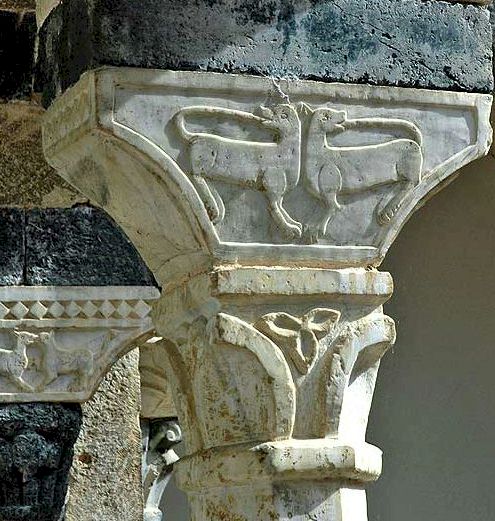
Vernacular stone carving is often less visible since so much of it is the quirky and humorous production of the mediaeval artisans who turned out decorated capitals and pilastres by the thousands. When visiting any of the numerous romanesque churches that dot the Tuscany countryside, look high up both inside and outside and the chances are you will see some fascinating and completely unique stone carving, possibly from the hand of a workman a thousand years gone.

Stone carving at Villa Viganamaggio
Carved capital at the Abbey of Santa Mustiola
Capital at the Abbey of Santa Mustiola
As you will no doubt notice, Tuscany is a very "stony" region and stone or stone-faced buildings outnumber those made entirely of brick, with wooden buildings being almost non-existent. It turns out that workable stone is quite common so, not surprisingly, stone carving embellishes buildings magnificent and humble throughout the area. Workable wood is for the most part imported from elsewhere but skilled wood carving has been a part of Tuscan art since the Renaissance and earlier when the Gothic art of fine woodcarving was introduced from Flanders.
Carved capital at the Abbey of Sant' Antimo
Capital at the Abbey of Sant' Antimo
Mediaeval stonework at Borgo di Vagli hamlet
Stonework at Borgo di Vagli hamlet
Cast iron decorative elements became extremely popular in the late Victorian and art deco periods and continue to be right up to the present day. Wrought iron work is also extremely common in Tuscany and is most commonly visible in the form of iron grills over windows. Wrought iron bedsteads, candelabra and chandeliers are typical of "Tuscan country style". The streets of Sienna are particularly well-endowed with wrought and cast iron decorations, including lamp supports and flag holders.
Cast iron door sign Sienna
Cast iron shop sign in Sienna
All of these details contribute to the charm of Tuscan cities, towns and villages. They repay attention!

More about what to see in Tuscany.

More about Borgo di Vagli.

My recommended vacation rentals in Tuscany.

Tuscany Toscana
Don't forget to visit Elena Spolaor's
Travel Guide!

Up-to-date news on what to see and where to stay in Chianti and all of Tuscany & Umbria.

Chianti Travel Guide

Author: Anna Maria Baldini

All content copyright © ammonet Italian Web Site Promotion 2013 - 2014. All rights reserved.

Wednesday, 1 May 2013

"The Springtime of the Renaissance" - a great exhibition currently showing in Florence

The Strozzi Palace is currently hosting a wonderful art exhibition under the title "The Springtime of the Renaissance" (La Primavera del Rinascimento. La scultura e le arti a Firenze 1400-1460. Palazzo Strozzi.). Everyone with an interest in the history of art, especially Renaissance art, should seize the opportunity to spend half a day (or a whole day) at this exhibition here in Florence or, from September, at the Louvre in Paris, if they possibly can. Every year there is a very good exhibition at the Palazzo Strozzi, but this year (2013), the Bargello and the Louvre have put together a truly fabulous show of early Florentine masterpieces displayed alongside equally beautiful Classical and late Gothic works of the kind from which the Florentines drew inspiration.

La Primavera del Rinascimento. La scultura e le arti a Firenze 1400-1460
The modern, the renaissance and the classical - a study in character.

The creators of this exhibition suggest that it was from sculpture more than painting that the Renaissance sprang, and they see the initial glimmer in the form of the two bronze relief panels submitted in 1401 by Brunelleschi and Ghiberti for the competition to create a set of new bronze doors of the Florentine baptistery. Sculpting scenes based on an identical biblical story, both artists combined Gothic elegance of costume and scenery with human figures inspired by classical sculpture. From this point on, the exhibition is dominated by the sculpture and spirit of Donatello, who did his apprenticeship in the workshops of Brunelleschi and Ghiberti. Donatello strongly influenced his contemporaries, both sculptors and painters, among whom we may count Michelozzo, Masaccio, Filippo Lippi, Paolo Uccello and Andrea del Castagno, stylistically and through his introduction of perspective in his low relief works.
Donatello at the Palazzo Strozzi in Florence
Single point perspective, classical depiction of the human form and draperies
- Donatello's St George and the Dragon in very shallow relief.

The spatial organisation of the exhibition is excellent, not least with the placement of a huge, 4th century BC, bronze horse's head, the Medici Protome, visible through an arch from the first room of the show. Later, when we enter this room, Donatello's Carafa Protome, is revealed, and we can easily see why it was long thought to be a classical work.
Donatello's Carafa Protome
Donatello or ancient Greek? Visit this exhibition to find out which!

At the appropriate points in the exhibition, Classical sculpture including portrait busts and sarcophagus friezes, are juxtaposed with early Renaissance works in which the artists were evidently struggling to relearn the artistic skills of the Greeks and Romans, especially in depicting the human form. At other points, the juxtapositions of contemporary paintings and sculptures emphasize how painters set out to make their paintings more sculptural

The Springtime of the Renaissance
Painters set out to make their paintings more sculptural.

During my visit at the end of April, viewers were sparse and I often had entire rooms to myself. You can also view the exhibits close up, with a magnifying glass if you wish (and have one with you). In most of their native museums, this is surely not possible. Try to attend this show early or at least in Florence. It will definitely be packed out when it moves to Paris

More about La Primavera del Rinascimento.

Recommended vacation accommodation in Chianti towns, villages and countryside.


Author: Anna Maria Baldini

All content copyright © ammonet Web Site Promotion 2012 - 2013. All rights reserved.