Showing posts with label tourist information. Show all posts

Sunday, 10 July 2022

Things to see in Lucca

Last Saturday, when temperatures were down slightly, I paid a visit to Lucca, that lovely walled town in the west of Tuscany. I had forgotten just how pleasant Lucca is for a stroll - so compact, beautiful, full of things to see and virtually free of motorised vehicles within the walls.

Visit Lucca
 
Partial view of Lucca within the walls.

The main things to see in Lucca are described on the Lucca Tourist Information website. Here I want to describe some of the things that I personally enjoyed on this visit.

Map of Lucca

Map of Lucca

I arrived by train from Florence (1 hour 20 minutes) walked to the main entry portal of Lucca, Porta San Pietro, and followed my favorite route past Piazza Napoleone to Piazza San Michele to visit the church and admire there the very fine glazed, terracotta bas-relief by Luca della Robbia. 

The piazza was baking in the sun but luckily Lucca's streets are, for the most part, narrow and therefore shaded. Lucca is also noticeably well-endowed with excellent pasticcerie so that more than once I picked up a pastry to accompany very necessary cold drinks.

Pasticceria in Lucca

Pasticceria in Lucca

Lucca is also a remarkably good town for shopping, especially taking into account its small size. There are certain towns in Tuscany that attract wealthy visitors from nearby vacation areas and which therefore offer very high quality stock. Pietrasanta for example, attracts clientele from Forte dei Marmi and environs. Lucca is similar but, because of the large general tourist traffic, has in addition many moderately priced shops selling beautiful ladies' clothes, as well as a good number of leather goods and jewellery shops - the most famous of the latter is Gioielleria Carli, which has been owned by the same family since the 1600's. I found that Marchi, on via S. Lucia, had the best stock of "non-industrial" jewellery. Many of the others sell inexpensive "fashion jewellery". 

Gioielleria Carli
 
Gioielleria Carli, via S. Lucia, Lucca

In fact, the small size of Lucca, as for Pietrasanta, is a part of what makes the shopping good - there are a few streets packed with interesting stops all within an easy walk of one another. I leave aside the salumerie which, although attractive and full of good offerings, are not different from similar places scattered more diffusely in Florence and elsewhere. Via Fillungo is the main shopping street with many unique shops but also rather too many designer outlets selling the same old stuff. However, in the streets round about - via S. Lucia, for example - you will find many individually-owned clothes shops currently selling very nice linen outfits, among many other skirts, dresses and tops.

Next, time for lunch. Lucca is very well-provided with good quality restaurants. Prices are slightly higher than elsewhere in Tuscany but on the whole the quality of the dishes is very good. I went to my favorite - and the favorite of a great many others - Osteria Rosolo which is located in a small and quiet piazza, Corte Campana, off Via Pozzotorelli which exits the Piazza San Michele on its SW corner. As its name says, Osteria Rosolo is an osteria (a trattoria, a small eating house) and it offers more or less standard Tuscan fare (plus lamb chops). I come here for two reasons - the TASTE of the food is exceptional and the service is incredibly welcoming, informal and flexible. They have an indoor, air conditioned dining room but despite the general temperature, the tables outside were delightfully cool under the umbrellas. I was very hungry so I had linguine with vongole (both fresh and delicious) with a glass of local white wine. It was a trebbiano, a highly productive grape which usually yields a faîrly bland wine, but in this case it was excellent. Next, a fillet steak on toast with a sauce of mustard, cream and green pepper corns - fabulous, and cooked exactly to the degree I requested. With that I had a glass of cabernet sauvignon from Bolgheri - plus plenty of cold water. They willingly put my red wine in the fridge for a few minutes to cool it down a bit, an act of sacrilege forced upon me by the current heat wave.

Osteria Rosolo in Lucca

Fillet of beef at Osteria Rosolo in Lucca

For the afternoon, I picked two sights quite unique to Lucca, the Palazzo Pfanner and the Botanical Gardens.

Palazzo Pfanner (also known as Palazzo Controni) was constructed in 1660 and is now the home of the Pfanner family. Felix Pfanner (1818-1892), a brewer from Hörbranz on the shores of Lake Constance, came to Lucca and founded a famous brewery. He eventually bought the Palazzo from the Controni family. Pietro Pfanner (1864-1935) was a surgeon, philanthropist and Mayor of Lucca from 1920-1922.

Palazzo Pfanner in Lucca

Palazzo Pfanner in Lucca

As my intelligent and discerning readers will recall, I am a garden nut, and you can safely believe me when I say that the small garden of Palazzo Pfanner is delightful, especially on a hot day. There I relaxed in the shade. The garden is surrounded by high shrubs and bamboo so that only the fine campanile of the Basilica di San Frediano is visible. In summer the big terracotta pots holding the lemon trees are dotted around - these are housed in the limonaia during the winter months. A short walk bordered by larger than life marble statues leads to a small pond with a simple fountain in the middle of it. The best view of this walk is from the splendid loggia of the palazzo. The apartments of the palazzo that are open to the public are of moderately interesting, and among other things display some of the surgical equipment of Pietro Pfanner. The main reason for ascending the grand staircase is the view it affords out over the garden.

My next and last visit for the day was to the Botanical Gardens in the SE corner of Lucca. They can be reached from Palazzo Pfanner via the Piazza del Amfiteatro (well worth a brief visit - some of the stonework of the Roman amphitheatre can be seen in the walls of the apartment buildings now delineating the outline of the amphitheatre) and the Torre Guinigi, the famous tower with the trees growing on top of it, and then following the Via del Fosso and its fast flowing canal.

Botanical Gardens in Lucca

The Botanical Gardens in Lucca - Sequoia sempervirens

For such a small town, Lucca has an excellent Botanical Garden, with specimens ranging from a giant sequoia to a good collection of insectivorous plants. They have a huge ginkgo tree, surely one of the first specimens planted in Europe. Ginkgo leaves were known from fossils dating as far back as the Permian period. The last surviving genus is native to China and was first described by Engelbert Kaempfer in 1690 based on a tree he saw in Japan. Specimens soon found there way into botanical gardens throughout the Western world. Not only the plants are interesting. While I was at the gardens, a beautiful hoopoe was busily digging up worms just a few meters away from me. I could spend hours in these gardens and will surely return to them.

I suppose being sensitised by an afternoon of plants, I couldn't help but be fascinated by the miles and miles of tree and shrub nurseries in the Arno flood plain visible from the train back to Florence. It reminded me yet again how horticulture dominates the rural economy of Tuscany.

More about Lucca: https://www.lucca.info/

Lucca on Facebook:  https://www.facebook.com/lucca.tuscany.italy/


Tuscany Toscana
Don't forget to visit my Tuscany
Travel Guide!

Up-to-date news on what to see and where to stay in Chianti and all of Tuscany.

Tuscany Travel Guide

vacation accommodations in Tuscany


Author: Anna Maria Baldini
All content copyright © ammonet Italian Web Site Promotion 2022. All rights reserved.

Sunday, 12 January 2020

Florentine villas and gardens: American and English expatriates in Tuscany

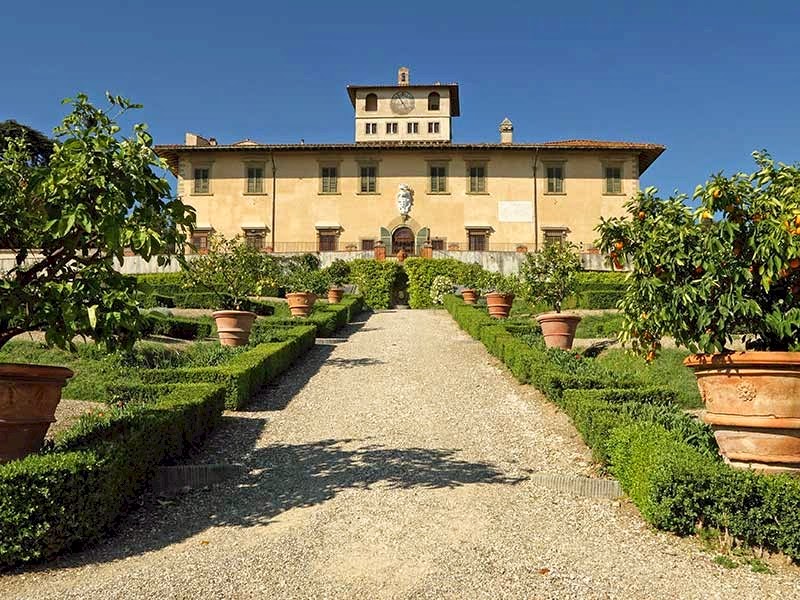
Villa Gamberaia , located i on the outskirts of Settignano above Florence was a favorite destination among the Florentine villas and gardens for American and English expatriates in Tuscany during the later 19th and early 20th centuries.

Florentine villas and gardens: American and English expatriots in Tuscany
The parterre of Villa Gamberaia

Villa Gamberaia, celebrated for its unique gardens and splendid views over the city of Florence and the Arno Valley, has long inspired American and British landscape designers, from Charles Platt and Cecil Pinsent to Ellen Biddle Shipman. In the early 1900s, it was the favorite meeting place of Bernard and Mary Berenson, Janet Ross, Vernon Lee and Arthur Acton, who gathered for tea, dinners on the terrace and talks on art and literature with their hostess, the Romanian princess Jeanne Ghyka and her American companion, artist Florence Blood, two very talented women who created the magnificent parterre d’eau.


Tuscany Toscana
Don't forget to visit my Tuscany
Travel Guide!

Up-to-date news on what to see and where to stay in Chianti and all of Tuscany.

Tuscany Travel Guide


vacation accommodations in Tuscany

Author: Anna Maria Baldini

All content copyright © ammonet Infotech website promotion 2023. All rights reserved.

Wednesday, 2 December 2015

Badia a Passignano, the abbey (abbazia) of San Michele Arcangelo a Passignano

One of the most photogenic and interesting structures in Chianti is the Abbey of Passignano, officially the Abbazia di San Michele a Passignano. I should say at the outset that it's not that easy to visit the interior of the monastery because there are very few monks there, often only two, and they have more than enough work to occupy their time. Nevertheless, during 2015, the ten year restoration of the refectory was completed and it is now possible to see the splendid "Last Supper" there, a fresco by Ghirlandaio which very likely influenced Leonardo's conception of the same subject. If you don't have a chance to go within the walls, there are nevertheless many vantage points to both the east and the west of the Badia for spectacular photography.

Abbey of Passignano near Tavarnelle in Chianti, Tuscany
Abbazia di Passignano

This ancient foundation passed several decades in private hands during which time it was much altered externally in the taste of Victorian times - fake crenellations and all the rest of it. However, the interior contains many ancient and beautiful features including the Ghirlandaio fresco. As a garden nut, I was much taken by the fine giardino all'italiana hidden behind the monastic walls. The abbey is definitely worth a visit if you can arrange it. The nearest towns are Sambuca and Greve in Chianti.

Italianate garden of the Badia a Passignano in Chianti, Tuscany

Note that the extensive cellars have been leased out to Antinori whose enormous vineyards cover many of the surrounding hills. A visit to the wine cellars is an activity entirely separate from a visit to the monastery proper. To visit the cellars and/or to do a wine tasting, contact Antinori.

To find out when the monastery is open, try phoning the tourist information office at Tavarnelle Val di Pesa  Tel. 055 8077832

More about the Badia a Passignano.

More about the gardens of Tuscany.


Tuscany Toscana
Don't forget to visit my Tuscany
Travel Guide!

Up-to-date news on what to see and where to stay in Chianti and all of Tuscany.

Tuscany Travel Guide

Author: Anna Maria Baldini

All content copyright © ammonet Italian Web Site Promotion 2015 - 2016. All rights reserved.

Thursday, 26 June 2014

"Under Petraia with some wanderings" - the second volume of Georgina Grahame's memoirs

Attentive readers will no doubt remember my post regarding the splendid and unjustly neglected volume "In a Tuscan Garden" by an anonymous author since identified as Mrs. Georgina Grahame, an aunt of Kenneth Grahame of "The Wind in the Willows" fame. I closed that post with the hope that I would be able to obtain a copy of the very scarce second volume of her memoirs, "Under Petraia", not a trace of which could be found in any of the big multidealer rare books websites. Well, less than a year later, my very good friend Paul Chipchase, scholar and gentleman, located a copy in Australia and nobly presented it to me.

This second volume was published in 1909, eight years before Mrs. Grahame's death in Florence in 1917 at the age of 79. It begins with a description of her successful efforts to find a new home when the lease on her house, Il Villino Landau, was terminated upon the death of the owner, Baron Landau, in 1903. The new house was located in an area to this day not especially popular with tourists, whether Italian or foreign, namely Castello, in the hills of Quarto, north west of Florence and on the boundary of Sesto Fiorentino (not surprisingly, since Quarto and Sesto refer to the 4th and 6th Roman milestones from Florence. Quinto lies between them and is home to Santo Croce a Quinto, the second most hideous church in Florence, the winner being Michelucci's brutalist Motorway Church). Quarto's main claim to fame is as the location of the Villa Medicea di Castello and, not far away, the Villa La Petraia, another Medicean villa and once the favorite residence of King Victor Emmanuel II.

The giardino all'italiana of Villa di Castello, Florence

The giardino all'italiana of Villa di Castello, Florence
 
The toponym for the location does not derive from a castle (castello) but rather from the cistern (castellum) of a Roman aquaduct starting here and running to Florence, constructed by the Roman Senator Marco Opellio Macrino (164-218). Mrs. Grahame refers more than once to the abundant springs in the hills hereabouts. Villa di Castello has a wonderful italianate garden and is a must see for anyone interested in the villa gardens of Tuscany.

Villa La Petraia near Florence

The Medicean Villa La Petraia near Florence

Villa La Petraia
is situated at the location of an old castle first documented in 1362 and which changed owners several times (Brunelleschi, Strozzi, Alessandra dei Bardi, Salutati). The castle was acquired by the Medici when they returned to Florence in 1530 and transferred from Cosimo I to his son, Cardinal Ferdinando in 1568. It was enlarged and transformed into a Villa on the initiative of the latter who became Grand Duke after the death of his brother, Francis I, in 1587. The basic layout of the gardens dates back to the late 16 C, with 18 C and 19 C additions such as the "Piano della figurina" decorated with the Fountain of Fiorenza and the English style park on the northern side, created according to the typically romantic taste that characterised the first half of the 19 C.

The gardens of Villa La Quiete near Florence

The gardens of Villa La Quiete near Florence

Another beautiful Medicean villa in the area, described in some detail by Mrs. Grahame, is the Villa La Quiete. known in the past as the Palagio di Quarto. It is recorded as being a possession of the Orlandini family when it was given to the condottiero Niccolò da Tolentino in 1438. The Medici bought it in 1453. For centuries a convent, then briefly in the 1990's a property of the University of Florence, La Quiete has belonged to the Region of Tuscany since 2008. Its fine italianate garden was created during the 18 C. The curator at that time was Sebastiano Rapi, head gardener at the Boboli Gardens in Florence.

The parco all'inglese of Villa di Quarto near Florence

The parco all'inglese of Villa di Quarto


Villa di Quarto, sometimes known as Villa di Castelquarto, Villa Paxton or Villa della Granduchessa, like some of the other villas in the area, possesses, in addition to its giardino all'italiana, a wonderful parco all'inglese. The property has a huge range of tree species and is a botanists' paradise. Villa di Quarto was rented for a time by Mark Twain and it was here that his wife passed away. At least one letter survives from Mark Twain to Mrs Graham (sic), dated 12 April, 1904 and appreciating her charming letter that added grace to the vivid, sunny morning in Florence, but adds, "Our house is a hospital, these 5 months, & the sunshine is all outside of it, there is none within." His stay there was not improved by the owner of the house, his compatriot Frances Paxton, Countess Massiglia, described by Mark Twain's secretary, who had known her previously in Philadelphia, in these words. "Count Massiglia is far away serving his country as Consul in Persia or Siam, and he is likely to stay there too; and it seems to me that for the sake of peace or freedom, he has left this Villa in the hands of the Countess … Here she remains, a menace to the peace of the Clemens household, with her painted hair, her great coarse voice, her slitlike vicious eyes, her dirty clothes, and her terrible manners." Twain himself described her as "excitable, malicious, malignant, vengeful, unforgiving, selfish, stingy, avaricious, coarse, vulgar, profane, obscene, a furious blusterer on the outside and at heart a coward." It must have been an interesting time at Villa di Quarto for all those not actually living there. Alas, we have no word on this topic from Mrs. Grahame.

Other villas in the area include Villa Corsini and Villa Medicea della Topaia. Topaia means "rats' nest" and hence "a dump" but the name of this villa, once a hunting lodge and definitely never a dump, has a much more appropriate origin, deriving from "opus topiarum", the art of topiary.

Mrs. Grahame's new address was given in her letters as "Bel Gioiello, Quarto, Castello, Florence", referring to a two storey farm house dating from well before 1481, belonging to the estate of Villa La Petraia, located on Via Pietro Dazzi (currently number 29) on the northern boundary of the estate of La Petraia - hence the name of her book, "Under Petraia". It is neighbour to another farmhouse at numbers 25-27, known as Villa del Gioiello. Mrs Grahame does not use the name Bel Gioiello in this book. I have been unable to obtain a picture of the house since it remains private property, but the layout of the grounds can be made out from the aerial photo below. The back of the contadino's house to the right forms one side of the quadrangle and the round well opposite seems to have been filled in since Mrs. Grahame's time.

Bel Gioiello Castello Firenze

Aerial view of Bel Gioiello Castello Firenze

Mrs. Grahame describes the creation of her new garden, slowed by the unfortunate employment of two crooked administrators in succession. The author's age and unavoidable absences prevented her from supervising the work as closely as she had done at Il Villino Landau but within a couple of years a jungle of weeds and areas as dry as "brick dust" had become a beautiful garden, many of the plants having been transferred from Il Villino.

The pergola from Under Petraia

A photo of the pergola from the book.

The later chapters of "Under Petraia" are devoted to the "wanderings" of the title and refer to the author's exploration of more northerly parts of Italy, with many lines devoted to her acute analysis of Italian government, character and customs. I was sad to reach the last page and bid farewell to Mrs. Grahame and her gardens.

More about the formal Tuscan gardens of the villas of Tuscany, Italy.

More about the villas of Tuscany .

Tuscany Toscana
Don't forget to visit Elena Spolaor's
Travel Guide!

Up-to-date news on what to see and where to stay in Chianti and all of Tuscany & Umbria.

Chianti Travel Guide


vacation accommodations in Tuscany

Author: Anna Maria Baldini

All content copyright © ammonet Infotech website promotion 2014 - 2026. All rights reserved.

Friday, 12 October 2012

Chianti Travel Guides and Chianti Tourist Information

Here I would like to provide some useful links for those seeking reliable Chianti travel guides and Chianti tourist information. The following websites are among the most comprehensive in terms of information for visitors on what to see and things to do in the Chianti area of Tuscany and also to other parts of Tuscany, Italy. At the bottom of this post, I've also placed a link to a good selection of travel guide books available from Amazon along with my recommendations.

Chianti Travel Guides and Chianti Tourist Information
A classic Tuscan farmhouse (casa colonica)
One of the first and still one of the best websites devoted to Chianti is www.greve-in-chianti.com (established 1997) which is a travel guide not only to Greve in Chianti, the market town of the Chianti Classico area, but also to many points of interest in the surrounding area. It offers an excellent owner-direct list of vacation accommodation in Chianti. I also publish articles there from time to time on different aspects of Tuscan life plus tips for tourists visiting Tuscany: Tuscany Blog. My friend and colleague, Elena Spolaor, is rapidly expanding her Chianti Blog at www.chiantitravelguide.com

www.bella-toscana.com (1998) is a travel guide website containing a mass of useful and information on Tuscany - architecture, history, food, wine, accommodation as well as links to tourist information websites about individual towns throughout the region. Their map of Tuscany has similar links to towns, monasteries, villas, mountains and other geographical points of interest to tourists in Tuscany and also Umbria.

Another excellent Chianti travel guide is www.chianti.info (2001). Despite its name, this travel guide website covers not only Chianti but provides tourist information on other parts of Tuscany. Do you want to gather, or simply eat, porcini mushrooms? To grill, or simply eat, a bistecca alla fiorentina? Learn about the history of the part of Tuscany known as Chianti? This site is for you!

Two smaller, more recent but increasingly popular travel guide sites are www.chianti-italy.com and www.tuscanyitaly.com. The former provides a list of air conditioned vacation rentals among other things, while the latter offers a comprehensive list of events and fairs, and a list of market days throughout Tuscany.

My recommendations for the best Tuscany guide books are:
- for those interested in the details of history and architecture, the Blue Guides, namely Blue Guide Florence and Blue Guide Tuscany. These are excellent scholarly guide books.
- for those who prefer diagrams more than text, the best guide book, in my opinion, is the Eyewitness Travel Guide: Florence & Tuscany. This is quite a weighty book to carry but it's packed with excellent illustrated maps, cut-away illustrations of architecture and so on.

I have assembled a comprehensive list of Tuscany travel guide books available from Amazon here. Titles and some reviews of more specific interests are as follows:

Some general Tuscany guide books.
Cycling in Tuscany.
Hiking in Tuscany.
Gardens of Tuscany.
Orchids in Tuscany


All content copyright © ammonet European domain name registration 2012 - 2015. All rights reserved.