Saturday, 8 March 2014

American girl in Italy - an iconic photo shot in Florence, Italy

How did this great photograph come about and who are the people in it?

An American girl in Italy by Ruth Orkin
"An American girl in Italy" taken by Ruth Orkin
What do we know about this famous photograph? Well, it was taken by 29-year-old Ruth Orkin in Florence on 12 August, 1951, in the Piazza della Repubblica, in front of Caffè Gilli. The girl attracting all the attention was the then 23-year-old model Ninalee Craig (called Jinx Allen by Orkin). The photograph was conceived inadvertently when Orkin noticed the men ogling the beautiful, six-foot Allen as she walked down the street. Orkin asked Allen to walk down the street again for a second shot. The only staged aspect was that she asked the man on the scooter to tell everyone else not to look at the camera. Ruth Orkin passed away in 1985 after a successful career as a free-lance photographer and, with her husband, film editor and director. Ninalee Craig was still full of fun when she was interviewed in 2011 at the age of 85. She still owned the bright orange shawl that featured in the photograph and described her stay in Florence as having a wonderful time - including being justly admired for her beauty.

And what about the good-looking guy on the Lambretta scooter? That was none other than Carlo Marchi, one of the offspring of the Italian chemicals magnate, Ferruccio Marchi. After a scandalous and short-lived marriage to a French woman, he was sent by his father to America in 1956 for a "change of scenery". After a playboyish start, he studied business at Columbia and was soon part of the jet set, with numerous friends in Hollywood, including Henry Fonda and Gregory Peck at the start of their careers. His second marriage, to Gioia Falck of the Milanese steel dynasty, lasted more than fifty years and produced three sons. His sister married into the Frescobaldi family. He died in Florence in 2012, aged 82.


Tuscany Toscana
Don't forget to visit my Tuscany
Travel Guide!

Up-to-date news on what to see and where to stay in Chianti and all of Tuscany.

Tuscany Travel Guide

Author: Anna Maria Baldini

All content copyright © ammonet Italian Web Site Promotion 2014. All rights reserved.

Wednesday, 26 February 2014

Another two newly-renovated rooms open at the Uffizi Gallery in Florence, Italy

The Uffizi gallery has opened a further two renovated rooms, "Green" Rooms numbers 33 and 34, located next to Room 35, the Michelangelo Room (Sala di Michelangelo), on the second floor. The two new rooms, which, before restoration, used to house works by 16 C Tuscan and Lombard painters, display Roman copies of Greek sculptures, as well as paintings, related to the famous Giardino di San Marco which was created as a kind of art school or academy by Lorenzo de' Medici, il Magnifico, and where Michelangelo did some of his early training.

New rooms at the Uffizi Gallery in Florence
Roman copy of a Greek original, in a new room at the Uffizi Gallery, Florence
The Giardino di San Marco was dotted with classical marble statues, portraits and sarcophagi to instruct the sculptors of the early Renaissance about what the ancient Greeks were capable of doing, with the aim of replicating those skills in Florence.

The restoration of these rooms forms a part of the commemoration of the 450th anniversary of death of Michelangelo last week on 18 February.

Among the 39 works displayed in the Green Rooms, there are 35 works that have come out of storage, providing yet another reasons to visit or revisit this fabulous art museum.

Tuscany Toscana
Don't forget to visit my Tuscany
Travel Guide!

Up-to-date news on what to see and where to stay in Chianti and all of Tuscany.

Tuscany Travel Guide


Author: Anna Maria Baldini

All content copyright © ammonet Italian Web Site Promotion 2014. All rights reserved.

Friday, 31 January 2014

Tuscan winery vacation accommodations

I recently visited the Il Santo winery on the outskirts of Greve in Chianti. I'd forgotten just how good their wine is. Il Santo is also an excellent example of the kind of Tuscan winery vacation accommodations available in this area of Chianti - both comfortable and economical. Budget travellers without a car will find Il Santo additionally attractive because it is within reasonable walking distance of the Florence bus stop in Greve (1 km). The owner and manager is the kind and attentive Alessandro Turchi.

Tuscan winery vacation accommodations
View out from Il Santo Tuscan winery vacation accommodations

Il Santo offers accommodation for up to 11 persons in four small apartments, two of which are air conditioned. Each has a private entrance and its own outdoor table and chairs on a terrace or in the garden. The views are panoramic, taking in the Il Santo vineyards and olive trees, and then the forested Chianti hills. The large swimming pool is available to guests and there is a good WiFi connection.

Il Santo winery and vacation rental in Chianti, Tuscany
Dining room of one of the vacation apartments at Il Santo
The great thing about Il Santo as a Tuscan vacation location is that it is centrally located in Chianti, half way between Florence and Sienna, making it an ideal base for exploring almost every corner of Tuscany. Greve in Chianti is on the Via Chiantigiana, one of the most scenic motoring routes in Tuscany, if not in all Italy.

You can't go wrong choosing Il Santo as your holiday home in Tuscany.

More about Azienda Agricola Il Santo near Greve in Chianti, Tuscany.


Tuscany Toscana
Don't forget to visit my Tuscany
Travel Guide!

Up-to-date news on what to see and where to stay in Chianti and all of Tuscany.

Tuscany Travel Guide

Author: Anna Maria Baldini

All content copyright © ammonet Italian Web Site Promotion 2014. All rights reserved.

Saturday, 25 January 2014

Pienza is a must see when you visit Tuscany

The little town of Pienza in the Val d'Orcia of southern Tuscany seems to the visitor to be an ideal town, filled with light, human in its balance and proportions. This is no accident. Enea Silvio Piccolomini, a Renaissance man in every sense, as Pope Pius II, had his native village of Corsignano rebuilt to embody in urban form the humanist ideals of the architect Leon Battista Alberti. The work was supervised by Bernardo di Matteo del Borra Gamberelli (1409–1464), better known as Bernardo Rossellino, and the outcome was a model for many later Renaissance towns and cities. Corsignano is now known as Pienza, from the name of its greatest benefactor, Pio II.

Pienza
Pienza seen from the Val d'Orcia

Without doubt I can say that Pienza is a must see when you visit Tuscany. The focal point for a visit to Pienza is the trapezoidal main piazza which is defined by four buildings: the Palazzo Piccolomini, the Duomo, the Palazzo Vescovile and the Palazzo Comunale.

To me the three storey Palazzo Piccolomini is one of the most beautiful secular buildings of the Renaissance, enhanced as it is by an interior courtyard and a splendid italianate garden on the south side, looking out over the Val d'Orcia to Monte Amiata in the distance. This integration of the garden into the architecture of the villa, together with the wonderful vista beyond the garden, is the hallmark of Renaissance domestic architecture.

A visit to Pienza can comfortably be combined with visits to the wine towns Montalcino and Montepulciano, or a visit to Villa La Foce, if formal gardens are among your enthusiasms.

And let's not forget that the sheep of the Val d'Orcia together with the skill of its artisans make Pienza the home of the best Tuscan pecorino, ewes' milk cheese. Don't forget to buy some during your stay in Pienza!

More Pienza tourist information.

Tuscany Toscana
Don't forget to visit Elena Spolaor's
Travel Guide!

Up-to-date news on what to see and where to stay in Chianti and all of Tuscany & Umbria.

Chianti Travel Guide


vacation accommodations in Tuscany

Tuscany tourist information - tourist information

Author: Anna Maria Baldini

All content copyright © ammonet Infotech website promotion 2014 - 2020. All rights reserved.

Wednesday, 23 October 2013

Harry Brewster, the last of the Florentine cosmopolitans

A few years back, I read and greatly enjoyed The Cosmopolites, a book by Harry Brewster who was among the very last of the Florentine cosmopolitans. Discovering Harry Brewster and his family and learning about their life at their home, the former convent of San Francesco di Paola, located in Florence below the Torre di Bellosguardo, expanded my appreciation of the expatriate culture of Florence. I had hitherto approached these "romantic exiles" mainly via my (and their) enthusiasm for Tuscan villa gardens. Since then I've read two more of Harry Brewster's books, namely A Cosmopolite's Journey: episodes from a life and Out of Florence: From the World of San Francesco di Paola. Of the three books, A Cosmopolite's Journey is the wittiest and lightest read, and probably his best book.

Harry Brewster, the last of the Florentine cosmopolitans
The view from Bellosguardo out over Florence, with San Francesco di Paola hidden among the trees below the crest.
Foreigners flocked to Florence from the 18th century onwards and, by the late 19th century, 30,000 of the 200,000 residents of Florence were Anglo-Florentines who had adopted the city as their home. It's often said that Sir Harold Acton was the last survivor of pre-war Anglo-Florentine culture but Harry Brewster outlasted Acton by five years, passing away in 1999.

Harry Brewster was born in Rome in 1910. One of his grandfathers, descended from William Brewster of the Mayflower, was a friend of Henry James, who reportedly used him as the model for Gilbert Osmond in The Portrait of a Lady. His maternal grandfather was the German sculptor Adolf von Hildebrandt, whose studio occupied part of San Francesco di Paola. Harry, with his brother Ralph and sister Clotilde, grew up behind the high walls of what was essentially a rambling Tuscan farm that happened to be only a ten minute walk from the centre of Florence. The Brewsters were American through and through, but, because of their long residence in Europe, no longer qualified for US citizenship. However, when Harry married an English actress, Elizabeth Home, he took on British citizenship and served as a police officer in Kenya throughout the war.

Villa San Francesco di Paola
Statue of San Francesco di Paola at the entrance to the villa

After working for several years as part of the Allied commission administering Berlin and as an attaché at the British Embassy in Rome, he returned to Florence to devote the rest of his life to enjoying his beautiful home, San Francesco di Paola.

His main occupations during the post-war decades were writing and photography. Aside from his autobiographical volumes, he wrote Classical Anatolia and River Gods of Greece, based on numerous visits to classical sites, especially in Turkey and the Middle East, both books being illustrated with his own excellent photographs.

Harry Brewster had three sons. His second marriage was to Fiona Warnant- Peterich and his travelling companion in his later years was the immensely cultured Barbara Emo di Capodilista (née Barbara Steven) who herself passed away in 2003.

If you're able to borrow or buy any of Harry Brewster's books about his life in and around Florence, I recommend them highly.  They open a window onto a world of immensely interesting individuals who style of life, although not that far in the past, has more or less disappeared completely.

My recommended Tuscan vacation accommodations:

Greve in Chianti accommodation.

Panzano in Chianti accommodation.

Villa hotels.


Tuscany Toscana
Don't forget to visit my Tuscany
Travel Guide!

Up-to-date news on what to see and where to stay in Chianti and all of Tuscany.

Tuscany Travel Guide

Author: Anna Maria Baldini

All content copyright © ammonet Italian Web Site Promotion 2013 - 2016. All rights reserved.

Friday, 20 September 2013

"In a Tuscan garden" - who was the author of this book?

Attentive readers of my blog posts will long ago have realised that I'm a garden nut - not just an enthusiast for classic Tuscan gardens but also for gardening in and of itself. This week I was lucky enough to add to my Tuscan gardens library a wonderful volume with a beautiful art deco cover, published in 1902. The author was an anonymous English lady who, at the time of writing her book (1901), had spend 15 years cultivating the garden of her villa near Florence. The book, In a Tuscan Garden, is a quite charming description of her adventures in setting up and maintaining the garden that was obviously an important part of her life in Tuscany. She has much to say on the character not only of the Tuscan seasons, soil and garden plants, but also the character of Tuscan gardeners!

In a Tuscan garden by Georgina S. Grahame
The villa forming the frontispiece of In a Tuscan Garden by Georgina S. Grahame
In her unpublished recollections, Annie Grahame reveals the author to have been her mother, Mrs Georgina S. Grahame. The John Lane archive at the Harry Ransom Center in Texas also contains correspondence between John Lane, who published the book under the Bodley Head imprint, and Georgina Grahame.

Who was Georgina S. Grahame? She was born in 1838, the daughter of George Bell (1795-1864) and Ann Robertson (b. 1800) and was an aunt of Kenneth Grahame, the author of The Wind in the Willows. She married Robert Vetch Grahame in 1857 when she was 19 years old and he was 33. Robert Vetch Grahame, born in 1824, was the son of Thomas Grahame (1793 - 1881) and Agnes Vetch (1801 - 1878) who married in 1822. Robert Vetch Grahame (1824 - 1890) was a merchant who spent much of his working life abroad in Manila and later lived in London. Georgina mentions having been in the Philippines. The couple had two children, Annie Grahame, born in 1859 and died in 1937, and Thomas George Grahame, born in 1861 and died in 1922, both born in the Philippines. Annie was the same age as her cousin Kenneth Grahame and a sympathetic friend of his. Robert Vetch Grahame retired in 1879 while resident in Edinburgh.

The Grahame family was Scottish in origin but Robert Vetch Grahame and his family lived at Draycott Lodge in Fulham, West London, which he owned from 1870 until 1879. (In November 1881, the house passed to the pre-Raphaelite artist, William Holman Hunt.) Kenneth Grahame lived with them for some time between leaving school and taking up employment at the Bank of England in 1879. Annie recalled visits from Kenneth Grahame after they established themselves Italy and there was an interesting exchange of letters between them.

Georgina Grahame refers to the "breakup" of their household, presumably upon her husband's retirement, and the purchase of a smaller place, probably not in London, a few years before her husband took out the lease on Villino Landau, an old farmhouse located on Via Bolognese about 3 km from the historic centre of Florence, on the hills of Fiesole in Tuscany. This seems to have taken place in about 1885 and it is unclear how often her husband accompanied her there. In her book she refers to her son Thomas as "The Junior Partner" and her husband as "The Absentee".

The Villino was an annex to a famous Renaissance villa known under various names over the centuries and which currently belongs to the University of Paris, under the name Villa Finaly. It was Allied Headquarters during the liberation of Florence. The golden age of the villa, then known as Villa Montughi, was the period as 1427-1816, especially after 1586 when it was owned by the Corsi family. From 1854 until 1858, it was the country seat of the last English Minister to the Grand Duchy of Tuscany, Constantine Phipps, 1st Marquess of Normanby, who sold it to James de Rothschild shortly before his death in 1863. Rothschild had little interest in the property and sold it two years later to Baron Horace de Landau who was the owner at the time of the lease of the farmhouse to Georgina Grahame's husband, Robert. On the death of the Baron in 1903, his niece, Jenny Ellenberger, inherited his fortune, including the villa, and it was this change in ownership that brought to an end the residence of the Grahames at the Villino. Annie Grahame recorded that Jenny Ellenberger and her cousin and husband, Hugo Finaly, were "too high and mighty to tolerate neighbours"!

In 1909, Georgina published, also anonymously, a second book, Under Petraia, With Some Saunterings which was reviewed as far away as in New Zealand (New Zealand Herald 1908) in large part because of the popularity of her first book among gardeners world-wide. In the second book, she describes their search for a new home in Tuscany after the change of ownership of Villino Landau forced them to give up their lease. This latter volume is scarcer than In a Tuscan Garden. I am still searching for a copy to learn more about this unjustly neglected Victorian authoress and member of the amazingly talented Anglo-American population of Tuscany in the late 19th century.

More about the gardens of the Tuscan villas.

Tuscan villas and their gardens.

Italian Renaissance villas and their gardens.

Cecil Pinsent and the villa gardens of Tuscany.

Vacation accommodation in Tuscany
www.bella-toscana.com
Author: Anna Maria Baldini

All content copyright © ammonet Italian Web Site Promotion 2013 - 2016. All rights reserved.

Monday, 16 September 2013

WiFi hotspots in Florence - free public WiFi access in Firenze

Free WiFi access in Florence, Italy
Although many European cities offer comprehensive public WiFi connectivity, Italy has lagged in this sphere in part due to anti-terrorist regulations that required traceable registration before you could access the internet. These regulations have been relaxed recently (4 September, 2013) and there are now around 250 WiFi hotspots in Florence, albeit still with technical limitations. In other words, no login credentials are required at all. Currently, you can use the internet free for two hours per day using these WiFi hotspots. Coverage is patchy but denser in the popular tourist areas.


Map of free public WiFi hotspots in Florence, Italy


Vacation accommodation in Tuscany
www.bella-toscana.com
Author: Anna Maria Baldini

All content copyright © ammonet Italian Web Site Promotion 2013 - 2019. All rights reserved.

Sunday, 4 August 2013

Why is the Conca d'Oro of Panzano in Chianti called the Conca d'Oro?

The rich history of Tuscany not only manifests itself in ancient towns, abbeys and castles, but also in the place names of villages, hills and rivers and many other topographical features. One of the most beautiful names for a beautiful area is the Conca d'Oro below Panzano. Conca d'oro means "golden basin", so looking at the picture of the vineyards of the Conca d'Oro below, we have to ask ourselves why is the Conca d'Oro of Panzano in Chianti called the Conca d'Oro? Why isn't it called the Conca Verde - the green basin - for example?

Conca d'Oro of Panzano in Chianti
View over the Conca d'Oro towards Panzano in Chianti
The answer to this riddle is quite simple (once you've been told). For centuries, Florence and Sienna fought for control of the historical Chianti area (now the Chianti Classico wine zone) that forms the territory between them. They did this in large part because of the critical value of its agricultural production. Wine? Olive oil? Only in small part. Until the middle of the 19 C, agriculture in Chianti was given over principally to grain production, meaning wheat. Most of the population of both Chianti and Florence subsisted on bread as their staple diet - and, indeed, bread is still an important part of every Tuscan meal. As a consequence, every piece of land that supported wheat was used to grow it. Even into the pre-war 20 C, wheat was grown in the spaces between the rows of grape vines. One of the most productive areas for wheat was in fact the Conca d'Oro of Panzano, and as harvest time approached it was exactly what its name says, a golden basin of ripening wheat. It was only in the post-war years that wheat was replaced by the increasingly lucrative crops yielding olive oil and wine. This change coincided with the reclamation of the Maremma and the modernisation of agriculture in the Val d'Orcia (described by Iris Origo in her wonderful book, War in the Val d'Orcia) and the consequent increase in the wheat harvest in those areas.

More about what to see in and near Panzano in Chianti.

My recommended vacation rentals in Tuscany.

Tuscany Toscana
Don't forget to visit my Tuscany
Travel Guide!

Up-to-date news on what to see and where to stay in Chianti and all of Tuscany.

Tuscany Travel Guide

Author: Anna Maria Baldini

All content copyright © ammonet Italian Web Site Promotion 2013. All rights reserved.

Sunday, 7 July 2013

The Baptistry in Florence is open during the evening three nights each week during summer 2013

As an addition to my post about museum cocktail evenings in Florence, it has just been announced that the Baptistry in Florence is open during the evening three nights each week during summer 2013. The Baptistry of San Giovanni, located next to the Duomo and Giotto's campanile, will stay open until 11pm on Thursday, Friday and Saturday nights until 28 September. Entry is still by ticket, but you will have the opportunity to gaze up at some of the most beautiful mosaics in Italy outside of Ravenna in much less crowded and cooler conditions than by day.

Baptistry in Florence is open during the evening three nights each week
The Baptistry of San Giovanni in Florence
A stroll around central Florence during a warm summer evening is always a pleasure - the Italian expression passeggiata encapsulates this quality perfectly. The baptistry is artfully illuminated at night to emphasize its Romanesque architecture - it is, in fact, not only one of the best-loved structures in Florence but also one of the oldest, having been built in its current form between 1059 and 1128. An earlier octagonal baptistry was erected here in the late fourth or early fifth century, very likely over the remains of a Roman watch tower, and, according to some sources, at the behest of Theodolinda, queen of the Lombards (570-628), to commemorate the conversion of her husband, King Authari.

Mosaics in the Baptistry of San Giovanni in Florence

From outside, you can admire the exquisite bronze doors by Ghiberti and Pisano but, to me, the interior, with its magnificent cycles of mosaics, is without equal. The various panels tell stories from the Bible, most famously a representation of the Last Judgement and the grisly punishments that await those sinners consigned to Hell. And don't forget to give some attention to the mosaic marble pavement which was begun in 1209. There was also an octagonal font in the Baptistry, its footprint is still clearly visible in the middle of the floor. This font, which originated in the church of Santa Reparata, was placed here in 1128 and was taken away again in 1571.

In summary, the Baptistry is now joins the many other enjoyable activities available during the evening this summer in Florence.

Vacation accommodation in Tuscany
www.bella-toscana.com
Author: Anna Maria Baldini

All content copyright © ammonet Italian Web Site Promotion 2013. All rights reserved.

Thursday, 27 June 2013

Evening drinks at Florence Museums - "Aperitivo ad Arte"

Last year a number of the top museums in Florence stayed open late on certain summer evenings and offered a glass of wine and a snack buffet along with a close-up view of some of their famous works of art. I reviewed the Palazzo Davanzati cocktail evenings with enthusiasm. Evening drinks at Florence Museums "Aperitivo ad Arte" has been announced again for summer 2013, starting with three museums, the Uffizi, the Bargello and, new this year, the Accademia, including the tribuna where the statue of David is displayed. If you'll be in Florence this year, try not to miss these wonderful occasions! They're a chance to see some great art in a very enjoyable ambiance. What better way to pass a summer evening in Florence?

Evening drinks at Florence museums
The Palazzo Vecchio seen from the Uffizi aperitivo
on the terrace above the Loggia dei Lanzi.
The Galleria dell’Accademia Aperitivo ad Arte takes place every Wednesday from 7-10 pm, from 5 June until 25 September. The exhibition areas that will be open are the Gallery of Prisons with the Tribuna of David. The aperitivo will be offered in the flowered courtyard of the Galleria.

The Uffizi Gallery Aperitivo ad Arte takes place every Thursday from 7-10 pm, from 6 June until 26 September. The Sale del Cinquecento, including works by Raphael, Bronzino, Allori, Vasari, Andrea del Sarto, Rosso Fiorentino and Pontormo will be open. The aperitivo will be offered on the terrace above the Loggia dei Lanzi.

The Bargello Aperitivo ad Arte takes place every Tuesday from 7-10 pm, from 6 August to 24 September. The Sala di Michelangelo, Rinascimento, and the Sala di Donatello will be open. The aperitivo will be offered in the courtyard of Museum. There will also be performances by the Compagnia delle Seggiole about the secrets of the Bargello and its role during the course of seven centuries of Florentine history.

Aperitivo ad Arte Firenze

Tickets cost €15 and should be reserved (no reservation fee), by calling 055 29 48 83.
 

If you are an ATAF card holder, you are entitled to a 30% discount!

STOP PRESS! The Florence Baptistry will also be open during the evening for three nights a week during summer 2013.

"NON-COCKTAIL" LATE OPENINGS: The Uffizi and the Accademia are open until 10 pm (last entry probably 9.35 pm) on Tuesdays.

Vacation accommodation in Tuscany
www.bella-toscana.com
Author: Anna Maria Baldini

All content copyright © ammonet Italian Web Site Promotion 2013. All rights reserved.

Saturday, 15 June 2013

Enchanting Tuscany - it's in the details. Tuscan vernacular art in cast iron, carved wood and sculpted stone

Every visitor to Tuscany experiences the power of fine architecture and paintings on the grand scale, but let's not forget the endless enchanting details of Tuscan vernacular art that reflect the love of fine workmanship that has characterised Tuscany since at least the end of the Dark Age. Among the most prolific and accessible anonymous works of art in Tuscany are those in cast iron, carved wood and sculpted stone. And the age of the digital camera makes these miniature masterpieces all the more accessible since many of them are in locations often too high to be seen other than by means of a zoom lens. Not all of course - door knockers and door wood carvings are right there to be observed close up by those with a sharp eye for detail.
Tuscany door knocker
Tuscan art deco door-knocker
Tuscany door wood carving
Exquisite door wood-carving

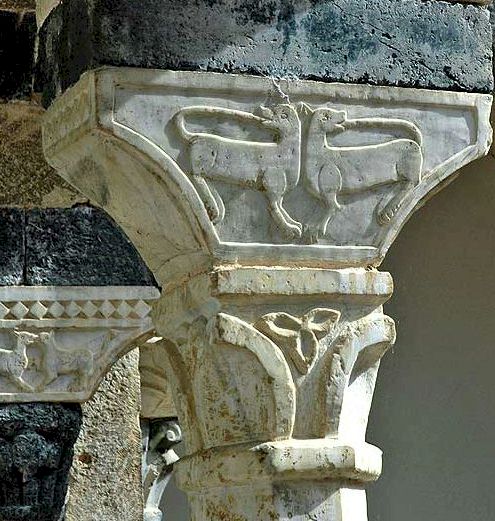
Vernacular stone carving is often less visible since so much of it is the quirky and humorous production of the mediaeval artisans who turned out decorated capitals and pilastres by the thousands. When visiting any of the numerous romanesque churches that dot the Tuscany countryside, look high up both inside and outside and the chances are you will see some fascinating and completely unique stone carving, possibly from the hand of a workman a thousand years gone.

Stone carving at Villa Viganamaggio
Carved capital at the Abbey of Santa Mustiola
Capital at the Abbey of Santa Mustiola
As you will no doubt notice, Tuscany is a very "stony" region and stone or stone-faced buildings outnumber those made entirely of brick, with wooden buildings being almost non-existent. It turns out that workable stone is quite common so, not surprisingly, stone carving embellishes buildings magnificent and humble throughout the area. Workable wood is for the most part imported from elsewhere but skilled wood carving has been a part of Tuscan art since the Renaissance and earlier when the Gothic art of fine woodcarving was introduced from Flanders.
Carved capital at the Abbey of Sant' Antimo
Capital at the Abbey of Sant' Antimo
Mediaeval stonework at Borgo di Vagli hamlet
Stonework at Borgo di Vagli hamlet
Cast iron decorative elements became extremely popular in the late Victorian and art deco periods and continue to be right up to the present day. Wrought iron work is also extremely common in Tuscany and is most commonly visible in the form of iron grills over windows. Wrought iron bedsteads, candelabra and chandeliers are typical of "Tuscan country style". The streets of Sienna are particularly well-endowed with wrought and cast iron decorations, including lamp supports and flag holders.
Cast iron door sign Sienna
Cast iron shop sign in Sienna
All of these details contribute to the charm of Tuscan cities, towns and villages. They repay attention!

More about what to see in Tuscany.

More about Borgo di Vagli.

My recommended vacation rentals in Tuscany.

Tuscany Toscana
Don't forget to visit Elena Spolaor's
Travel Guide!

Up-to-date news on what to see and where to stay in Chianti and all of Tuscany & Umbria.

Chianti Travel Guide

Author: Anna Maria Baldini

All content copyright © ammonet Italian Web Site Promotion 2013 - 2014. All rights reserved.

Wednesday, 12 June 2013

Famous Tuscan butchers Falorni in Greve in Chianti and Cecchini in Panzano in Chianti

In ancient times, meaning before WWII, most of the contadini in Tuscany ate meat only once a week, mostly in the form of a selection of salumi. For the remainder of the week they ate ribollita in winter and panzanella in summer - both dishes being based on Tuscan bread and Tuscan olive oil with the addition of whatever fresh vegetables were available. In fact, that's how it's been for the past thousand years, at the very least. Nowadays, the meat-based dishes of Tuscan cuisine are much more prominent and famous, and as a consequence so are some wonderful Tuscan butchers shops (macellerie). In this post, I will say something about just two among many, the famous Tuscan butchers Falorni in Greve in Chianti and Cecchini in Panzano in Chianti.

Antica Macelleria Falorni Greve in Chianti
Antica Macelleria Falorni in Greve in Chianti
Antica Macelleria Falorni, located on Piazza Matteotti of Greve in Chianti, claims to be the oldest butchers shop (macelleria) in Italy. The shop was founded by Gio Batta in 1729. Today Antica Macelleria Falorni is run by the eighth generation, brothers Lorenzo and Stefano Bencistà, related by marriage to the founding family. Along with fresh meat, Falorni sells a fine range of salami, prosciutto and other prepared meats and in fact the company has a large production that is sold throughout Italy and abroad. When you visit Greve in Chianti, be sure to drop in to look at the amazing display of Tuscan meat specialities on show at Macelleria Falorni, taste some samples if they're on offer and, of course, buy some great food!

Dario Cecchini in his butchers shop in Panzano in Chianti

Macellaria Cecchini, located ten minutes drive away in Panzano in Chianti, is entirely different in style from Macellaria Falorini. Macellaria Cecchini is, simply, Dario Cecchini, the mad butcher of Panzano. Cecchini specialises in prepared meats, one could almost say, anything other than salumi. And in contrast to the export-oriented business of Falorni, Cecchini has entered the restaurant trade in a very original way, particularly in his Panzano restaurant Solociccia. Dario Cecchini very often serves in his shop and welcomes visitors, even those just coming to look. While the display of meat products is amazing, you're basically coming to see Dario perform - and of course to buy some excellent eats.

Dario Cecchini is famous as a promoter of bistecca alla fiorentina and both of these butchers shops sell excellent cuts of beef suitable for grilling.

More about Piazza Matteotti in Greve in Chianti.

More about Macellaria Cecchini in Panzano in Chianti.

More about bistecca alla fiorentina.

More about Tuscan culinary specialities.

More about places to stay in Chianti.

Tuscany Toscana
Don't forget to visit Elena Spolaor's
Travel Guide!

Up-to-date news on what to see and where to stay in Chianti and all of Tuscany & Umbria.

Chianti Travel Guide

Author: Anna Maria Baldini

All content copyright © ammonet Web Site Promotion 2013 - 2022. All rights reserved.

Saturday, 25 May 2013

Radda in Chianti, a classic Chianti wine village

Today I would like to introduce you to one of the small towns located near where I live, namely Radda in Chianti, a classic Chianti wine village. Radda, along with Castellina and Gaiole, was one of the three counties that formed the original Lega del Chianti from the 15 C onwards until the league was dissolved in the late 18 C. Today, clustered around its church, it is a tranquil village that serves the numerous wineries and agriturismi (farmhouse vacation rentals) in the surrounding countryside. The area is famous for the numerous castles, both ruined and inhabited, that dot the hills.

Radda in Chianti
View of Radda in Chianti, Tuscany, Italy
Radda is a place to buy your supplies or dine out while spending your vacation in one of the many places to stay in and near Radda in Chianti. The Palazzo del Podestà is the principal building in Radda, aside from the romanesque Church of San Niccolò, which houses a venerated wooden Crucifix dating from the 15 C. Nearby is the convent Santa Maria al Prato which dates from the mediaeval period. It now houses an art museum. Another interesting sight is the "Ice House" of the Grand Duke, built at the end of the 19 C to store snow and turn it into ice for cooling purposes.

More about Radda in Chianti and its environs.

Tuscany Toscana
Don't forget to visit Elena Spolaor's
Travel Guide!

Up-to-date news on what to see and where to stay in Chianti and all of Tuscany & Umbria.

Chianti Travel Guide

Author: Anna Maria Baldini

All content copyright © ammonet Web Site Promotion 2013 - 2014. All rights reserved.

Wednesday, 1 May 2013

"The Springtime of the Renaissance" - a great exhibition currently showing in Florence

The Strozzi Palace is currently hosting a wonderful art exhibition under the title "The Springtime of the Renaissance" (La Primavera del Rinascimento. La scultura e le arti a Firenze 1400-1460. Palazzo Strozzi.). Everyone with an interest in the history of art, especially Renaissance art, should seize the opportunity to spend half a day (or a whole day) at this exhibition here in Florence or, from September, at the Louvre in Paris, if they possibly can. Every year there is a very good exhibition at the Palazzo Strozzi, but this year (2013), the Bargello and the Louvre have put together a truly fabulous show of early Florentine masterpieces displayed alongside equally beautiful Classical and late Gothic works of the kind from which the Florentines drew inspiration.

La Primavera del Rinascimento. La scultura e le arti a Firenze 1400-1460
The modern, the renaissance and the classical - a study in character.

The creators of this exhibition suggest that it was from sculpture more than painting that the Renaissance sprang, and they see the initial glimmer in the form of the two bronze relief panels submitted in 1401 by Brunelleschi and Ghiberti for the competition to create a set of new bronze doors of the Florentine baptistery. Sculpting scenes based on an identical biblical story, both artists combined Gothic elegance of costume and scenery with human figures inspired by classical sculpture. From this point on, the exhibition is dominated by the sculpture and spirit of Donatello, who did his apprenticeship in the workshops of Brunelleschi and Ghiberti. Donatello strongly influenced his contemporaries, both sculptors and painters, among whom we may count Michelozzo, Masaccio, Filippo Lippi, Paolo Uccello and Andrea del Castagno, stylistically and through his introduction of perspective in his low relief works.
Donatello at the Palazzo Strozzi in Florence
Single point perspective, classical depiction of the human form and draperies
- Donatello's St George and the Dragon in very shallow relief.

The spatial organisation of the exhibition is excellent, not least with the placement of a huge, 4th century BC, bronze horse's head, the Medici Protome, visible through an arch from the first room of the show. Later, when we enter this room, Donatello's Carafa Protome, is revealed, and we can easily see why it was long thought to be a classical work.
Donatello's Carafa Protome
Donatello or ancient Greek? Visit this exhibition to find out which!

At the appropriate points in the exhibition, Classical sculpture including portrait busts and sarcophagus friezes, are juxtaposed with early Renaissance works in which the artists were evidently struggling to relearn the artistic skills of the Greeks and Romans, especially in depicting the human form. At other points, the juxtapositions of contemporary paintings and sculptures emphasize how painters set out to make their paintings more sculptural

The Springtime of the Renaissance
Painters set out to make their paintings more sculptural.

During my visit at the end of April, viewers were sparse and I often had entire rooms to myself. You can also view the exhibits close up, with a magnifying glass if you wish (and have one with you). In most of their native museums, this is surely not possible. Try to attend this show early or at least in Florence. It will definitely be packed out when it moves to Paris

More about La Primavera del Rinascimento.

Recommended vacation accommodation in Chianti towns, villages and countryside.


Author: Anna Maria Baldini

All content copyright © ammonet Web Site Promotion 2012 - 2013. All rights reserved.

Tuesday, 30 April 2013

What is the origin of those photogenic glades of cypress trees in the Val d'Orcia?

A number of readers returning from visits to Tuscany south of Siena have asked me about the origin of those photogenic glades of cypress trees in the Val d'Orcia. I have enthused about the Val d'Orcia more than once in this blog and for photographers (and others), among the visual attractions of the Val d'Orcia are the cypress trees artfully planted in rows on either side of roads leading up to isolated farmhouses and the small clusters of cypresses standing alone among the crops on otherwise bare hillsides. Why are they there?

cypress trees in the Val d'Orcia

Probably the most photographed glade of cypress trees in the whole world,

located between San Quirico d'Orcia and Montalcino in the Val d'Orcia of Tuscany, Italy.

These clusters of cypresses where, in fact, planted as bird traps. Among the trees, some of the branches and twigs, as well as artificial perches, were coated with birdlime, a sticky substance that prevents small birds flying away once they have landed on it. Italian birdlime was made by a complicated process of boiling and pounding from mistletoe berries. These birds, especially blackbirds and thrushes, were harvested as often as twice a day during the season and provided a significant part of the protein diet of the poor farmers who struggled to make a living from the clay soil here (the famous crete senesi). As in many parts of the world, trapping birds using birdlime has long been prohibited in Italy but these beautiful cypress glades remain, to the delight of visitors to this part of Tuscany.

Strada di Valoresi as seen from from Villa La Foce

The Strada di Valoresi as seen from from Villa La Foce

More about the Val d'Orcia.

More about “Villa La Foce” and Iris Origo.


Recommended vacation accommodation in Chianti towns, villages and countryside.


Author: Anna Maria Baldini

All content copyright © ammonet Web Site Promotion 2012 - 2026. All rights reserved.