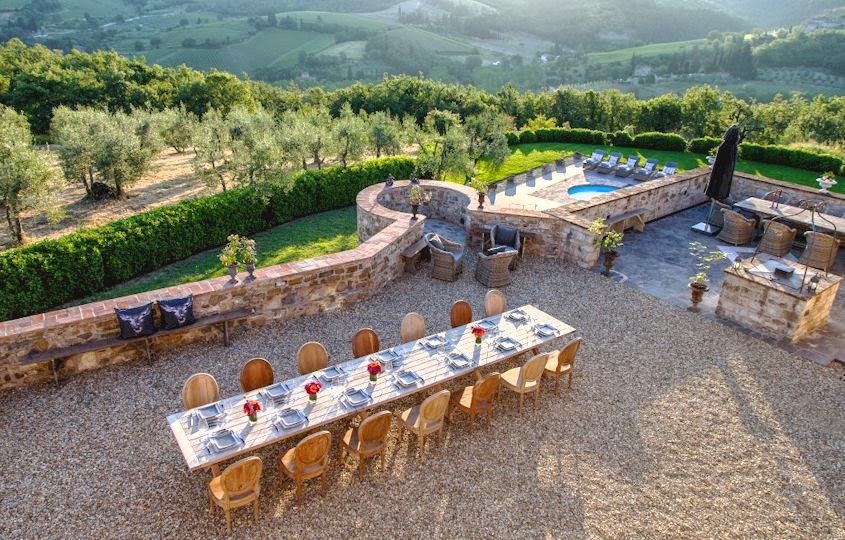
Sunday, 25 July 2021

Romanesque Parish Churches of Chianti

A one day driving tour of the Romanesque parish churches (Pievi) of Chianti is a great way to introduce yourself to the highways and byways of Chianti Italy as well as, of course, to see some of the oldest and most evocative architecture and works of art in Tuscany. One good route is simply to follow the Via Chiantigiana and make the appropriate detours.

Romanesque Parish Churches of Chianti
Pieve di San Cresci - a romanesque parish church in Chianti


The historic pievi (singular: pieve) are for the most part mediaeval although the Pieve di San Vincenti near Castelnuovo Berardenga dates from the Dark Age - it was a Basilica in the 7 C. They range from the magnificent (e.g. San Polo in Rosso) to the simple, single nave structures such as the Pieve di Santa Maria a Pacina, dating from the 8 C and characterised by a highly unusual cylindrical campanile (bell tower). 

If you are a Tuscan wine lover, you can combine visiting what is probably the oldest extant parish church in Chianti with a visit to a winery that takes its name from the church - namely, the Pieve di San Cresci winery. This wine producer belongs to the Ballini family who have been making wine here for almost two hundred years. Their wines are personal favorites of mine and I recommend them highly, especially the three Chianti Classicos. The winery has a wine tasting facility just in front of the church.

Author: Anna Maria Baldini


Saturday, 17 July 2021

The most beautiful villages in Tuscany

 "La Bandiera Arancione" - the Orange Flag - of the Touring Club Italia is one of the most sought after accolades among the villages of Italy and nearby areas. To win a place on the Orange Flag list means that the Touring Club and its members have assessed your village to be one of the most attractive villages in Italy in terms of beauty and livability, and with a great artistic and cultural heritage. The list is renewed every three years with only about 8% of 3,200 candidates making the grade. This year, 38 villages in Tuscany found a place on the list.

 The 38 most beautiful villages in Tuscany

Anghiari, Province of Arezzo

I have one quibble with their list, namely that they have selected mostly not villages but towns, some of them quite considerable. I guess that's a consequence of their voting system since obviously more of their members visit towns than small villages. I would have included both Montefioralle and Panzano in Chianti on my list of the most beautiful villages in Tuscany.

Anyway, here are the 38 most beautiful villages in Tuscany, according to Touring Club Italia, the Province of Sienna receiving the most awards:

 
San Gimignano

There are 16 awarded villages in the Province of Sienna: Casole d'Elsa, Castelnuovo Berardenga, Cetona, Chiusi, Montalcino, Montefollonico, Montepulciano, Monteriggioni, Murlo, Pienza, Radda in Chianti, Radicofani, San Casciano dei Bagni, San Gimignano, Sarteano and Trequanda.

If you are in the Province of Pisa: Casale Marittimo, Casciana Terme Lari, Castelnuovo di Val di Cecina, Peccioli, Pomarance and Volterra.

Four in the Province of Grosseto: Massa Marittima, Pitigliano, Santa Fiora and Sorano;

Three in the Province of Arezzo: Anghiari, Castiglion Fiorentino and Lucignano.

Three villages in the Province of Firenze: Barberino Tavarnelle, Certaldo and Vinci.

Two in the Province of Lucca: Barga and Montecarlo.

Two in the Province of Pistoia: Abetone Cutigliano and Collodi.

One in the Province of Livorno: Suvereto.

One in the Province of Massa-Carrara: Fosdinovo.


Tuscany Toscana
Don't forget to visit my Tuscany
Travel Guide!

Up-to-date news on what to see and where to stay in Chianti and all of Tuscany.

Tuscany Travel Guide

vacation accommodations in Tuscany


Author: Anna Maria Baldini

All content copyright © ammonet Italian Web Site Promotion 2021. All rights reserved.

Friday, 28 May 2021

An exquisite reliquary bust at the Diocesan Museum of Florence

My attentive readers will know that from time to time I like to draw attention to works of art in small museums that are unjustly negrlected by visitors to Tuscany. Today I want to describe a beautiful reliquary bust commissioned by the Grand Duke of Tuscany Cosimo III and created in 1703. The bust is silver cast using the lost wax method and finished by chisel, with gilded copper details. It was intended for the Pieve di San Cresci located on the slopes of Monte Giovi (province of Florence). San Cresci lived during the 3C and is considered to be the evangeliser of the Mugello where he was martyred around the year 250.

For the execution of this splendid reliquary, the Grand Duke turned to his court artist, the sculptor, architect and great draftsman Giovanni Battista Foggini who executed the design, leaving the execution of the work to another great artist of the Medici court, the German silversmith Bernard Holzman who performed the work in silver, clothing the saint in finely decorated and chiseled Roman armour. The youthful face of the saint, bearded and with thick hair, is slightly turned to the right. On the base runs the inscription: Sancti Crescij Xp Martyris Caput.

From a stylistic point of view, you can see the high quality in the accuracy of the finishing of the details and in the pride of the figure, clearly derived from the classical models, already used in the Middle Ages by the Arezzo goldsmiths Pietro and Paolo and then again in the Renaissance also by Donatello when he made the reliquary bust of San Rossore in Pisa.

This reliquary is one of the many masterpieces exhibited in the all too neglected Diocesan Museum of Florence in Santo Stefano al Ponte. If you can spare the time during your visit to Florence, I strongly recommend spending a couple of hours there.


Tuscany Toscana
Don't forget to visit my Tuscany
Travel Guide!

Up-to-date news on what to see and where to stay in Chianti and all of Tuscany.

Tuscany Travel Guide

vacation accommodations in Tuscany


Author: Anna Maria Baldini

All content copyright © ammonet Italian Web Site Promotion 2021. All rights reserved.

Sunday, 23 May 2021

Getting married in Tuscany: great wedding venues in Tuscany

If you're planning on getting married in Tuscany, a wonderful wedding venue will be at or near the top of the list of "musts" to make the your wedding a super-special occasion. There's an enormous range of great wedding venues in Tuscany at your disposal so I want to mention some wedding locations of which I have personal experience.

Getting married in Tuscany
Wedding dinner at Villa Felceto

For a do-it-yourself wedding in Tuscany, I can strongly recommend Villa Felceto, located on the Podere Felceto olive farm near Panzano in Chianti, halfway between Florence and Sienna. The villa, in ancient times a monastery, and the nearby dependencies provide accommodation for 20 people while the nearby agriturismi plus hotel and apartment accommodation in Panzano offer a good range of additional places to stay for your guests. The villa and its grounds provide beautiful settings for your wedding ceremony and wedding dinner. And very importantly, the owners, Roberto and Jussara, who speak excellent English, can and will provide lots of assistance with your arrangements, especially catering, so that you can organise everything without the assistance of a wedding planner.

More about Villa Felceto wedding venue in Tuscany.


Do it yourself wedding location in Tuscany
Wedding feast at La Ghiandaia in Tuscany

Another great do-it-yourself wedding venue in Tuscany is Agriturismo La Ghiandaia which is located near the tiny village of Lucolena in central Chianti, 30 km from Florence. The agriturismo is an ideal location for a wedding of up to 30 - 35 guests all of whom will be able to stay on site. For your wedding buffet you can take advantage of the beautiful veranda with its panoramic view, ideal for dancing, or a splendid converted wine cellar for inside dining in case of rain.

Silvia, the gracious owner of La Ghiandaia, is ready and able to organise everything for your wedding. She is experienced in organising complete, customised weddings at her house, including accommodation, finding a church or town hall, reserving a suitable restaurant if required, organising the buffet and party at her house with musicians and waiters, flower decorations, rental vans and wedding car and in general everything that is necessary to make your wedding day happy and memorable for you and your wedding party.

Review on Trip Advisor: "A perfect Wedding" at La Ghiandaia in Tuscany.

More about La Ghiandaia wedding location in Tuscany.


Wedding in Tuscany - Villa Vitigliano
Villa Vitigliano dining al fresco

Last but not least, the height of luxury and sophistication in Tuscany is to be found at Vitigliano , a recently restored rural "borgo" located between Panzano and Greve in Chianti, 45 minutes south of Florence. I have already praised this uniquely beautiful Tuscan boutique hotel, and I want to add that Vitigliano is surely the most luxurious wedding venue in all of Tuscany, with its own Turkish bath, whirlpool and professional kitchens. The Bridal Suite in the Tower offers an unforgettable ambiance for your wedding night, and the other luxury suites are ready for the bridal couple and their families. Accommodation for the wedding guests is readily available within a ten minute drive. Vitigliano has its own ancient chapel for a traditional wedding ceremony.

More about Vitigliano wedding venue.


Tuscany Toscana
Don't forget to visit my Tuscany
Travel Guide!

Up-to-date news on what to see and where to stay in Chianti and all of Tuscany.

Tuscany Travel Guide

Author: Anna Maria Baldini

All content copyright © ammonet Italian Web Site Promotion 2015 - 2023. All rights reserved.

Friday, 7 May 2021

Bargello Museum in Florence re-opens: Sala degli Avori (Room of the Ivories) re-organised

To me, the Bargello Museum of Florence is one of the most under-appreciated art collections in the world. There are bigger museums without a doubt but many of them require a pair of roller blades to visit. The Bargello is intimate and human in scale, and stuffed with masterpieces, both Florentine and especially pieces collected by Florentines from elsewhere. On no account miss it when you visit Florence.

After being closed for several months on account of the corvid pandemic, the Bargello is open once again and with a completely re-organised Sala degli Avori (Room of the Ivories), now completed after six years of work. 

Bargello Museum room of the ivories

 The Room of the Ivories in the Bargello Museum, Florence

The exhibition layout has been completely re-organised and includes the display of works that were previously kept in the archives, among them a valuable Baroque crucifix that is back on display after almost a century in dark obscurity. The collection of works in ivory covers 15 centuries, ranging from rare Etruscan and Roman objects to 19 C artefacts. There are about 250 works on display, in a wide variety of styles and from both Eastern and Western civilisations. The displayed works of art now have labels in English in addition to Italian. 

Byzantine ivories in the Bargello Museum, Florence

 Byzantine ivories in the Bargello Museum, Florence

The Sala degli Avori is located on the first floor of the Bargello and exhibits precious and historic ivories such as a diptych with scenes from the life of Saint Paul and Adam in the earthly paradise and a plaque with the Byzantine Empress. Other works include the rare Carolingian Flabellum from the abbey of Tournus, the Olifante of Sainte-Chapelle, donated to the king of France in 1274, as well as mediaeval paintings, mosaics and sculptures.

Ivory mirror in the Bargello Sala degli Avori

Ivory mirror in the Bargello Sala degli Avori

Many of the art works that comprise the Bargello's ivory collection are the legacy of the Lyonnaise antique dealer Louis Carrand who, on his death in 1888, gifted to the Bargello almost 2,600 works, including sculptures, jewels, paintings and fabrics. Other ivories in the collection come from 19 C purchases and from historic Florentine Grand-Ducal collections.


Tuscany Toscana
Don't forget to visit my Tuscany
Travel Guide!

Up-to-date news on what to see and where to stay in Chianti and all of Tuscany.

Tuscany Travel Guide

vacation accommodations in Tuscany

Author: Anna Maria Baldini

All content copyright © ammonet Italian Web Site Promotion 2021. All rights reserved.

Monday, 26 April 2021

17th century fresco uncovered in the Uffizi during covid-19 closure.

It seems that work continued in the Uffizi Galleries in Florence while they were closed as part of the battle against Covid-19. During renovation work, lost frescoes were discovered. The director of the Uffizi, Eike Schmidt, said that the six months of closure were put to good use, renovating 14 new rooms that will open to the public next month, and discovering frescoes that would otherwise have remained hidden. The previously hidden frescoes include a life-size figure of a young Cosimo II de Medici dating from the 1600s, as well as decorative plant motifs from the 1700s on the walls and ceiling of nearby rooms.

Newly uncovered fresco in the Uffizi depicting Cosimo II de Medici


Tuscany Toscana
Don't forget to visit my Tuscany
Travel Guide!

Up-to-date news on what to see and where to stay in Chianti and all of Tuscany.

Tuscany Travel Guide

vacation accommodations in Tuscany


Author: Anna Maria Baldini

All content copyright © ammonet Italian Web Site Promotion 2021. All rights reserved.

Are the museums open in Florence?

As the traditional tourism season approaches and we all hope for Italy to be able to re-open to visitors, the question is "Are the museums open in Florence?" The answer is YES some sights opened today since Tuscany, along with most but not all of Italy, is now in Covid status "orange", and others will open during the course of May 2021. The Regions are opening up and relaxing their anti-covid precautions as the number of new infections continues to drop.

The Duomo (Cathedral) of Florence is open for visitors from Monday to Saturday, 10:15 am - 5:00 pm and access to the dome itself is possible daily 12:45 - 7:00 pm; Saturday and Sunday 12:45 - 5:30 pm. 


 On 16 May, Giotto’s Campanile will reopen daily 12:45 - 7:00 pm, and the Opera del Duomo Museum will be open on Saturdays, Sundays and Mondays 10:15 am - 5 pm. The Baptistery remains closed for restoration. 


On Tuesday, April 27, the Boboli Gardens reopen daily (apart from the first Monday of the month) 8:15 am - 6:30 pm.


The Uffizi and Palazzo Pitti will reopen on 4 May. Opening hours (Uffizi): 8:15 am - 6:30 pm. Opening hours (Palazzo Pitti): 1:30 - 6:30 pm. Booking is now required at weekends to limit numbers, but bookings are not required for other days.


The Palazzo Vecchio is open daily 9:00 am - 7:00 pm and 9:00 am - 2:00 pm on Thursdays. 

The Museo Novecento is open daily 11:00 am - 7:00 pm and 1100 am - 2:00 pm on Thursdays. 

The Brancacci Chapel is open on Wednesdays, Thursdays and Fridays 10:00 am - 5:00 pm.


The Bardini Gardens are open 10:00 am - 6:00 pm until at least the end of May. Booking is required on the weekend and on holidays.


Tuscany Toscana
Don't forget to visit my Tuscany
Travel Guide!

Up-to-date news on what to see and where to stay in Chianti and all of Tuscany.

Tuscany Travel Guide

vacation accommodations in Tuscany


Author: Anna Maria Baldini

All content copyright © ammonet Italian Web Site Promotion 2021. All rights reserved.

Sunday, 4 April 2021

Historical libraries of Florence, Italy

The historical libraries of Florence preserve some of the most important book, periodical and manuscript collections in Europe. One or two of them are in themselves works of art, ranking among the most beautiful in the world.

The most beautiful libraries of Florence

La Biblioteca Nazionale Centrale di Firenze
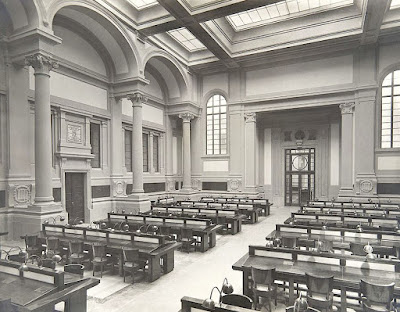

La Biblioteca Nazionale Centrale di Firenze
Reading room of the Biblioteca Nazionale Centrale di Firenze
Let's begin with the Biblioteca Nazionale Centrale di Firenze because it is the largest library in Italy, housing as it does more than six million volumes. The library was founded in 1714 and opened to the public under the name Biblioteca Magliabechiana in 1774 which of course long predates the formation of the modern country of Italy. That's why this national library is located in Florence. There is also a large National Library in Rome, founded in 1876, and a much smaller one in Naples, the splendid Biblioteca nazionale Vittorio Emanuele III.

Since 1935, the collections of the BNCF have been housed in a neo-classical structure designed by Bazzani and Mazzei, and located near the Arno in the Santa Croce district. Tragically, as a consequence of its location, the 1966 flood damaged nearly one third of the library's holdings, most notably its periodicals, and the Palatine and Magliabechi collections, and some were irrecoverably lost.

The reading room is severely neoclassical, making it, for me, the least attractive of Florence's important libraries.

La Biblioteca degli Uffizi


La Biblioteca degli Uffizi
The reading room of the Biblioteca degli Uffizi in Florence
The Uffizi Library, much frequented by art historians but much less known to the general public, was founded in the second half of the 18 C by the Grand Duke Peter Leopold and over the years has specialised in the field of art history. The Uffizi Library was housed up until 1998 in the part of Vasari’s complex that was originally the ridotto or foyer of the Medici Theatre. The new location was opened on 16 December 1998 in the renovated areas previously occupied by the Biblioteca Magliabechiana, under the porch, near the entrance to the gallery. It's not a large library, but has very good holdings of periodicals. The 78,600 titles include 470 manuscripts, 5 incunabula, 192 sixteenth-century books, 1,445 books printed between 1601 and 1800 and 1,136 periodicals. The reading room is quite spectacular, as we would expect in a part of the Uffizi.

La Biblioteca Marucelliana


La Biblioteca Marucelliana Firenze
The reading room of the Biblioteca Marucelliana in Florence
The Marucelliana Library is the result of a bequest by Abbot Francesco Marucelli, from whom the library takes its name. The donation of this rich and substantial library was made with the express aim of facilitating study by young people from the poorer sector of the Florentine populace. It was opened to the public in 1752. The structure was built specifically to house the library. Construction (1747–1751) on Via Cavour was directed by the architect Dori who had won the public contest for the design. By the late 18 C, space was becoming tight, so that the library had to be expanded beyond the original building into the adjacent Palazzi Della Stufa and Pegna, and the ground floor of the Palazzo Fenzi Dardinelli. Although not great architecture, the Marucelliana Library has a wonderfully homely feeling about it - a bibliophile's paradise!

La Biblioteca Riccardiana
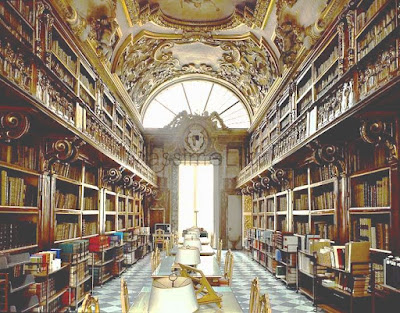

La Biblioteca Riccardiana in Florence
The reading room of the Biblioteca Riccardiana in Florence
The Riccardian Library was founded in 1600 by Riccardo Riccardi and was moved to its present location in 1670. In 1715, it was opened to the public. In 1812, there was a risk of the library being auctioned off, but the Florence authorities were authorised by the Government to buy it, which they did in 1813 and two years later it was sold to the state. I'm a sucker for Baroque libraries, and so you can readily imagine, I come and spend a bit of time in the Biblioteca Riccardiana whenever I need a bit of aesthetic relaxation. The library is packed with treasures. For example, it holds a copy of Pliny's Historia naturalis dating from the 10 C and an autograph manuscript of the Florentine Histories of Niccolò Machiavelli.

La Biblioteca Moreniana

La Biblioteca Moreniana
The Biblioteca Moreniana in Florence
In the same building as the Riccardian Library, the Palazzo Medici Riccardi, we have Morenian Library which speciliases in the history and culture of Tuscany. The library originated with the acquisition in 1870 by the Florentine authorities of the library assembled by Pietro Bigazzi. The most important foundations of the collection were parts of the library of Domenico Maria Manni and that of Domenico Moreni, compiler of the annotated historical bibliography of Tuscany (1805), and consisting mostly of documents relating to the history and culture of Tuscany. Subsequent acquisitions included collections formed by other scholars and gatherers Tuscan antiquities such as enthusiasts like Giuseppe Palagi, Emilio Frullani and Giovanni Antonio Pecci. In 1942, the library was opened to the public in the historical setting of the Palazzo Medici Riccardi next to the Biblioteca Riccardiana. In recent decades, other manuscripts of particular interest for the history of Tuscany have become part of the library's patrimony including of books by Rubieri-Zannetti, Rosini and Ombrosi Frullani). Since 1978, the library has been managed directly by the Province of Florence while continuing to share some public services with the Biblioteca Riccardiana.

Biblioteca dell'Accademia di Belle Arti di Firenze


Biblioteca dell'Accademia di Belle Arti di Firenze
The Library of the Academy of Fine Arts is located on via Ricasoli, next door to the Galleria dell'Accademia where the original statue of David is displayed. The library first saw the light of day in 1801 with the purchase, sponsored by Giovanni Degli Alessandri, the then president of the Accademia di Belle Arti di Firenze and director of the Uffizi, of the library belonging to the architect Giuseppe Salvetti. The library contains texts relating to the history of art and music. The reading room is quite small with a pleasing ambience with a number of fine sculptures decorating the space.

La Biblioteca Medicea Laurenziana


La Biblioteca Medicea Laurenziana in Florence
The Laurentian Library is one of the major collections of manuscripts in the world and a major architectural gems of Florence. The library was designed by Michelangelo between 1519 and 1534, but work was completed only in 1571. Laurentian Library was built in a cloister of the Medicean Basilica di San Lorenzo di Firenze under the patronage of the Medici pope, Clement VII, to emphasize that the Medici family were no longer mere merchants but members of "the better classes". To me, this library is one of the most perfect, in architectural terms, in the world. Even leaving that aside, the library contains the manuscripts and books belonging to the private library of the Medici family, the collection now amounting to about 11,000 manuscripts, 2,500 papyri, 43 ostraca, 566 incunabula, 1,681 16 C prints, and 126,527 prints of the 17 C to 20C. Changing exhibitions allow one to view and study these incredible treasures.

More about the Laurentian Library.

Il Gabinetto Scientifico Letterario G. P. Vieusseux
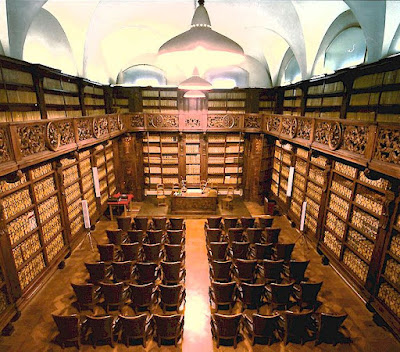

Il Gabinetto Scientifico Letterario G. P. Vieusseux
Conference room of the Vieusseux Library in Florence
The Vieusseux Library in Piazza Strozzi was founded in 1819 in Florence by Giovan Pietro Vieusseux, a Genovese banker, merchant and publisher. The reading room made leading European periodicals available to Florentines and visitors from abroad in a setting that encouraged conversation and the exchange of ideas so that the library soon became a cosmopolitan meeting point of Italian and European culture. A circulating library with the latest publications in Italian, French and English was later installed next to the reading room. Numerous literary Italians, among them Giacomo Leopardi and Alessandro Manzoni, frequented the Gabinetto Vieusseux when they were in Florence, as did literary foreign residents and visitors, including Stendhal, Schopenhauer, James Fenimore Cooper, Thackeray, Dostoevsky, Mark Twain, Émile Zola, André Gide, Kipling, Aldous Huxley and D. H. Lawrence. The warm 19 C conference room is the part of the library most familiar to the public.

The Berenson Library at Villa I Tatti
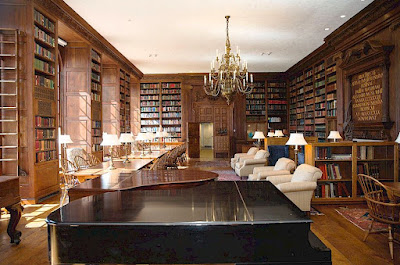

Berenson Library at Villa I Tatti

Berenson Library at Villa I Tatti

The most recent foundation in our list is the Berenson Library which is a part of Villa I Tatti, the home of the art historian Bernard Berenson for most of his life and now an Italian Renaissance research institute belonging to Harvard University. Villa I Tatti located outside Florence close to the municipal boundary with Fiesole and near Settignano. Bernard Berenson lived there from 1900 and the adjoining library and art collection were designed for him in 1936. Berenson was a fastidious man in himself (personally - although it tormented him, his relationship with the art dealer Duveen and others was not quite so fastidious) and not surprisingly his library is exquisite. He accumulated (and often read) a huge number of art historical books and periodicals, and these form the basis of this, one of the most beautiful and complete small libraries created during the 20 C.

Historical villas of Tuscany.

Historical gardens of Tuscany.


Tuscany Toscana
Don't forget to visit my Tuscany
Travel Guide!

Up-to-date news on what to see and where to stay in Chianti and all of Tuscany.

Tuscany Travel Guide


vacation accommodations in Tuscany

Author: Anna Maria Baldini

All content copyright © ammonet Infotech website promotion 2016 - 2021. All rights reserved.

Thursday, 1 April 2021

Tuscany celebrates the 700th anniversary of Dante's death

The year 2021 is the 700th anniversary of Dante's death. Throughout the year there will be events and celebrations of the great poet. If I were asked whose life marks the boundary in literature between the Mediaeval world and the Modern world, I would be hard put to choose between Shakespeare and Dante, even though Shakespeare died 300 years after Dante.

In any case, I will be posting here items about Dante that appeal to me, starting today with the report of the discovery of two triplets from the Divine Comedy that are not present in the current canonical text

In the holdings of the National Library in Florence, an incunabulum, printed in Venice on 1 April 1493, has been found containing one of the very first printed editions of the Divine Comedy, which, in addition to showing interesting variations to the currently known text, presents two triplets totally unknown until today. The verses refer to Canto VI of Purgatory, in which Dante has a vision of the future - or so the Comune of Florence would have us believe, according to their Instagram page (where else?).

Quando si parte il gioco della Viola,
Colui che perde si riman dolente
E il tristo colpo gli rimane in gola:
Ben lo imparò la bianconera gente,
La qual, credendo andare innanzi,
ratto lo gol in sua rete si trova.

HOWEVER, please note that this announcement was made on 1 April!

Here's my rough translation:

When the game of the Viola begins,
He who loses remains sore
And the sad blow stays stuck in his throat:
The Black and White people learned it well,
Those who, thinking to advance,
Find a rat has placed a goal in their net.

Here's what lies behind this joke:

The ancient aversion of Fiorentina (Viola - Florence) to Juventus (Black and White - Turin) dates back to 1928, the first competitive fixture between the two clubs. On 7 October of that year, in fact, in Turin, the Bianconeri defeated the Viola team, winning 11-0. The next day a Turin newspaper headlined: "Firenze, un…dici nulla?" "Florence, uh ... are you not saying anything?", a pun on 11 (undici) to 0 (nulla), the final score in favour of Turin - an affront never forgotten by the Viola fans.

Oh - and here's the manuscript - strange that in Venice in 1493 they embossed ACF and the Fleur de Lis of Florence on the cover!

See you here in Tuscany soon!

Tuscany Toscana
Don't forget to visit Elena Spolaor's
Travel Guide!

Up-to-date news on what to see and where to stay in Chianti and all of Tuscany & Umbria.

Chianti Travel Guide

All content copyright © ammonet Web Site Promotion 20121. All rights reserved.

Monday, 4 January 2021

Tuscany vacation accommodations with handicapped access

Tuscany is high on the list of travel destinations that are friendly to the elderly and those with mobility limitations, especially since laws were introduced several years ago regarding provision of suitable facilities for the physically handicapped. I'm often asked for information about Tuscany vacation accommodations with handicapped access. One important piece of information everyone should take account of is that Tuscan farmhouses ("villas") and sometimes genuine villas are characterised by numerous steps and steep staircases. For this reason, if your mobility is impaired, read the descriptions of rural vacation accommodations in Tuscany with care and feel free to ask the owners detailed questions. This is one of the several reasons to rent owner-direct, by the way. Agencies rarely have the kind of information you need.

Tuscan vacation accommodation handicapped accessibility
A fairly frequent sight in Tuscany - this you don't want if moving around isn't all that easy for you.
Step-free or almost step-free agriturismi and other rural holiday homes are definitely available. Today I want to describe one of them which has recently been renovated and which enjoys one of the most beautiful locations in Tuscany. This is Agriturismo Felciano, a cottage with two large double rooms and a large living-dining room, situated on a winery near Panzano, in the famous Conca d'Oro.

Accommodation in Tuscany for mobility impaired visitors
Agriturismo Felciani - an ideal Tuscan vacation location for anyone with mobility problems.
Agriturismo Felciano has a large terrace in front of the entry and flat ground round about, including the location of the gazebo. There is one very slight step at the large entrance and none at all inside the cottage. Of the two modern bathrooms, one is fully-equipped for handicapped accessibility. You can bring your car right up to the terrace.

In addition to being able to buy your Chianti Classico wine directly from the cask and extravergine olive oil by the bottle, you can buy Tuscan saffron grown on the Felciano farm.

Click here to visit the Agriturismo Felciano website.

More about Panzano in Chianti.

Vacation accommodation in Tuscany
www.bella-toscana.com
Author: Anna Maria Baldini

All content copyright © ammonet Italian Web Site Promotion 2013 - 2021. All rights reserved.

Thursday, 10 December 2020

A tour of the Val d'Orcia by steam engine - the Trenonatura

A couple of years back, I went on a tour of the Val d'Orcia by steam engine - the Trenonatura. I can safely recommend this excursion to all who would like to do something a little different during their stay in Tuscany. My babbo was a train nut, with the result that some of my earliest memories are of visits to obscure stations and smokey engine sheds to view huge, steaming machines with gleaming pistons gracefully sliding back and forth. This Spring, I decided it was time to go for a ride in a train pulled by one of these splendid monsters. I discovered that the Provincia di Siena and a group of volunteers organise train tours every Spring and Autumn (the risk of fire being too high during Summer). These tours usually depart from Siena and do a loop through the Val d'Orcia, dropping the passengers off for a few hours at whichever town has an interesting event or festival taking place on the day in question.

A tour of the Val d'Orcia by steam engine - the Trenonatura
The Trenonatura follows a route through a variety of terrains including the classic Val d'Orcia "big sky" country with views of Monte Amiata, the Crete Senesi, the River Orcia itself and the famous cypress tree clusters and rows that are so popular with photographers. At Monte Antico, the engine is moved to the other end of the train and filled up with water. This occasion provides plenty of photo opportunities for the passengers.

Most of the carriages are third class and dating from before World War II. The wooden seats are very comfortable and you have to wonder how the airlines and, for that matter, modern railways have got it so wrong despite the money they claim to pour into seat design. Bring some refreshments, including something to drink, because these are not available on board. My carriage was filled with a merry crowd and a very informative volunteer who provided an interesting commentary both on the train and on the country we were passing through. He was happy to answer everyone's questions. I was surprised to see that on the return route we went a far as Castelnuovo Berardenga at the southern boundary of Chianti Classico.

Steam engine in Tuscany Italy
Steam engine in Tuscany Italy - Trenonatura


A note on reservations. I reserved my place via email about two weeks ahead of time and paid, as the agency requested, by bank transfer. They never confirmed receiving the payment nor did they send me a confirmation nor any other information, despite multiple emails from me. I phoned them two days before the trip and they confirmed verbally, more or less by chance also giving me my carriage and seat number. My name was on the list when I showed up at Siena station. If you don't receive a confirmation from the agency, my advice is to bring along a copy of your email requesting a reservation plus a copy of the bank transfer, just in case your name isn't on the list.

Trenonatura 2021 time table

Provisional Trenonatura timetable for 2021


Val d'Orcia Tourist Information.

Val d'Orcia on Facebook. 

Recommended vacation accommodation in Chianti towns, villages and countryside.


Author: Anna Maria Baldini

All content copyright © ammonet Web Site Promotion 2012 - 2021. All rights reserved.

Thursday, 2 April 2020

Italian lessons in Tuscany

If you're under lock-down due to Coronavirus, maybe this is the moment to take some Italian lessons using Skype. Lorella is ready and willing to provide Italian lessons at all levels via the internet.

Taking Italian lessons in Tuscany can and should be both practical and fun. There are multiple approaches, all of which have strong positive points. One approach to learning Italian is to use an online Italian language beginners' course or CD course and then to follow that up with intensive Italian lessons with a professional Italian language teacher, either in a group or one-to-one. Another approach to learning Italian is to start from the beginning with your professional Italian language teacher, taking your lessons at an easy pace, and backing them up with taped or CD lessons. Both of these approaches are enormously enhanced if you have the chance to take your Italian lessons in Italy so that you hear the language all day long and, of course, have the opportunity or the necessity to use your Italian language skills, rudimentary as they might be at the start.

Italian lessons in Tuscany
Lorella Federico, certified Italian teacher
If you have the chance to study Italian in Italy, I can strongly recommend Lorella Federico who is a professional Italian language teacher who gained her qualification at the University of Siena and who is based in Panzano in Chianti. Lorella is a skilled teacher - no doubt about that - and Panzano and its environs are a great base for your vacation in Tuscany. And they say that Siennese is the purest and most beautiful dialect of Italian.

Italian lessons via Skype

If you're coming here on vacation, you can even take a single lesson with her so that you can pronounce places names correctly and apply a few useful phrases. Those are her beginner-level Italian lessons. She also offers a highly popular programme where you can continue your Italian lessons back home via Skype. And she also offers an intensive Italian course for those who, for one reason or another, must or wish to acquire good Italian conversational and reading skills in a short time.

More about Lorella's Italian lessons in Tuscany.

Tuscany Toscana
Don't forget to visit Elena Spolaor's
Travel Guide!

Up-to-date news on what to see and where to stay in Chianti and all of Tuscany & Umbria.

Chianti Travel Guide


All content copyright © ammonet Web Site Promotion 2010 - 2020. All rights reserved.