Saturday, 15 December 2012

Sights and attractions of the Val d'Orcia in Tuscany, Italy

The Val d'Orcia, the valley of the River Orcia, sometimes written Valdorcia is located to the SE of Sienna and is one of the most famous areas of Tuscany. Indeed, it is a UNESCO world heritage site. So today, let me say a little bit about the sights and attractions of the Val d'Orcia in Tuscany, Italy. The attractiveness of the Val d'Orcia for many lies in what I've previously called its "big sky" panoramas. The hills are rolling on the grand scale, at least by Tuscan standards, and are virtually unforested, making the characteristic dark green silhouettes of umbrella pines and cypress trees on distant horizons all the more appealing. There are also areas of highly characteristic badlands where the whitish clays, known as the crete senesi, has been eroded by the rain into what are often referred to as "lunar landscapes". It is these clays that have made parts of the Val d'Orcia so very difficult to farm in the past. Many of the most famous views of the Val d'Orcia feature the volcanic cone of Monte Amiata rising up in the background.

Sights and attractions of the Val d'Orcia in Tuscany, Italy
Iconic casa colonica and cypresses in the Val d'Orcia.
However, the Val d'Orcia is by no means simply a collection of magnificent landscapes. It includes five of the most charming hill towns in Tuscany, namely Pienza, Montalcino, San Quirico D’Orcia, Castiglione D’Orcia and Radicofani - as well as numerous castles and villas. One of the most famous of the latter is La Foce, home of the late Iris Origo whose evocative books about life in the Val d'Orcia, especially during World War II, are a must read. The grounds of La Foce are open to the public from time to time and represent probably the most famous creation of Cecil Pinsent.

View of the Valdorcia
Misty morning in the Valdorcia.
If you base yourself in the area between Montepulciano and Pienza, in addition to those two "must sees", any and all of Montalcino, Montefollonico, Monticchiello and Bagno Vignoni are worth a visit. Those interested in religion, art and architecture won't want to miss the very picturesque abbeys of Monte Oliveto and Sant’Antimo, at both of which there is Gregorian chant by the monks. Montalcino is close by Sant'Antimo. Other unspoilt villages include Castelmuzio, Montisi, Petroio and Trequanda. Petroio in particular is the place that time forgot and few tourists go there even in August.

Beautiful motoring routes include Pienza to San Quirico. Montefollonico - Castelmuzio - San Giovanni d'Asso - Asciano - Sienna is another must-do road. Yet another is SS 153 (the Pienza to Radicofani road) that goes right through the heart of the Val d'Orcia, and then, possibly best of all, San Quirico - Castiglione d'Orcia - Castelnuovo d'Abate - Montalcino.

Even if you don't base yourselves there for part of your vacation in Tuscany, the Val d'Orcia should not be missed. It's easily accessible for a day excursion from Chianti, Sienna and also the areas around Arezzo and Cortona.

Castles of the Val d'Orcia include:
Rocca di Tentennano.
Rocca Aldobrandesca.
Ripa d'Orcia.

More about the Val d'Orcia.

Another great Val d'Orcia photo.

Today's top links: For everything you need to know about what to do and where to stay in Tuscany: The Chianti Travel Guide and The Greve in Chianti Tuscany Blog.


All content copyright © ammonet Web Site Promotion 2012 - 2020. All rights reserved.

Monday, 10 December 2012

The Mercato Centrale in Florence is not the same as the San Lorenzo Market!

Today we have a post of interest to visitors to Florence. I want to demonstrate emphatically that the Mercato Centrale in Florence is not the same as the San Lorenzo Market! They may be right next to one another, but that's all they have in common.

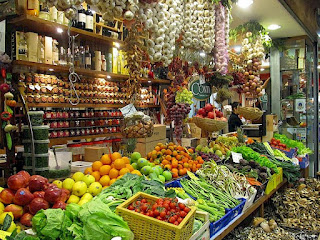
Here's the take-home message right at the start. The Mercato Centrale is a marvellous meat, seafood, charcuterie, fruit and vegetable market patronised by Florentines. It's housed in a beautiful 1874 Art Deco iron and glass structure and is one of the most interesting and colourful markets in Europe. In contrast, the outdoor San Lorenzo market is a crowded cluster of booths and barrows populated by aggressive touts selling overpriced tourist tat, mainly of Chinese and Indian origin.

Let's go first at the Mercato Centrale of Firenze. Here's how it looks, outside and in.

The Mercato Centrale in Florence is not the same as the San Lorenzo Market
The exterior of the Mercato Centrale in Florence.

Mercato Centrale Firenze
Just one of dozens of produce stands in the Mercato Centrale.
The Mercato Centrale is not only a wonderful place to buy your fresh produce, meat, salumi, fish, cheese, olive oil, sweets, herbs and spices, but it is also so colourful and full of life with great opportunities for some very creative photoshoots. You can also eat well at the little restaurants and food stalls inside the Mercato where you will find Tuscan home cooking, including (BUT NOT LIMITED TO!) favorite Florentine dishes such as lampredotto (tripe). (Avoid Gastronomia Perini's meat and cheese counter. They have a reputation for cheating tourists on the grand scale.)

The Mercato opens Monday through Saturday early in the morning (7 am) and closes at 2 pm. By 1.30 pm many of the stalls are already closed or closing. The Mercato Centrale is an easy stroll from the Duomo.
Mercato San Lorenzo a Firenze
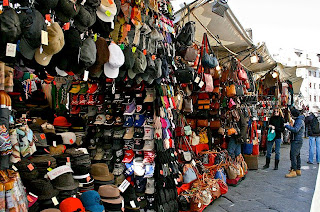
Tourist souvenirs on sale at the Mercato San Lorenzo

San Lorenzo market in Florence

Almost outside the door of the Mercato Centrale is the open air Mercato San Lorenzo. Many years ago, San Lorenzo was a local market that specialised in high quality, Italian-made leather articles ranging from hand bags through jackets to leather coats. The market has long since changed into an area catering solely to tourists and manned mostly by non-Italians. The goods are largely of Chinese and Indian origin, and, despite a reputation for allowing haggling, the prices are very uniform for the same item. Those labelled 'Made in Italy', when not outright fakes, are made in Chinese sweatshops in Prato. In addition to the endless hats, T shirts and scarves, there are leather goods (and plenty of vinyl goods masquerading as leather goods) but generally of very poor quality. The mismatched pieces of leather fade badly and fade at different rates, and often rip under the slightest tension. The vendors are extremely aggressive and the place is a haven for pickpockets. The shops associated with the stalls and to which customers are often lead are not better in the quality that they offer but ARE better adapted to the hard sell. In summary, unless you want to pick up a few inexpensive gifts for friends back home, there is no good reason to come to San Lorenzo Market.

Note: a classic scam practised by some vendors at this market works as follows.  You order a couple of high quality leather jackets in a size currently out of stock, to be send to you by post. What arrives is a rubbishy item nothing like what you ordered, but your credit card is charged for two expensive jackets. You contest this with your card company but the vendor has a shipping receipt. The card company says there's nothing they can do.


Today's top links: For everything you need to know about what to do and where to stay in Tuscany: The Chianti Travel Guide and The Greve in Chianti Tuscany Blog.


All content copyright © ammonet Web Site Promotion 2012 - 2019. All rights reserved.

Saturday, 8 December 2012

Palazzo Davanzati cocktail evenings 2013

The opportunity afforded by the Bargello Museum to admire the works of art there after hours while sipping a glass of wine has now moved to the wonderful Palazzo Davanzati, one of the great under-estimated sights of Florence. Palazzo Davanzati cocktail evenings 2013 actually begin now and continue every Friday evening until 1 February 2013, with the exception of 28 December 2012 and 4 January 2013. The aperitif evening at the Davanzati Palace takes place from 7 pm to 10.30 pm and costs €15 per person. A reservation is recommended (Tel. 055 294883).

Palazzo Davanzati cocktail evenings
One of the spectacular rooms of the Palazzo Davazati.
For me, the Palazzo Davanzati is one of the most enjoyable and educational museums in Florence and I strongly recommend that you seize any opportunity to spend some time there.

The Palazzo Davanzati was built during the second half of the 14 C by the Davizzi, a family of very rich wool merchants. In 1516, it was sold to the Bartolini family and, later in the same century, to the Davanzati family, also rich merchants, in whose hands it remained until 1838. The palazzo was then divided into flats and suffered severe structural damage. However, in 1904 it was restored by the antique furniture dealer Elia Volpi, who opened it to the public in 1910 as the Museo Privato della Casa Fiorentina Antica. He used it to display his stock of antique furniture. After passing through other hands, the palazzo was purchased in 1951 by the Italian government and opened once more to the public in 1956. A major restoration became necessary in 1995 and this work continued more or less until 2012 when all floors were finally re-opened to the public. The Palazzo Davanzati is now restored as closely as possible to its original 14 C appearance with the corresponding furnishings and decorations, some from that period and some later. The effect is dramatic. It really is as if we have returned to the 14 C and gained entry into the private domain of one of the incredibly wealthy Florentine families of that period. Don't miss it!

Opening hours:

Every day of the week from 8.15 am to 1.50 pm.
Closed on the second and fourth Sundays of the month and the first, third and fifth Mondays of the month, New Year’s Day, 1 May and Christmas Day.

The areas that can be visited are the ground-floor loggia and the first floor (Salone Madornale, Sala dei Pappagalli, Studiolo, Camera dei Pavoni and the two rooms displaying lace).

Access to the second floor (Salone Madornale, Camera da letto della Castellana di Vergy, Studiolo, Sala da Pranzo) and the third floor (Kitchen and Camera delle impannate) is organised for accompanied group visits, on request and by appointment, at 10.00, 11.00 and 12.00 on the normal opening days.

Tel: 0039 055 2388610
Fax: 0039 055 289805
E-mail: museo.davanzati@polomuseale.firenze.it


All content copyright © ammonet Web Site Promotion 2012. All rights reserved.

Thursday, 6 December 2012

Best place to stay in Chianti, Italy

If you will be staying outside of the big towns in Tuscany for part or all of your vacation (something that I strongly recommend), then Chianti is definitely one of the great locations. Rather than a hotel, I will be recommending good holiday villas, Chianti farm houses and vacation apartments. The Chianti hills, with their case coloniche, olive trees, vineyards and forests, are more intimate than in the Val d'Orcia, for example. The hilltop villages of Chianti are better preserved and both Florence and Sienna are readily accessible for day trips from almost any place in Chianti. Of course, no one can tell you the best place to stay in Chianti, Italy! However, I'm happy recommend a good selection of accommodations that I have personally visited in Chianti. The list below links mostly to Tuscan farm houses, agriturismi, vacation rental apartments and B&Bs, but I have also included a couple of hotels with loads of character. At the bottom is a link to a complete list of my recommended Tuscan vacation rentals. Enjoy!

Best place to stay in Chianti, Italy
Could this be the best place to stay in Chianti, Italy?


All content copyright © ammonet Web Site Promotion 2012 - 2018. All rights reserved.