Sunday, 20 March 2022

Beavers re-appear in the wild in Tuscany

The wild life of Tuscany is by no means static. For example, several species of deer plus wild boar were rare in the Chianti Classico wine zone of Tuscany 80 year ago. They're now so common as to be a pest to the extent that most vineyards are have to be surrounded by high mess fences to keep them out. Now that these ungulate populations are out of control, wolves have made an appearance over the past 2-3 years, presumably having migrated down from the Apennines to easy pickings in Chianti.

Another pest is the nutria or coypu, a rodent that resembles a beaver but lacks its flat tail. Some years back, these rodents escaped from breeding facilities where they were raised for their pelts. They are now found in rivers and steams all over Italy, and cause damage by burrowing into stream banks, causing collapse of the ground along waterways.

Nutria or coypu (Myocastor coypus)

Nutria or coypu (Myocastor coypus)

Historically, true beavers used to be very common all across Europe. However, due to hunting for their pelts, beavers became almost extinct. In several countries, reintroduction projects successfully brought back the beaver. In Italy, the beaver remained absent until at least one was reported in the Friuli-Venezia Giulia region in the Tarvisiano woods, about 3 years ago. This individual and possibly others probably migrated over the Alps from Austria.
Beavers in Tuscany

 Beavers in Tuscany

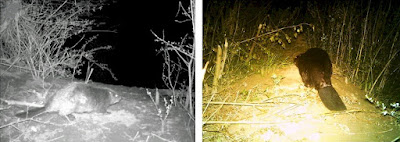
Over the past two years, there has been photographic confirmation that the Eurasian beaver Castor fiber L. has re-appeared in the wild Tuscany for the first time in more than 500 years. There are at least a couple of colonies, one sighted in the province of Arezzo, in Valtiberina, along the Tiber river. Another on the border between the provinces of Sienna and Grosseto. Local freelance wild life technicians and government scientists, Chiara Pucci, Davide Senserini, Giuseppe Mazza and Emiliano Mori, confirmed the occurrence of beavers through camera trapping. Genetic analyses (cytochrome-b mitochondrial gene) and hair microstructure confirmed the beavers to be the Eurasian species now in a new range about 530 km south to the historical range for this species. The presence of a relict population in this area is unlikely and the researchers therefore suggest that these newly reported beavers are the result of unauthorised releases. A recent radio broadcast by Radio 24 suggested that the Tuscan beavers are escapees from a small zoo near Aretino, but this can be ruled out by the genetic analysis.

Beavers photographed at night in Tuscany

Beavers photographed at night in Tuscany

More about the fauna of the Val d'Elsa.


Tuscany Toscana
Don't forget to visit my Tuscany
Travel Guide!

Up-to-date news on what to see and where to stay in Chianti and all of Tuscany.

Tuscany Travel Guide

vacation accommodations in Tuscany


Author: Anna Maria Baldini
All content copyright © ammonet Italian Web Site Promotion 2022. All rights reserved.

Sunday, 6 March 2022

The Medici. Masters of Florence. Use of digital backgrounds to re-create Renaissance Florence.

The TV series "I Medici" premiered on Italian television in 2016. I haven't had a chance to watch the whole series but I was greatly entertained to see in some clips how they re-created Renaissance scenes using digital composites. I'll show one or two here and add some more in due course.

Here's a scene which represents one of the gates of Florence during Renaissance times.

A scene from the TV series on the Medici family

A scene of Florence from the TV series on the Medici family

Observant readers (all of my readers are observant) will notice, first, that the Duomo sports the decorative facade that was added in the 19 C. The original facade was the raw brickwork that we still see on some other Florentine churches. So that was a blooper that they hoped no one would see - or perhaps they didn't know? It would have been easy to photoshop the facade for the digital background of this scene. The dome is depicted as completed, but that might be correct, depending on the period represented. Elsewhere in the series they make a big deal of the uncompleted dome.

The original facade of the Duomo of Florence
 
The original facade of the Duomo of Florence

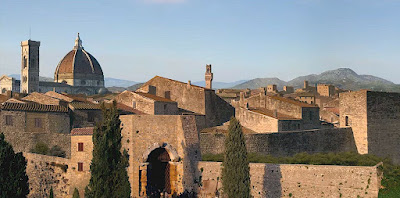
Now let's look at the gate where live action is taking place in the film. That's the Etruscan gate at Volterra with the fake Florence in the background.

The Etruscan gate at Volterra in Tuscany

The Etruscan gate at Volterra in Tuscany

Now what about the Ponte Vecchio? Here it is in the series with its four arches - whoops, how many?

The fictional Ponte Vecchio in Florence

The digital Ponte Vecchio in Florence

The Ponte Vecchio has three arches (see below) and, furthermore, the Vasari Corridor, which is depicted on the bridge in the digitalised background of the TV series, was not built until 1565 (by the Grand Duke Cosimo I de’ Medici).

The Ponte Vecchio as it looks today in Florence

The Ponte Vecchio as it looks today in Florence

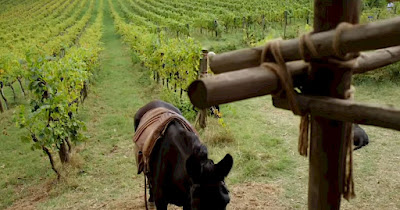
Now here's a Tuscan countryside backdrop from the scene leading up to the death of  Giovanni di Bicci de’ Medici (who died during February when the grape vines have no leaves and it's way too cold to be munching grapes outside). Oh, and he was not poisoned or murdered in any other way.

Vineyards in Tuscany

Vineyards in Renaissance Tuscany according to I Medici

Vineyards like this didn't exist much before 1950. These are post-war grape vines. We call them "Fiat vineyards" because the rows of vines are planted just wide enough apart for a Fiat caterpillar tractor to plough between them. Prior to that, Tuscan farms used the method known as "cultura promiscua" where vegetables, wheat, olive trees, vines etc were planted in close proximity. In Renaissance times, grape vines were grown more or less wild through trees. Children used to climb up for the bunches of grapes which they threw down to the adults below. Furthermore, most of the Tuscan countryside was planted with wheat, with far fewer olive trees on cultivatable ground and even fewer grape vines. 'F' for that one, I'm afraid.

Next time you want to film a TV series on location in Tuscany, maybe hire me as an advisor!

More about Volterra.

More about the history of the Medici family in Tuscany.

More about the history of the Medici.

More about films shot in Tuscany.

Tuscany Toscana
Don't forget to visit my Tuscany
Travel Guide!

Up-to-date news on what to see and where to stay in Chianti and all of Tuscany.

Tuscany Travel Guide

vacation accommodations in Tuscany


Author: Anna Maria Baldini

All content copyright © ammonet Italian Web Site Promotion 2022. All rights reserved.

Sunday, 20 February 2022

The Roman origin of the street plan of central Florence

I think everyone knows that Florence was founded by the Romans - and not by the Etruscans, who established themselves in the cooler heights at Fiesole. Perhaps not everyone is aware of the Roman origin of the street plan of central Florence.

Florence was founded by the veterans of Julius Caesar's legions, to whom, in 46 BC, under the Lex Julia Agraria, cultivatable land was assigned as part of their severance pay. As with a great many newly created Roman towns, Florentia was laid out by the ex-legionaries with the same ground plan as a military castrum (camp), meaning a rectangle crossed by two main roads: the cardo, from north to south and the decumano from east to west. New Roman towns followed this format wherever the terrain allowed it, and excellent examples are scattered all over the flat coastal regions of North Africa, for example, and, closer to home, the Roman city of Casulae in Umbria. As with many other Roman towns, the location was very probably determined by the option to build a bridge, in this case across the Arno, very near where the Ponte Vecchio is today, with the aim of both protecting and taxing a popular river crossing on the via Cassia trade route.

Today, in the centre of Florence, visitors can easily detect evidence of the ancient settlement. Florentia was originally a rectangular area of about 450 m by 550 m, in which all the roads still meet at right angles and are divided by via Roma-via Calimala (from north to south) and via Strozzi-via degli Speziale-via del Corso (from east to west) that meet in the centre, where the forum was located and where today we find the Piazza della Repubblica. The urban perimeter stretched from via Tornabuoni to via Proconsolo (west to east), and from Via Cerretani - piazza del Duomo to piazza della Signoria (north to south). The main buildings of the city were the temples dedicated to Jupiter, Juno, and Minerva, the forum, the amphitheatre, the theatre, the public baths, the temple of Isis and the temple consecrated to Mars.

Location in modern Florence of the Roman town of Florentia.

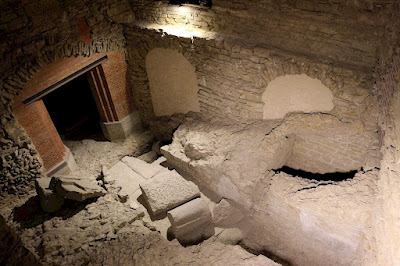
The Roman theatre of Florentia was located more or less where the Palazzo Vecchio stands today, some 4 m above the level of the Roman town. There are remains of the public baths are under Torre della Pagliazza, and other remnants have been excavated under the Duomo and under the Baptistery.

Remains of the Roman theatre under the Palazzo Vecchio in Florence.

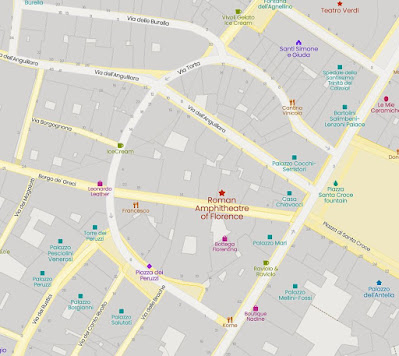
Between Piazza della Signoria and Piazza Santa Croce there is a curiously curved street, via Torta, which originated as part of the perimeter of the Roman amphitheatre. The latter had a diameter of 125 m, with a capacity of 20,000 seats. It was built in the 130 AD outside the walls and marked the point of maximum expansion of the town to the east. More of the outline of the amphitheatre is preserved in the curved Piazza dei Peruzzi.

Location of the Roman amphitheatre in Florence.

 
Roman streets in Florence
 

During the rule of the Emperor Hadrian, Florentia was enlarged, and by the 3 C it was a successful commercial centre. In 287, it became the capital of the region Tuscia et Umbria, and in 405 it was able to withstand the sieges of the Ostrogoths.

More complete Roman (and Etruscan) ruins can be visited in Fiesole where there were Roman baths and a Roman theatre.


Tuscany Toscana
Don't forget to visit my Tuscany
Travel Guide!

Up-to-date news on what to see and where to stay in Chianti and all of Tuscany.

Tuscany Travel Guide

vacation accommodations in Tuscany


Author: Anna Maria Baldini

All content copyright © ammonet Italian Web Site Promotion 2022. All rights reserved.

Sunday, 5 December 2021

Medioevo a Pistoia - the Middle Ages in Pistoia - an art exhibition not to be missed

From 27 November, 2021 until 8 May, 2022, an excellent art exhibition is taking place in Pistoia: Medioevo a Pistoia - the Middle Ages in Pistoia.

In 1140 at the behest of Bishop Atto, the relic of San Jacopo arrived in Pistoia, placing this Tuscan town onto one of the most important European pilgrimage routes, and eventually making it an international economic and artistic centre. This art exhibition features 60 Pistoian masterpieces from the Romanesque and Gothic periods, illustrating for the first time the extraordinary panorama of the arts in Pistoia from the 12 C to the beginning of the 15 C. Many of these works have been restored especially for this exhibition and they are absolutely worth seeing.


 Altarpiece by Taddeo Gaddi on show in Pistoia at Medioevo a Pistoia.

During the period covered by the exhibition, Pistoia was well provided with enlightened patrons who attracted artists such as the sculptors Guglielmo, Guido da Como, and Nicola and Giovanni Pisano. At the end of the 12 C, two great though anonymous artists were in the Pistoia: the Master of the Crucifix (n. 434 of the Uffizi) and the Master of Santa Maria Primerana. Not only sculptors and painters were attracted to Pistoia but, as in other Tuscan cities of the time, also goldsmiths, resulting in works like the Silver Altar of San Jacopo. There were also highly skilled miniaturists active during this period, especially in the workshop of the Master of Sant’Alessio in Bigiano, and the elegant illustrations by the Master of the Bracciolini Chapel in the Divine Comedy preserved in the National Library of Naples were produced in Pistoia during the 15 C.

Pistoia exhibition manuscript with miniatures

Pistoia exhibition manuscript with miniatures

During the 14 C, Pistoia was the home of artists of the calibre of Lippo di Benivieni, Taddeo Gaddi and Niccolò di Tommaso, who place Pistoia among the leading art cities of Tuscany - not to mention the Majesty and Angels by Pietro Lorenzetti. The latter is on loan from the Uffizi, and was restored for this exhibition.

Romolo di Senuccio Salvi, Reliquary of the Cross (1379-1383)

 Romolo di Senuccio Salvi, Reliquary of the Cross (1379-1383)

The works of art displayed at the "Middle Ages in Pistoia" exhibition are all the more interesting for their web of relationships with the masterpieces preserved in the churches and museums of Pistoia. The exhibition provides its visitors with a route by which they may discover mediaeval Pistoia via the churches of Sant'Andrea and San Giovanni Fuorcivitas (free admission with the exhibition ticket), the cathedral of San Zeno (see the Silver Altar of San Jacopo), and the churches of San Bartolomeo in Pantano, San Paolo, San Domenico, San Francesco, the church of Tau and the Baptistery.

Medioevo a Pistoia is an opportunity to spend an entire day exploring beautiful art works in a relatively concentrated area of a town that is often unjustly neglected by visitors. Don't miss it!

Medioevo a Pistoia takes place in the Antico Palazzo dei Vescovi piazza del Duomo, 3 and in the Museo Civico Piazza del Duomo, 1. Reservations and covid Green Passes (or equivalent) are required and tickets can be bought online at https://www.fondazionepistoiamusei.it/biglietteria/en/.

Tuscany Toscana
Don't forget to visit my Tuscany
Travel Guide!

Up-to-date news on what to see and where to stay in Chianti and all of Tuscany.

Tuscany Travel Guide

vacation accommodations in Tuscany


Author: Anna Maria Baldini

All content copyright © ammonet Italian Web Site Promotion 2021. All rights reserved.

Saturday, 13 November 2021

The Medicean Villa dell'Ambrogiana might become part of the "Uffizi Diffusi" project

A new and interesting possibility has arisen recently as part of the "Uffizi Diffusi" project in which works stored at the Uffizi Gallery in Florence will be displayed at other locations throughout the Province. The idea is to make more works of art easily accessible to the public as well as to enhance the touristic attractiveness of the new sites. The Villa Medicea dell'Ambrogiana, which is a splendid Renaissance villa located near Montelupo Fiorentino, might become a major location forming part of the project. Historically, the land and farm buildings, presumably including a villa, belonged to the Ambrogi family (hence the name) and were acquired by the Medici family prior to 1574. The latter built a huge hunting lodge on the site and this later became one of Cosimo III's favourite rural retreats. However, in the 19th Century, the Grand Duke Leopoldo II decided to transform the already crumbling villa into a remand home and then into a psychiatric prison, and this contributed substantially to its decline.

Villa Medicea dell'Ambrogiana

Villa Medicea dell'Ambrogiana

During November 2021, a government minister visited the villa and appeared to support the idea of central government funding to restore the Villa dell'Ambrogiana in order to house there paintings currently mostly in storage at the Uffizi, including some of those recently removed from the Vasari Corridor. The minister noted that "There are at least 100 works that today lie in the deposits and were historically here in the Medici villa dell'Ambrogiana, from the still lifes by Bindi, to the religious paintings by Cinqui that decorated that 'brother' of the Corridor Vasariano that we have right here at the Ambrogiana." There was even a suggestion that restoration could begin as early as 2022. The gardens are already in good condition and the building needs basically to be earthquake-proofed and given a coat of paint.

Montelupo Fiorentino is already well-know for the production and sale of Italian majolica, and is anyway well worth a visit for that reason.

More about Montelupo Fiorentino.


Tuscany Toscana
Don't forget to visit my Tuscany
Travel Guide!

Up-to-date news on what to see and where to stay in Chianti and all of Tuscany.

Tuscany Travel Guide

vacation accommodations in Tuscany


Author: Anna Maria Baldini

All content copyright © ammonet Italian Web Site Promotion 2021. All rights reserved.

Thursday, 11 November 2021

Chiesa di San Leolino at Panzano in Chianti

One of the many gems of the Chianti countryside is the Chiesa di San Leolino at Panzano in Chianti, a parish church and cloister dating from mediaeval times. The church is documented from the year 985 and has undergone two major restorations since that time.

During the late middle ages in Tuscany there was a burst of church construction that coincided with - indeed, was caused by - an increase in population and a rapid rural economic improvement. The latter was interrupted more than once by the Plague, but in essence both derived from and drove urban economic expansion - the rise of the rich city states such as Florence itself. The Pieve di San Leolino is not only beautiful in architectural and artistic terms, but enjoys magnificent views out over the Chianti countryside, with spectacular lighting at sunset.

Chiesa di San Leolino at Panzano in Chianti

The fine exterior consists of a Renaissance facade preceded by an imposing five-arched sandstone portico. The stone-framed portal leads to the extraordinary interior which is divided into three naves which house a number of splendid works of art, notably a beautiful triptych depicting the Madonna and Child flanked by saints, some wonderful glazed terracotta tabernacles near the altar and a beautiful plaster reliquary bust of Sant'Eufrosino in the left aisle. A portal in the right aisle leads to the small but charming cloister with a well, with a portico supported by brick columns and a wooden roof.


More about Romanesque parish churches of Chianti

More about Panzano in Chianti.

Tuscany Toscana
Don't forget to visit my Tuscany
Travel Guide!

Up-to-date news on what to see and where to stay in Chianti and all of Tuscany.

Tuscany Travel Guide

vacation accommodations in Tuscany


Author: Anna Maria Baldini

All content copyright © ammonet Italian Web Site Promotion 2021. All rights reserved.

Wednesday, 27 October 2021

Florence bus tickets - tickets for the ATAF buses in Firenze


STOP PRESS! As of 1 November 2021, ATAF as such disappears and re-incarnates under the auspices of Autolinee Toscane.

ATAF, or Azienda Tranviaria Automobilistica e Filoviaria, was established on October 25, 1945 to provide public transport in and around Florence. Now the signage has been taken down at the depot in viale dei Mille and the branding is being removed from the buses. On 31 October 2021, management of Florence’s bus service will shift to Autolinee Toscane, which will be in charge of bus services throughout Tuscany.

From 1 November, all times and services are expected to remain unchanged. Tickets may be purchased digitally by sending a SMS stating “Firenze” to 488.01.05 or by using the Tabnet app downloadable from the App Store or Google Play. Passengers will still be able to purchase tickets from official ticket offices, machines and authorised retailers that display the Autolinee Toscane sticker. Existing tickets will no longer be valid after 31 October, but refunds can be requested at Desks 8 and 9 at the Santa Maria Novella bus station ticket office.

STOP PRESS! As of 18th July 2019, Florence's ATAF buses allow contactless payment, meaning credit card touch technology. The system is installed on 355 buses within the city plus the airport bus, and currently accepts MasterCard, VISA, Maestro and V Pay. The ticket price of 1.50 euros and the validity duration of 90 minutes remain unchanged. When asked to produce your ticket by an inspector, simply tell him give the last four digits of the card with which you made the payment.This is an enormous time-saver and obviates the need to validate and manage paper tickets which tend to accumulate in the pockets of busy tourists. We await news on when the system will be installed on the trams.

There are a few simple but important things to know about using the city buses in Florence, Italy.


ATAF bus ticket
ATAF 90 minute bus ticket

ATAF bus tickets should be bought BEFORE you board the bus. They are available from any kiosk (news stand) and from many cafés (bars), and at tobacconists. There are also two ATAF offices very near the SMN railway station where you can buy tickets. The most useful ATAF office is the one at via Alamanni 20r. You can get to it from inside the station by going down the steps leaving the station on the right (when facing away from the platforms), turn right again at the bottom of the steps, go past the very useful Conad supermarket, a florist shop and a post office. The ATAF office is the next place and is open Monday through Saturday 7.15am to 7pm.

In extremity, you can buy a ticket from the driver. Note that he's not obliged to provide change and sales are suspended if an inspector is on board.

how to buy an ATAF bus ticket in Florence

Etiquette indicating that ATAF tickets are sold inside.


Sign indicating a tobacconist - they usually also sell bus tickets

Sign indicating a tobacconist - they usually also sell bus tickets

IMPORTANT Florence ATAF bus tickets must be validated as you enter the bus. You do this by inserting the ticket into the franking machine located beside or just behind the driver, and another near the rear entrance to the bus. Insert the pink strip uppermost and first into the machine. Check your ticket to make sure it was stamped with the date and time. Inspectors have no mercy on those without a ticket or with an unvalidated ticket or with an expired ticket - the fine is on-the-spot and painful (50 euros). If one machine is not working, try the other one. You only escape a fine if both machines are inoperative.

There is a good range of tickets available. Most commonly used is the 90 minute ticket. Using this you can get on and off as many buses as you like in any direction for the 90 minutes from when you validated the ticket.

Other tickets are good for four 90 minute rides. These tickets can be shared as long as they are validated the requisite number of times. For example, two people taking the number 7 bus to Fiesole could frank such a ticket twice to go and again twice to come back later in the day. These tickets have four strips for validation. Be sure not to overwrite your validation.

There are also 24 hours tickets and tickets for several days. Since these tickets are not meant to be passed from one person to another, YOU MUST WRITE YOUR NAME ON LONG DURATION ATAF TICKETS, such as 24 hour and three day tickets.

ATAF tickets are good for the small, electric buses that follow routes mainly through otherwise traffic-free lanes, and also for the trams. They are NOT valid for the bus that runs to and from SMN railway station and the airport. You can buy those tickets on the bus. Note that a taxi from the airport costs a fixed price of 20 euros plus baggage and late hours fees.

Last but not least, there are pickpockets on the buses and trams in Florence, especially when they are crowded and on routes favoured by tourists. Please read this article on pickpockets in Italy to understand what you can do to protect your valuables from these thieves. It's not as bad as in Rome, but they are here in Florence for sure.


Tuscany Toscana
Don't forget to visit my Tuscany
Travel Guide!

Up-to-date news on what to see and where to stay in Chianti and all of Tuscany.

Tuscany Travel Guide


vacation accommodations in Tuscany

Author: Anna Maria Baldini

All content copyright © ammonet Infotech website promotion 2016 - 2026. All rights reserved.

Thursday, 21 October 2021

Did the Etruscans really originate in Anatolia?

A September 2021 genetic study carried out on Etruscan skeletal remains throws new light on the question of whether the Etruscans really originated in Anatolia, during the 8th to 6th centuries BC, as first proposed by Herodotus and Hellanicus of Lesbos, and supported by later genetic studies of modern individuals living in and near Murlo, central Tuscany. Click the following link for a good summary of the facts and theories until now about who the Etruscan were and where they came from.

Origin of the Etruscans

In summary, present-day Tuscan mitochondrial DNAs (mtDNAs) demonstrate a relationship with current Anatolian populations that has been interpreted as evidence for a recent Near Eastern (Lydian) origin of the Etruscans, as proposed as early as Herodotus. This was supported by early studies on mtDNA from Etruscan-associated individuals that did not find any evidence of genetic continuity between Etruscans and present-day populations from the same region, except for some isolated locations in Tuscany

However, the study recently published in Science Advances based on genomic analyses of 82 ancient individuals from Tuscany, Lazio, and Basilicata spanning ca. 2000 years of Italian history, have revealed major episodes of genetic transformation. Across the first interval of the study's central Italian temporal transect (800 to 1 BC), most individuals form a homogenous genetic cluster (designated C.Italy_Etruscan), indicating that the sporadic presence of individuals with ancestry tracing back to other regions did not leave a substantial local genetic legacy. In particular, in agreement with the "local origin" proposal of the historian Dionysius of Halicarnassus in the first century BC, the Etruscan-related gene pool does not seem to have originated from bronze-age (800 to 600 BC) population movements from the Near East. Etruscans carry a local genetic profile shared with other neighboring populations such as the Latins from Rome and its environs despite the cultural and linguistic differences between the two neighboring groups. Furthermore, according to this new study, a large proportion of the C.Italy_Etruscan genetic profile can be attributed to Iron Age steppe-related ancestry (i.e. not Anatolian), confirming a trend observed in most other European regions.

So what about the Etruscan language? Although Etruscan is a non-Indo-European relict language, which survived in central Italy until the Imperial Period, it was not completely isolated. Instead, Etruscan seems to be linked to both Rhaetic, a language documented in the eastern Alps in a population that ancient historians claim to have migrated from the Po valley, and to Lemnian, a language putatively spoken on ancient Lemnos in the Aegean Sea. The relationship with Rhaetic is hard to account for, but the Anatolian-origin theory proposed that Lemnos was a stepping stone in the migratory path from nearby Lydia in Anatolia to Tuscany. However, the new model proposes that while the Etruscan language remained in place, eastern Mediterranean ancestries replaced a large portion of the native Etruscan-related genetic profile during the Roman Imperial period and not between 800 and 600 BC. This seems exceptionally odd since in almost every other historical example of replacement of a local population by Indo-European invaders, the local language as well as the genes were replaced.

This new study is sure to generate plenty of discussion. For example, the authors do not consider the possibility put forward by some historians that the Etruscans did not replace the native Umbrian population when they arrived from Anatolia but formed a ruling class, as did the Longobards much later, which left genetic markers only rarely (e.g. in the current population around Murlo in Tuscany).

The Volterra Estruscan Museum

The Gods, Goddesses and Mythology of the Etruscans


Tuscany Toscana
Don't forget to visit my Tuscany
Travel Guide!

Up-to-date news on what to see and where to stay in Chianti and all of Tuscany.

Tuscany Travel Guide

vacation accommodations in Tuscany


Author: Anna Maria Baldini

All content copyright © ammonet Italian Web Site Promotion 2021. All rights reserved.

Sunday, 25 July 2021

Romanesque Parish Churches of Chianti

A one day driving tour of the Romanesque parish churches (Pievi) of Chianti is a great way to introduce yourself to the highways and byways of Chianti Italy as well as, of course, to see some of the oldest and most evocative architecture and works of art in Tuscany. One good route is simply to follow the Via Chiantigiana and make the appropriate detours.

Romanesque Parish Churches of Chianti
Pieve di San Cresci - a romanesque parish church in Chianti


The historic pievi (singular: pieve) are for the most part mediaeval although the Pieve di San Vincenti near Castelnuovo Berardenga dates from the Dark Age - it was a Basilica in the 7 C. They range from the magnificent (e.g. San Polo in Rosso) to the simple, single nave structures such as the Pieve di Santa Maria a Pacina, dating from the 8 C and characterised by a highly unusual cylindrical campanile (bell tower). 

If you are a Tuscan wine lover, you can combine visiting what is probably the oldest extant parish church in Chianti with a visit to a winery that takes its name from the church - namely, the Pieve di San Cresci winery. This wine producer belongs to the Ballini family who have been making wine here for almost two hundred years. Their wines are personal favorites of mine and I recommend them highly, especially the three Chianti Classicos. The winery has a wine tasting facility just in front of the church.

Author: Anna Maria Baldini


Saturday, 17 July 2021

The most beautiful villages in Tuscany

 "La Bandiera Arancione" - the Orange Flag - of the Touring Club Italia is one of the most sought after accolades among the villages of Italy and nearby areas. To win a place on the Orange Flag list means that the Touring Club and its members have assessed your village to be one of the most attractive villages in Italy in terms of beauty and livability, and with a great artistic and cultural heritage. The list is renewed every three years with only about 8% of 3,200 candidates making the grade. This year, 38 villages in Tuscany found a place on the list.

 The 38 most beautiful villages in Tuscany

Anghiari, Province of Arezzo

I have one quibble with their list, namely that they have selected mostly not villages but towns, some of them quite considerable. I guess that's a consequence of their voting system since obviously more of their members visit towns than small villages. I would have included both Montefioralle and Panzano in Chianti on my list of the most beautiful villages in Tuscany.

Anyway, here are the 38 most beautiful villages in Tuscany, according to Touring Club Italia, the Province of Sienna receiving the most awards:

 
San Gimignano

There are 16 awarded villages in the Province of Sienna: Casole d'Elsa, Castelnuovo Berardenga, Cetona, Chiusi, Montalcino, Montefollonico, Montepulciano, Monteriggioni, Murlo, Pienza, Radda in Chianti, Radicofani, San Casciano dei Bagni, San Gimignano, Sarteano and Trequanda.

If you are in the Province of Pisa: Casale Marittimo, Casciana Terme Lari, Castelnuovo di Val di Cecina, Peccioli, Pomarance and Volterra.

Four in the Province of Grosseto: Massa Marittima, Pitigliano, Santa Fiora and Sorano;

Three in the Province of Arezzo: Anghiari, Castiglion Fiorentino and Lucignano.

Three villages in the Province of Firenze: Barberino Tavarnelle, Certaldo and Vinci.

Two in the Province of Lucca: Barga and Montecarlo.

Two in the Province of Pistoia: Abetone Cutigliano and Collodi.

One in the Province of Livorno: Suvereto.

One in the Province of Massa-Carrara: Fosdinovo.


Tuscany Toscana
Don't forget to visit my Tuscany
Travel Guide!

Up-to-date news on what to see and where to stay in Chianti and all of Tuscany.

Tuscany Travel Guide

vacation accommodations in Tuscany


Author: Anna Maria Baldini

All content copyright © ammonet Italian Web Site Promotion 2021. All rights reserved.

Friday, 28 May 2021

An exquisite reliquary bust at the Diocesan Museum of Florence

My attentive readers will know that from time to time I like to draw attention to works of art in small museums that are unjustly negrlected by visitors to Tuscany. Today I want to describe a beautiful reliquary bust commissioned by the Grand Duke of Tuscany Cosimo III and created in 1703. The bust is silver cast using the lost wax method and finished by chisel, with gilded copper details. It was intended for the Pieve di San Cresci located on the slopes of Monte Giovi (province of Florence). San Cresci lived during the 3C and is considered to be the evangeliser of the Mugello where he was martyred around the year 250.

For the execution of this splendid reliquary, the Grand Duke turned to his court artist, the sculptor, architect and great draftsman Giovanni Battista Foggini who executed the design, leaving the execution of the work to another great artist of the Medici court, the German silversmith Bernard Holzman who performed the work in silver, clothing the saint in finely decorated and chiseled Roman armour. The youthful face of the saint, bearded and with thick hair, is slightly turned to the right. On the base runs the inscription: Sancti Crescij Xp Martyris Caput.

From a stylistic point of view, you can see the high quality in the accuracy of the finishing of the details and in the pride of the figure, clearly derived from the classical models, already used in the Middle Ages by the Arezzo goldsmiths Pietro and Paolo and then again in the Renaissance also by Donatello when he made the reliquary bust of San Rossore in Pisa.

This reliquary is one of the many masterpieces exhibited in the all too neglected Diocesan Museum of Florence in Santo Stefano al Ponte. If you can spare the time during your visit to Florence, I strongly recommend spending a couple of hours there.


Tuscany Toscana
Don't forget to visit my Tuscany
Travel Guide!

Up-to-date news on what to see and where to stay in Chianti and all of Tuscany.

Tuscany Travel Guide

vacation accommodations in Tuscany


Author: Anna Maria Baldini

All content copyright © ammonet Italian Web Site Promotion 2021. All rights reserved.

Sunday, 23 May 2021

Getting married in Tuscany: great wedding venues in Tuscany

If you're planning on getting married in Tuscany, a wonderful wedding venue will be at or near the top of the list of "musts" to make the your wedding a super-special occasion. There's an enormous range of great wedding venues in Tuscany at your disposal so I want to mention some wedding locations of which I have personal experience.

Getting married in Tuscany
Wedding dinner at Villa Felceto

For a do-it-yourself wedding in Tuscany, I can strongly recommend Villa Felceto, located on the Podere Felceto olive farm near Panzano in Chianti, halfway between Florence and Sienna. The villa, in ancient times a monastery, and the nearby dependencies provide accommodation for 20 people while the nearby agriturismi plus hotel and apartment accommodation in Panzano offer a good range of additional places to stay for your guests. The villa and its grounds provide beautiful settings for your wedding ceremony and wedding dinner. And very importantly, the owners, Roberto and Jussara, who speak excellent English, can and will provide lots of assistance with your arrangements, especially catering, so that you can organise everything without the assistance of a wedding planner.

More about Villa Felceto wedding venue in Tuscany.


Do it yourself wedding location in Tuscany
Wedding feast at La Ghiandaia in Tuscany

Another great do-it-yourself wedding venue in Tuscany is Agriturismo La Ghiandaia which is located near the tiny village of Lucolena in central Chianti, 30 km from Florence. The agriturismo is an ideal location for a wedding of up to 30 - 35 guests all of whom will be able to stay on site. For your wedding buffet you can take advantage of the beautiful veranda with its panoramic view, ideal for dancing, or a splendid converted wine cellar for inside dining in case of rain.

Silvia, the gracious owner of La Ghiandaia, is ready and able to organise everything for your wedding. She is experienced in organising complete, customised weddings at her house, including accommodation, finding a church or town hall, reserving a suitable restaurant if required, organising the buffet and party at her house with musicians and waiters, flower decorations, rental vans and wedding car and in general everything that is necessary to make your wedding day happy and memorable for you and your wedding party.

Review on Trip Advisor: "A perfect Wedding" at La Ghiandaia in Tuscany.

More about La Ghiandaia wedding location in Tuscany.


Wedding in Tuscany - Villa Vitigliano
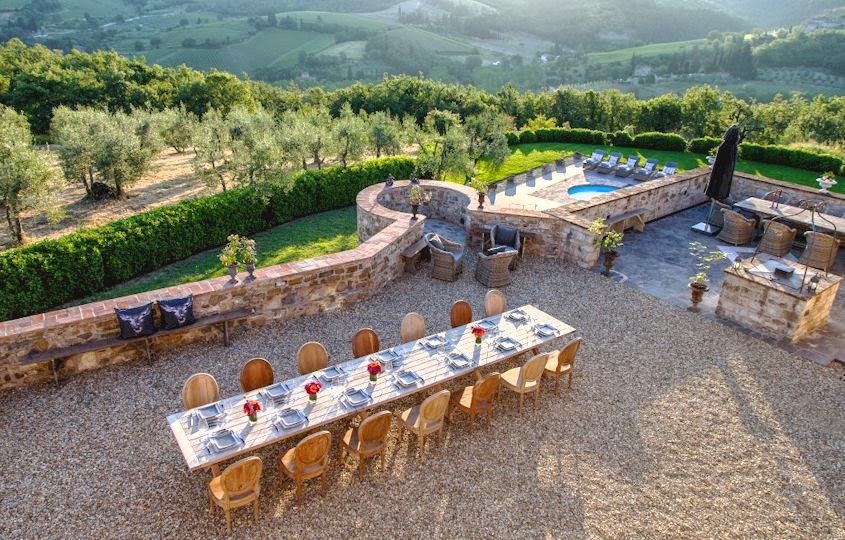
Villa Vitigliano dining al fresco

Last but not least, the height of luxury and sophistication in Tuscany is to be found at Vitigliano , a recently restored rural "borgo" located between Panzano and Greve in Chianti, 45 minutes south of Florence. I have already praised this uniquely beautiful Tuscan boutique hotel, and I want to add that Vitigliano is surely the most luxurious wedding venue in all of Tuscany, with its own Turkish bath, whirlpool and professional kitchens. The Bridal Suite in the Tower offers an unforgettable ambiance for your wedding night, and the other luxury suites are ready for the bridal couple and their families. Accommodation for the wedding guests is readily available within a ten minute drive. Vitigliano has its own ancient chapel for a traditional wedding ceremony.

More about Vitigliano wedding venue.


Tuscany Toscana
Don't forget to visit my Tuscany
Travel Guide!

Up-to-date news on what to see and where to stay in Chianti and all of Tuscany.

Tuscany Travel Guide

Author: Anna Maria Baldini

All content copyright © ammonet Italian Web Site Promotion 2015 - 2023. All rights reserved.