Tuesday, 10 May 2022

When do the poppies appear in Tuscany?

Wild flowers in Tuscany.

This is the time of year when many readers ask me, "When do the poppies appear in Tuscany?" Of course, the exact time varies a bit from year to year, but right now, the end of April and beginning of May, is the time to see poppies and many, many other species of wild flowers in Tuscany. This is basically because April is one of the two rainy months in Tuscany (the other being October) and as long as the temperature and rainfall are more or less average, flowers will spring up everywhere - ploughed fields, olive groves, vineyards, roadside.

The picture below shows a bunch of wild flowers that I picked yesterday during the course of a 20 minute walk through my olive grove here in central Chianti. Those are just a few of the more spectacular blooms that had sprung up since the thunderstorm the day before, irises and poppies among them.

wild flowers of Tuscany

Tuscan wild flowers 


Poppies of the Val d'Orcia

When visitors to Tuscany ask about poppies in bloom, they're usually referring to the red poppies that blanket the Val d'Orcia at this time of year. This display is most spectacular on the ploughed hills of the heavily alkaline Crete Senesi in the Val d'Orcia before the crops are planted, and is the object of many a photographic excursion to that area of Tuscany during the last days or April and early May. Cultivation of agricultural land is often detrimental to wild plant species but not so the Tuscan poppy which, indeed, is also known as the "corn poppy" because it thrives on land subject to the annual rhythm of grain cultivation. This species is also famous under the name "Flanders poppy", the emblem of the fallen soldiers of World War I. Papaver rhoeas, the variety of papavero (poppy) that has become known as the Tuscan poppy, probably originated in Egypt, where the cyclic agricultural practices regulated by the annual flood of the Nile began favouring this spectacular plant. By growing on disturbed soil and seeding itself profusely during its growing season, the poppy has found a perfect harmony with the agricultural practices for the past 3,000 years or so and remains of poppies have been found in ancient Egyptian tombs.

Poppies in the Val d'Orcia of Tuscany
Poppies blooming in the Val d'Orcia of Tuscany

Orchids in Tuscany

Not everyone realises that there are more than 40 species of orchid native to Tuscany. Ophrys speculum is one of the most common and easiest to recognise of the Tuscan orchids, but the diligent flower enthusiast will soon discover several other common species that are currently in flower. Many of these are found in or near bogs high in the Apuan Alps, but others are common throughout Tuscany, especially in the hilly vineyards and fields of Chianti. The flowers of members of the genus Ophrys are famous for their resemblance to female insects, to the extent that male insects, bees in particular, attempt to copulate with them, hence pollinating the flowers. Although many authorities list between 50 and 150 species of Ophrys in Europe, molecular genetic analysis suggests that there might be as few as 10 species, with the other apparent species being variants arising from hybridisation. Nevertheless, whether they are different species or not, this genus alone provides a huge variety of floral pleasures for country walkers in Tuscany.

A Tuscan orchid, Ophrys speculum

More about the orchids of Tuscany.

Vacation accommodation in Tuscany
www.bella-toscana.com


All content copyright © ammonet Italian Web Site Promotion 2014 - 2026. All rights reserved.

Sunday, 8 May 2022

Anglo-American Florence since the mid 19th Century

Not everyone realises just how small Florence was in the mid-19th Century compared with today. The city walls were still intact. The latter weren't demolished until between 1865 and 1871 when Florence was provisional capital of Italy. I recently came across a provincial map dating from 1841. To the NE, Florence more or less ended just behind the railway station!

Florence in 1841
Florence in 1841

During the second half of the 19th century, a third of the population of Florence was made up of foreigners, the majority of them from England and America - the Anglo-American Florentines - along with numerous Germans, French and Russians. The English foreign colony between 1850 and 1930 included the poet Walter Savage Landor, Robert and Elizabeth Browning with their literary salon in Casa Guidi on Via Maggio, George Nassau, the third Earl Cowper, the countess of Orford, Lady Sybil Cutting (the mother of Iris Origo) at Villa Medici, Longworth Powers, Janet Ross, Norman Douglas, Vernon Lee, Bernard Berenson at Villa I Tatti and many, many others. The last direct connections to the last of the Anglo-American Florentines was probably Sir Harold Acton (1904 - 1994) whose father moved into Villa La Pietra in 1903, or perhaps Harry Brewster who passed away in 1999.

Aside from those who made Florence their home, there was a constant stream of illustrious visitors who came to stay for months at a time. In 1869, Henry James made his first visit to the city that became one of his favorites and one of the settings for his wonderful novel, The Portrait of a Lady.

Since that time, the city has spread out across the flood plain of the Arno, virtually swallowing up Prato and, no doubt soon, Pistoia to the NE, and with hardly a patch of green separating its outskirts from Signa and Lastra d Signa.

Florence in 2022
Florence in 2022

Tuscany Toscana
Don't forget to visit my Tuscany
Travel Guide!

Up-to-date news on what to see and where to stay in Chianti and all of Tuscany.

Tuscany Travel Guide

vacation accommodations in Tuscany

Author: Anna Maria Baldini

All content copyright © ammonet Italian Web Site Promotion 2022. All rights reserved.
Saturday, 7 May 2022

Palazzo Chigi Zondadari in Sienna opens to the public

Everyone visiting the main piazza of Sienna, especially during the Palio, will have seen, although perhaps not particularly noticed, the Palazzo Chigi Zondadari which is located on the higher side of the Piazza del Campo and provides the perfect view of the Palio. However, very few know that the interior of this palazzo is spectacularly decorated and furnished.

From 8 May 2022, the Palazzo Chigi Zondadari in Sienna opens to the public on a permanent basis.

Palazzo Chigi Zondadari in Siena

Palazzo Chigi Zondadari

The Palazzo was built for Cardinal Antonfelice Zondadari (1655 - 1737) and his brother Bonaventura (1652 - 1719), first Marquis Chigi Zondadari and founder of this aristocratic dynasty. The palazzo has been the Siennese residence of the family since 1724 and was the last palazzo to be constructed in the Piazza del Campo.

The Palazzo Chigi Zondadari is a typical baroque-neoclassical structure designed by Antonio Valeri (1648 - 1736), the last pupil of Gian Lorenzo Bernini, who was brought in from Rome to modernise and expand the pre-existing mediaeval buildings that were were purchased by the Chigi at end of the 17 C.

Bust of Pope Alexander VII by Bernini
$
Bust of Pope Alexander VII by Bernini

The palazzo is a linear structure, with five rows of windows, an internal courtyard and a splendid main staircase. The main floor is the most interesting. The halls and galleries have frescoed ceilings, house a collection works of art, archaeological finds, paintings and sculptures, among them a fine bust of Pope Alexander VII by Gian Lorenzo Bernini, and three rooms have their walls decorated in spectacular Venetian "corami" from the 1780s.

Salotto Rosso of the Palazzo Chigi Zondadari

Salotto Rosso of the Palazzo Chigi Zondadari

Among the renowned artists who worked on the palace were Placido Costanzi, a pupil of Francesco Trevisani, one of the most important artists who was a followers of Carlo Maratta and of Benedetto Luti. Cardinal Antonfelice Zondadari entrusted the execution of some frescoes depecting episodes from the life of Pope Alexander VII and Cardinal Zondadari to Placido Costanzi. Another painter who worked on the noble floor was Marco Benefial, a pupil of the Carraccesco Bonaventura Lamberti. Francesco Nenci who completed the decoration of the rooms during the 19 C.

Tuscany Toscana
Don't forget to visit my Tuscany
Travel Guide!

Up-to-date news on what to see and where to stay in Chianti and all of Tuscany.

Tuscany Travel Guide

Author: Anna Maria Baldini

All content copyright © ammonet Italian Web Site Promotion 2022. All rights reserved.

Wednesday, 27 April 2022

Who was Mona Lisa?

 Who was Mona Lisa?

"Mona Lisa" by Leonardo da Vinci

The question of who was Mona Lisa has occupied scholars for at least 150 years, more or less since Leonardo da Vinci's painting, known in English as "Mona Lisa", became the most famous painting on the planet - before that time it was well-known but not as highly esteemed as it became. The subject of the painting is widely believed to be Lisa del Giocondo who was a member of the Gherardini family of Florence and Tuscany, and the wife of the wealthy Florentine silk merchant, Francesco del Giocondo. This was Vasari's belief and there is no doubt that Leonardo worked on a portrait of Lisa del Giocondo. This was confirmed in 2005, when a scholar at Heidelberg University discovered a marginal note in a 1477 edition of a work by Cicero. The note was written by Leonardo's contemporary Agostino Vespucci, is dated October 1503 and states that Leonardo was at that time working on a painting of Lisa del Giocondo. There have even been claims that the portrait was painted at Villa Vignamaggio near Greve in Chianti, and that some of the geological formations in the background are the famous Tuscan balze, a type of eroded badlands formation.

However, was that painting the one we know today as "Mona Lisa"? According to Martin Kemp, one of the foremost Leonardo scholars, there is not the slightest scrap of evidence that it was. In his still valuable 1981 study, "Leonardo da Vinci. The marvellous works of Nature and Man", Kemp punctiliously refers to the Louvre painting as "Portrait of a Lady on a Balcony" and is convinced that it was started shortly before 1506 during Leonardo's Florentine period. Based on the 1517 report of his meeting with Leonardo by Antonio de' Beatis, Kemp also rules out the possibility of identifying her as one of the great ladies of the Renaissance. de' Beatis stated that it was a "portrait of a certain Florentine lady, made from nature at the instigation of the late Magnificent Giuliano de' Medici". However, Kemp thinks that the portrait was worked on from time to time later, especially the elaboration of the background.

Needless to say, several other names have been proposed for the subject this portrait, including Isabella d'Este, Isabella of Aragon, Cecilia Gallerani, Costanza d'Avalos, Duchess of Francavilla, Pacifica Brandano or Brandino, Isabela Gualanda, Caterina Sforza and, most recently, Bianca Giovanna Sforza. 

Carla Gori has proposed that the Mona Lisa is in fact a portrait of Bianca Giovanna Sforza, wife of the jouster Galeazzo Sanseverino, daughter of Ludovico il Moro, Duke of Milan and Lord of Bobbio near Piacenza. The basis of her hypothesis is as follows. She considers that the mural drawings of the Malaspina dal Verme castle dedicated to Sanseverino, patron and friend of Leonardo, were, at the very least, supervised on site by Leonardo. 

Bridge in the background of Mona Lisa
The bridge in the background of the Mona Lisa

Ponte Gobbo di Bobbio

In the background of the Mona Lisa, a bridge is depicted which she identified, in 2010, as the Ponte Gobbo di Bobbio, specifically as viewed from Malaspina dal Verme castle. In addition to the Ponte Gobbo, the Trebbia river and its large bend coincide with the stream depicted to the right of the Mona Lisa. The same goes for the mountains in the background, similar to the topography of the Val Tidone, the Pietra Parcellara and the badlands area. Most recently, circumstantial evidence suggests that Leonardo did indeed spend time at Pierfrancesco di Gropparello, near Bobbio. A group of geologists published a description of ichnofossils quite specific to that zone which seem to be the same as those illustrated by Leonardo in the Codex Leicester.

It's unlikely that Bianca Giovanna Sforza will displace Lisa del Giocondo as "Mona Lisa" anytime soon, but as research continues, who can tell?


Tuscany Toscana
Don't forget to visit Elena Spolaor's
Travel Guide!

Up-to-date news on what to see and where to stay in Chianti and all of Tuscany & Umbria.

Chianti Travel Guide

Author: Anna Maria Baldini

All content copyright © ammonet Web Site Promotion 2015 - 2022. All rights reserved.
Saturday, 2 April 2022

Free entry to state museums in Florence on the first Sunday of each month

Starting on the 3rd of April, 2022, there will be free access for all visitors to state museums, archaeological parks and cultural sites in Florence and elsewhere in Tuscany on the first Sunday of the every month. This might not apply to municipal museums and other sights that belong to the city of Florence.

Free entry into Florence museums

 Florence is one of several cities in Italy that have had, for several years, a  day of the month when entry to many museums is free for residents. In Florence the programme is known as Domenica Metropolitana. All of this was disrupted by the COVID-19 pandemic. However, as the severity of the pandemic declines and the rules are slowly relaxed, state-owned sights are being added to the municipal ones that are included in the Domenica Metropolitana programme. In Florence, this allows residents of the metropolitan city of Florence to visit city museums for free on first Sunday of every month, and all visitors to enter state-owned sights free.

Although it has been reported that from the 1st of April 2022, access to historical sights, museums, galleries and gardens no longer requires the covid vacination Green Pass (or equivalent document providing evidence that you have been vaccinated and have received a booster shot within the past 6 months), it is unclear whether this applies everywhere. It therefore remains advisable for you to have your Green Pass with you. The requirement to wear a face mask remains in place in all instances.

Tuscan sights open to all for free on the first Sunday of every month include: 

Antiquarium nazionale di Sestino
Via Marche - 52038 Sestino (AR)

Area archeologica di Vetulonia
vie Case di Siena, s.n.c. - 58043 Castiglione della Pescaia (GR)

Basilica di San Francesco
piazza San Francesco, 1 - 52100 Arezzo (AR)
    
Cenacolo di Andrea del Sarto a San Salvi
via di San Salvi, 16 - 50135 Firenze (FI)

Eremo di San Leonardo al Lago
strada dell'Osteriaccia, 4 - 53035 Monteriggioni (SI)

Galleria dell'Accademia di Firenze
via Ricasoli - 50122 Firenze (FI)

Gallerie degli Uffizi – Gli Uffizi
piazzale degli Uffizi - 50122 Firenze (FI)

Gallerie degli Uffizi - Tesoro dei Granduchi (Palazzo Pitti)
piazza Pitti - 50125 Firenze (FI)
    
Gallerie degli Uffizi - Museo della Moda e del Costume (Palazzo Pitti)
piazza Pitti - 50125 Firenze (FI)
    
Gallerie degli Uffizi - Galleria Palatina e Appartamenti Reali e Imperiali (Palazzo Pitti)
piazza Pitti - 50125 Firenze (FI)
    
Gallerie degli Uffizi - Giardino di Boboli
piazza Pitti - 50125 Firenze (FI)
    
Gallerie degli Uffizi - Museo delle porcellane
piazza Pitti - 50125 Firenze (FI)

Gallerie degli Uffizi – Galleria d’Arte Moderna (Palazzo Pitti)
piazza Pitti - 50125 Firenze (FI)

Museo archeologico nazionale ed Area archeologica di Cosa
via delle Ginestre, s.n.c. - 58015 Orbetello (GR)

Museo archeologico nazionale di Firenze
piazza S.S. Annunziata, 9b - 50122 Firenze (FI)

Museo archeologico nazionale “Gaio Cilnio Mecenate” e Anfiteatro romano
via Margaritone, 10 - 52100 Arezzo (AR)

Museo delle arti e tradizioni popolari dell’Alta Valle del Tevere - Palazzo Taglieschi
piazza Mameli, s.n.c. - 52031 Anghiari (AR)
    
Museo di Casa Vasari
via XX settembre, 55 - 52100 Arezzo (AR)

Museo nazionale della Certosa monumentale di Calci
via Roma, 79 - 56011 Calci (PI)
    
Museo nazionale delle residenze Napoleoniche Palazzina dei Mulini
piazzale Napoleone, 1-3 - 57037 Portoferraio (LI)

Museo nazionale delle residenze Napoleoniche Villa S. Martino
via di San Martino - 57037 Portoferraio (LI)
    
Museo nazionale di Casa Giusti
viale Vincenzo Martini, 18 - 51015 Monsummano Terme (PT)
    
Museo nazionale di Palazzo Mansi
via Galli Tassi, 43 - 55100 Lucca (LU)
    
Museo nazionale di San Matteo
piazza S. Matteo In Soarta - 56126 Pisa (PI)

Museo nazionale di Villa Guinigi
via della Quarquonia s.n.c. - 55100 Lucca (LU)

Museo nazionale etrusco e necropoli di Chiusi
via Porsenna, 93 - 53043 Chiusi (SI)
    
Museo nazionale etrusco, Necropoli di Poggio Renzo e Tomba del Colle
via della Pellegrina - 53043 Chiusi (SI)
    
Musei del Bargello - Museo nazionale del Bargello
via del Proconsolo, 4 - 50122 Firenze (FI)
    
Parco di Villa Il Ventaglio
via Giovanni Aldini, 10/12 - 50131 Firenze (FI)
    
Pinacoteca nazionale di Siena
via San Pietro, 29 - 53100 Siena (SI)
    
Villa medicea della Petraia
via della Petraia, 40 - 50141 Firenze (FI)
    
Villa medicea di Cerreto Guidi e Museo storico della Caccia e del Territorio
via Ponti Medicei, 7 - 50050 Cerreto Guidi (FI)

Free entry on the first Sunday of every month in Florence
 

Tuscany Toscana
Don't forget to visit Elena Spolaor's
Travel Guide!

Up-to-date news on what to see and where to stay in Chianti and all of Tuscany & Umbria.

Chianti Travel Guide

Author: Anna Maria Baldini

All content copyright © ammonet Web Site Promotion 2015 - 2022. All rights reserved.

Sunday, 20 March 2022

Beavers re-appear in the wild in Tuscany

The wild life of Tuscany is by no means static. For example, several species of deer plus wild boar were rare in the Chianti Classico wine zone of Tuscany 80 year ago. They're now so common as to be a pest to the extent that most vineyards are have to be surrounded by high mess fences to keep them out. Now that these ungulate populations are out of control, wolves have made an appearance over the past 2-3 years, presumably having migrated down from the Apennines to easy pickings in Chianti.

Another pest is the nutria or coypu, a rodent that resembles a beaver but lacks its flat tail. Some years back, these rodents escaped from breeding facilities where they were raised for their pelts. They are now found in rivers and steams all over Italy, and cause damage by burrowing into stream banks, causing collapse of the ground along waterways.

Nutria or coypu (Myocastor coypus)

Nutria or coypu (Myocastor coypus)

Historically, true beavers used to be very common all across Europe. However, due to hunting for their pelts, beavers became almost extinct. In several countries, reintroduction projects successfully brought back the beaver. In Italy, the beaver remained absent until at least one was reported in the Friuli-Venezia Giulia region in the Tarvisiano woods, about 3 years ago. This individual and possibly others probably migrated over the Alps from Austria.

Beavers in Tuscany

 Beavers in Tuscany

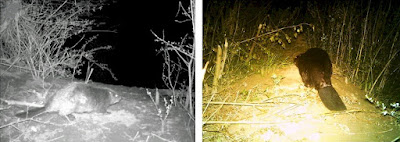
Over the past two years, there has been photographic confirmation that the Eurasian beaver Castor fiber L. has re-appeared in the wild Tuscany for the first time in more than 500 years. There are at least a couple of colonies, one sighted in the province of Arezzo, in Valtiberina, along the Tiber river. Another on the border between the provinces of Sienna and Grosseto. Local freelance wild life technicians and government scientists, Chiara Pucci, Davide Senserini, Giuseppe Mazza and Emiliano Mori, confirmed the occurrence of beavers through camera trapping. Genetic analyses (cytochrome-b mitochondrial gene) and hair microstructure confirmed the beavers to be the Eurasian species now in a new range about 530 km south to the historical range for this species. The presence of a relict population in this area is unlikely and the researchers therefore suggest that these newly reported beavers are the result of unauthorised releases. A recent radio broadcast by Radio 24 suggested that the Tuscan beavers are escapees from a small zoo near Aretino, but this can be ruled out by the genetic analysis.

Beavers photographed at night in Tuscany

Beavers photographed at night in Tuscany

More about the fauna of the Val d'Elsa.


Tuscany Toscana
Don't forget to visit my Tuscany
Travel Guide!

Up-to-date news on what to see and where to stay in Chianti and all of Tuscany.

Tuscany Travel Guide

vacation accommodations in Tuscany


Author: Anna Maria Baldini

All content copyright © ammonet Italian Web Site Promotion 2022. All rights reserved.

Sunday, 6 March 2022

The Medici. Masters of Florence. Use of digital backgrounds to re-create Renaissance Florence.

The TV series "I Medici" premiered on Italian television in 2016. I haven't had a chance to watch the whole series but I was greatly entertained to see in some clips how they re-created Renaissance scenes using digital composites. I'll show one or two here and add some more in due course.

Here's a scene which represents one of the gates of Florence during Renaissance times.

A scene from the TV series on the Medici family

A scene of Florence from the TV series on the Medici family

Observant readers (all of my readers are observant) will notice, first, that the Duomo sports the decorative facade that was added in the 19 C. The original facade was the raw brickwork that we still see on some other Florentine churches. So that was a blooper that they hoped no one would see - or perhaps they didn't know? It would have been easy to photoshop the facade for the digital background of this scene. The dome is depicted as completed, but that might be correct, depending on the period represented. Elsewhere in the series they make a big deal of the uncompleted dome.

The original facade of the Duomo of Florence
 
The original facade of the Duomo of Florence

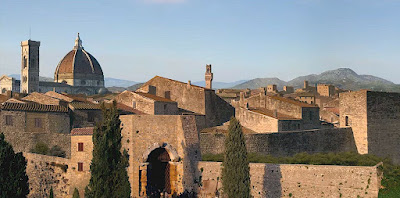
Now let's look at the gate where live action is taking place in the film. That's the Etruscan gate at Volterra with the fake Florence in the background.

The Etruscan gate at Volterra in Tuscany

The Etruscan gate at Volterra in Tuscany

Now what about the Ponte Vecchio? Here it is in the series with its four arches - whoops, how many?

The fictional Ponte Vecchio in Florence

The digital Ponte Vecchio in Florence

The Ponte Vecchio has three arches (see below) and, furthermore, the Vasari Corridor, which is depicted on the bridge in the digitalised background of the TV series, was not built until 1565 (by the Grand Duke Cosimo I de’ Medici).

The Ponte Vecchio as it looks today in Florence

The Ponte Vecchio as it looks today in Florence

Now here's a Tuscan countryside backdrop from the scene leading up to the death of  Giovanni di Bicci de’ Medici (who died during February when the grape vines have no leaves and it's way too cold to be munching grapes outside). Oh, and he was not poisoned or murdered in any other way.

Vineyards in Tuscany

Vineyards in Renaissance Tuscany according to I Medici

Vineyards like this didn't exist much before 1950. These are post-war grape vines. We call them "Fiat vineyards" because the rows of vines are planted just wide enough apart for a Fiat caterpillar tractor to plough between them. Prior to that, Tuscan farms used the method known as "cultura promiscua" where vegetables, wheat, olive trees, vines etc were planted in close proximity. In Renaissance times, grape vines were grown more or less wild through trees. Children used to climb up for the bunches of grapes which they threw down to the adults below. Furthermore, most of the Tuscan countryside was planted with wheat, with far fewer olive trees on cultivatable ground and even fewer grape vines. 'F' for that one, I'm afraid.

Next time you want to film a TV series on location in Tuscany, maybe hire me as an advisor!

More about Volterra.

More about the history of the Medici family in Tuscany.

More about the history of the Medici.

More about films shot in Tuscany.

Tuscany Toscana
Don't forget to visit my Tuscany
Travel Guide!

Up-to-date news on what to see and where to stay in Chianti and all of Tuscany.

Tuscany Travel Guide

vacation accommodations in Tuscany


Author: Anna Maria Baldini

All content copyright © ammonet Italian Web Site Promotion 2022. All rights reserved.

Sunday, 20 February 2022

The Roman origin of the street plan of central Florence

I think everyone knows that Florence was founded by the Romans - and not by the Etruscans, who established themselves in the cooler heights at Fiesole. Perhaps not everyone is aware of the Roman origin of the street plan of central Florence.

Florence was founded by the veterans of Julius Caesar's legions, to whom, in 46 BC, under the Lex Julia Agraria, cultivatable land was assigned as part of their severance pay. As with a great many newly created Roman towns, Florentia was laid out by the ex-legionaries with the same ground plan as a military castrum (camp), meaning a rectangle crossed by two main roads: the cardo, from north to south and the decumano from east to west. New Roman towns followed this format wherever the terrain allowed it, and excellent examples are scattered all over the flat coastal regions of North Africa, for example, and, closer to home, the Roman city of Casulae in Umbria. As with many other Roman towns, the location was very probably determined by the option to build a bridge, in this case across the Arno, very near where the Ponte Vecchio is today, with the aim of both protecting and taxing a popular river crossing on the via Cassia trade route.

Today, in the centre of Florence, visitors can easily detect evidence of the ancient settlement. Florentia was originally a rectangular area of about 450 m by 550 m, in which all the roads still meet at right angles and are divided by via Roma-via Calimala (from north to south) and via Strozzi-via degli Speziale-via del Corso (from east to west) that meet in the centre, where the forum was located and where today we find the Piazza della Repubblica. The urban perimeter stretched from via Tornabuoni to via Proconsolo (west to east), and from Via Cerretani - piazza del Duomo to piazza della Signoria (north to south). The main buildings of the city were the temples dedicated to Jupiter, Juno, and Minerva, the forum, the amphitheatre, the theatre, the public baths, the temple of Isis and the temple consecrated to Mars.

Location in modern Florence of the Roman town of Florentia.

The Roman theatre of Florentia was located more or less where the Palazzo Vecchio stands today, some 4 m above the level of the Roman town. There are remains of the public baths are under Torre della Pagliazza, and other remnants have been excavated under the Duomo and under the Baptistery.

Remains of the Roman theatre under the Palazzo Vecchio in Florence.

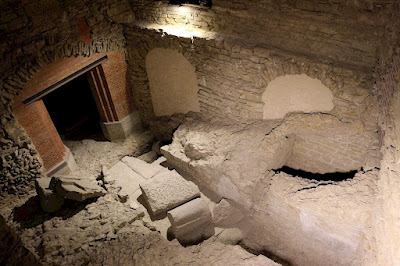
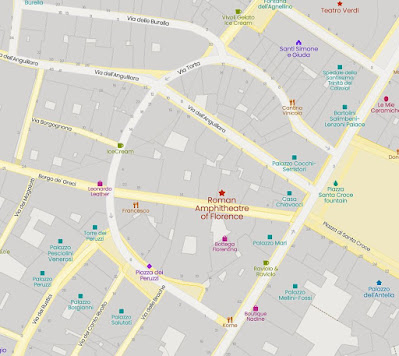
Between Piazza della Signoria and Piazza Santa Croce there is a curiously curved street, via Torta, which originated as part of the perimeter of the Roman amphitheatre. The latter had a diameter of 125 m, with a capacity of 20,000 seats. It was built in the 130 AD outside the walls and marked the point of maximum expansion of the town to the east. More of the outline of the amphitheatre is preserved in the curved Piazza dei Peruzzi.

Location of the Roman amphitheatre in Florence.

 
Roman streets in Florence
 

During the rule of the Emperor Hadrian, Florentia was enlarged, and by the 3 C it was a successful commercial centre. In 287, it became the capital of the region Tuscia et Umbria, and in 405 it was able to withstand the sieges of the Ostrogoths.

More complete Roman (and Etruscan) ruins can be visited in Fiesole where there were Roman baths and a Roman theatre.


Tuscany Toscana
Don't forget to visit my Tuscany
Travel Guide!

Up-to-date news on what to see and where to stay in Chianti and all of Tuscany.

Tuscany Travel Guide

vacation accommodations in Tuscany


Author: Anna Maria Baldini

All content copyright © ammonet Italian Web Site Promotion 2022. All rights reserved.

Sunday, 5 December 2021

Medioevo a Pistoia - the Middle Ages in Pistoia - an art exhibition not to be missed

From 27 November, 2021 until 8 May, 2022, an excellent art exhibition is taking place in Pistoia: Medioevo a Pistoia - the Middle Ages in Pistoia.

In 1140 at the behest of Bishop Atto, the relic of San Jacopo arrived in Pistoia, placing this Tuscan town onto one of the most important European pilgrimage routes, and eventually making it an international economic and artistic centre. This art exhibition features 60 Pistoian masterpieces from the Romanesque and Gothic periods, illustrating for the first time the extraordinary panorama of the arts in Pistoia from the 12 C to the beginning of the 15 C. Many of these works have been restored especially for this exhibition and they are absolutely worth seeing.


 Altarpiece by Taddeo Gaddi on show in Pistoia at Medioevo a Pistoia.

During the period covered by the exhibition, Pistoia was well provided with enlightened patrons who attracted artists such as the sculptors Guglielmo, Guido da Como, and Nicola and Giovanni Pisano. At the end of the 12 C, two great though anonymous artists were in the Pistoia: the Master of the Crucifix (n. 434 of the Uffizi) and the Master of Santa Maria Primerana. Not only sculptors and painters were attracted to Pistoia but, as in other Tuscan cities of the time, also goldsmiths, resulting in works like the Silver Altar of San Jacopo. There were also highly skilled miniaturists active during this period, especially in the workshop of the Master of Sant’Alessio in Bigiano, and the elegant illustrations by the Master of the Bracciolini Chapel in the Divine Comedy preserved in the National Library of Naples were produced in Pistoia during the 15 C.

Pistoia exhibition manuscript with miniatures

Pistoia exhibition manuscript with miniatures

During the 14 C, Pistoia was the home of artists of the calibre of Lippo di Benivieni, Taddeo Gaddi and Niccolò di Tommaso, who place Pistoia among the leading art cities of Tuscany - not to mention the Majesty and Angels by Pietro Lorenzetti. The latter is on loan from the Uffizi, and was restored for this exhibition.

Romolo di Senuccio Salvi, Reliquary of the Cross (1379-1383)

 Romolo di Senuccio Salvi, Reliquary of the Cross (1379-1383)

The works of art displayed at the "Middle Ages in Pistoia" exhibition are all the more interesting for their web of relationships with the masterpieces preserved in the churches and museums of Pistoia. The exhibition provides its visitors with a route by which they may discover mediaeval Pistoia via the churches of Sant'Andrea and San Giovanni Fuorcivitas (free admission with the exhibition ticket), the cathedral of San Zeno (see the Silver Altar of San Jacopo), and the churches of San Bartolomeo in Pantano, San Paolo, San Domenico, San Francesco, the church of Tau and the Baptistery.

Medioevo a Pistoia is an opportunity to spend an entire day exploring beautiful art works in a relatively concentrated area of a town that is often unjustly neglected by visitors. Don't miss it!

Medioevo a Pistoia takes place in the Antico Palazzo dei Vescovi piazza del Duomo, 3 and in the Museo Civico Piazza del Duomo, 1. Reservations and covid Green Passes (or equivalent) are required and tickets can be bought online at https://www.fondazionepistoiamusei.it/biglietteria/en/.

Tuscany Toscana
Don't forget to visit my Tuscany
Travel Guide!

Up-to-date news on what to see and where to stay in Chianti and all of Tuscany.

Tuscany Travel Guide

vacation accommodations in Tuscany


Author: Anna Maria Baldini

All content copyright © ammonet Italian Web Site Promotion 2021. All rights reserved.
Saturday, 13 November 2021

The Medicean Villa dell'Ambrogiana might become part of the "Uffizi Diffusi" project

A new and interesting possibility has arisen recently as part of the "Uffizi Diffusi" project in which works stored at the Uffizi Gallery in Florence will be displayed at other locations throughout the Province. The idea is to make more works of art easily accessible to the public as well as to enhance the touristic attractiveness of the new sites. The Villa Medicea dell'Ambrogiana, which is a splendid Renaissance villa located near Montelupo Fiorentino, might become a major location forming part of the project. Historically, the land and farm buildings, presumably including a villa, belonged to the Ambrogi family (hence the name) and were acquired by the Medici family prior to 1574. The latter built a huge hunting lodge on the site and this later became one of Cosimo III's favourite rural retreats. However, in the 19th Century, the Grand Duke Leopoldo II decided to transform the already crumbling villa into a remand home and then into a psychiatric prison, and this contributed substantially to its decline.

Villa Medicea dell'Ambrogiana

Villa Medicea dell'Ambrogiana

During November 2021, a government minister visited the villa and appeared to support the idea of central government funding to restore the Villa dell'Ambrogiana in order to house there paintings currently mostly in storage at the Uffizi, including some of those recently removed from the Vasari Corridor. The minister noted that "There are at least 100 works that today lie in the deposits and were historically here in the Medici villa dell'Ambrogiana, from the still lifes by Bindi, to the religious paintings by Cinqui that decorated that 'brother' of the Corridor Vasariano that we have right here at the Ambrogiana." There was even a suggestion that restoration could begin as early as 2022. The gardens are already in good condition and the building needs basically to be earthquake-proofed and given a coat of paint.

Montelupo Fiorentino is already well-know for the production and sale of Italian majolica, and is anyway well worth a visit for that reason.

More about Montelupo Fiorentino.


Tuscany Toscana
Don't forget to visit my Tuscany
Travel Guide!

Up-to-date news on what to see and where to stay in Chianti and all of Tuscany.

Tuscany Travel Guide

vacation accommodations in Tuscany


Author: Anna Maria Baldini

All content copyright © ammonet Italian Web Site Promotion 2021. All rights reserved.

Thursday, 11 November 2021

Chiesa di San Leolino at Panzano in Chianti

One of the many gems of the Chianti countryside is the Chiesa di San Leolino at Panzano in Chianti, a parish church and cloister dating from mediaeval times. The church is documented from the year 985 and has undergone two major restorations since that time.

During the late middle ages in Tuscany there was a burst of church construction that coincided with - indeed, was caused by - an increase in population and a rapid rural economic improvement. The latter was interrupted more than once by the Plague, but in essence both derived from and drove urban economic expansion - the rise of the rich city states such as Florence itself. The Pieve di San Leolino is not only beautiful in architectural and artistic terms, but enjoys magnificent views out over the Chianti countryside, with spectacular lighting at sunset.

Chiesa di San Leolino at Panzano in Chianti

The fine exterior consists of a Renaissance facade preceded by an imposing five-arched sandstone portico. The stone-framed portal leads to the extraordinary interior which is divided into three naves which house a number of splendid works of art, notably a beautiful triptych depicting the Madonna and Child flanked by saints, some wonderful glazed terracotta tabernacles near the altar and a beautiful plaster reliquary bust of Sant'Eufrosino in the left aisle. A portal in the right aisle leads to the small but charming cloister with a well, with a portico supported by brick columns and a wooden roof.


More about Romanesque parish churches of Chianti

More about Panzano in Chianti.

Tuscany Toscana
Don't forget to visit my Tuscany
Travel Guide!

Up-to-date news on what to see and where to stay in Chianti and all of Tuscany.

Tuscany Travel Guide

vacation accommodations in Tuscany


Author: Anna Maria Baldini

All content copyright © ammonet Italian Web Site Promotion 2021. All rights reserved.